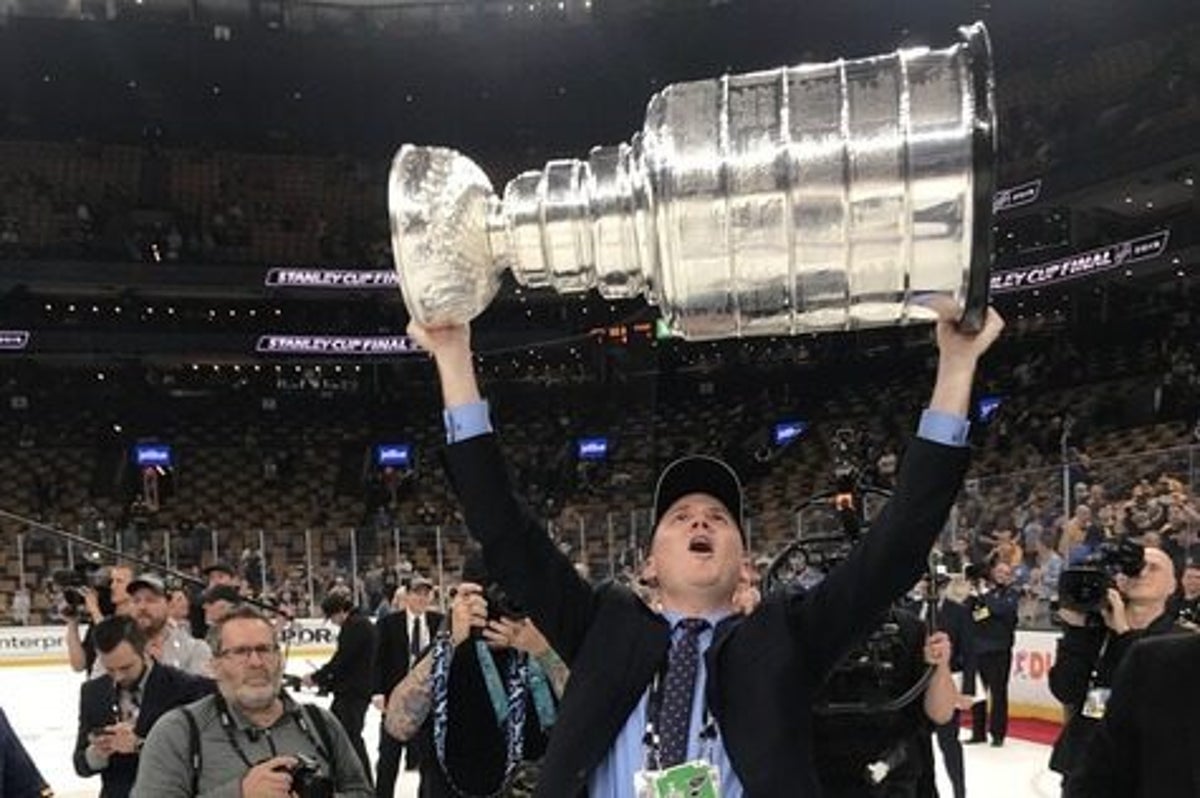
ST. LOUIS — When Ryan Miller was in his early 20s, he saw his future as a lawyer specializing in financial industry regulation. He was living in Louisville, Colo., and there was a Securities and Exchange Commission (SEC) enforcement office in nearby Denver, so that was a possible career.
“That’s where my interest was,” Miller says.
That would’ve fallen in line with the rest of the family. His father, Marc, owned his own market research and strategy company. His mother, Laurie, was a psychology professor and dean of students. His middle brother, Kyle, would become an engineer and physicist and his younger brother, Kellen, a professional arborist.
But for the oldest Miller son, that job with the SEC, or even a private firm, never came about. That’s because after earning a law degree at the University of Denver, he was told about an internship with a local hockey agency, which sent him down an entirely different track.
In 2010, Miller accepted a position on the management staff of the NHL’s St. Louis Blues, and 16 years later, he is an assistant general manager with the club.
A Colorado Avalanche fan growing up, the 42-year-old never dreamt of being behind the scenes in a professional sports league. Now, instead of cheering on the team from his seat, the right-hand man of GM Doug Armstrong is negotiating the players’ contracts from his office.
On Friday and Saturday, Miller was in the Blues’ war room for the 2026 NHL Draft as the front office shaped the future of the franchise through multiple trades and a draft class that included two first-rounders, and this week he’ll be huddled up with club executives again for the start of free agency. The “jack-of-all-trades” is involved in multiple departments within the organization, and — oh, yeah — weighs in on trades, too.
“I couldn’t have imagined the path that I’m on now,” Miller says. “If you would’ve told me that this is what it looks like in 2026, I’d have been over the moon. It was very much one foot in front of the other back then.”
Miller started playing hockey at 8, and growing up in Denver in the mid-1990s couldn’t have been better timed for his passion level to take off the way it did.
The International Hockey League’s Denver Grizzlies played just one season in the city, 1994-95, and won the Turner Cup. A year later, the Colorado Avalanche relocated from Quebec to Denver, and in their first season, 1995-96, they won the Stanley Cup.
“I’m 10 and 11 years old, and these teams are winning championships, so I got the bug,” Miller recalls.
Like any adolescent in Colorado at the time, his bedroom was littered with pennants and posters of the Avs’ future Hall of Famers.
“We saw an extremely high level of hockey skill, and that’s what intrigued Ryan,” Marc Miller says. “He was always explaining the details of the game, and this is the maturity he had at 12 years old — he said, ‘I can’t touch the Cup. I’m not a player.’ He had that level of respect when he was a young man.”

Ryan Miller got a chance to see the Stanley Cup in 1996 but didn’t touch it. (Photo courtesy of the Miller family)
Miller was captain of his peewee club, but Marc and Laurie were more concerned about A’s and B’s in the classroom than the “C” on his chest.
One season, he had an important science test the same week as a tournament in Vail, Colo. His parents told him he needed a B to play in the tournament. He came home with a C+, but the teacher told him he could turn it into a B with extra credit.
“It was tough love, but we said, ‘You’re not going to Vail,’” Marc recalls. “He went, ‘But, but, but …’ I said, ‘I’m sorry, it’s not a B.’ We didn’t have another conversation like that all through his high school years.”
Following Miller’s two-year hockey career at Monarch High — “I like to say I was the first call-up from JV to varsity,” he jokes — his focus turned to a law career.
In college, Miller had a roommate who was taking a sports law class, and a guest speaker in the class was looking for an intern. That was a Thursday night, and by 9 a.m. the next day, Miller’s resume was on the desk of that guest speaker, Kurt Overhardt, an NHL agent with Colorado-based KO Sports, Inc.
Miller got the internship in the winter of 2007.
“He was a very analytical, intelligent man and worked tirelessly,” Overhardt remembers. “He had a really big affinity for hockey operations, and the nice thing about being a small shop, the interns had a chance to learn and apply the CBA (collective bargaining agreement).”
Miller’s duties included contract research for NHL players Brandon Dubinsky, Travis Zajac, Kevin Bieksa and Marty Turco in advance of negotiations with their respective teams.
“I loved it,” he says. “As a fan, you always want to see behind the curtain and take an active part in the process and have an impact.”
Still, there was no guarantee it would lead to a full-time job, and joining an NHL team wasn’t even on Miller’s radar yet.
But in 2008, Josh Flynn, another law school graduate and employee at KO Sports, left the agency to become the director of hockey administration with the Columbus Blue Jackets.
“I didn’t have an understanding of what was next until I saw what Josh did,” he says. “Then it was, ‘OK, you’re saying there’s a chance.’”
Miller, then 26, enjoyed working for the players but wanted to be part of a roster-building process that could potentially win a Stanley Cup. Overhardt encouraged him to pursue it.
“You always want people who work for you to have aspirations,” he said.
Miller was making contacts around the NHL when Blues GM-in-waiting Doug Armstrong reached out to Overhardt and asked if he had anyone on staff with a track record like Flynn’s.
“I’ve got the perfect guy,” Overhardt told Armstrong. “His name is Ryan Miller.”
Armstrong and Miller met at the NHL Draft in Montreal in 2009 and also got together when the Blues played in Colorado. Each time, Miller provided Armstrong with a sample of his potential work.
“It was a transition time for the league with the CBA, which got a little more complicated than it was prior to that,” Armstrong says. “Having someone with a passion for hockey and lawyer’s background was important for us.
“He could be our in-house counsel for a lot of things and break everything down into layman’s terms. And working with (Overhardt), he knew the other side of it, so he was a natural candidate.”
The Blues hired Miller in June 2010, which his family celebrated by giving him a jersey with No. 10 on the back for the year.
“Like he was a rookie being drafted by the team,” his dad says.

Ryan Miller’s mother, Laurie, gave him a Blues jersey when the Blues hired him in 2010. (Photo courtesy of the Miller family)
A week later, Miller was in his 2002 Honda Accord with 180,000 miles on it and on his way to St. Louis. He checked into a hotel and the next morning walked into Enterprise Center for his first day on the job.
“It was right to work,” he says. “We were preparing for the draft, and it was, ‘Hey, I need this research done.’”
As Miller settled in, he began assisting many departments in the organization.
He became the Blues’ resident capologist, and soon was preparing the amateur scouting staff for the draft and pro staff for free agency, handling arbitration cases and finalizing entry-level contracts.
It was a work ethic that his paternal grandfather, Paul Miller, a former executive at AT&T, instilled in Marc, who passed it on to Ryan.
“If all you’re doing is your job, you’re not a strong asset to the organization,” Marc says. “You need to do your job and a big part of what your superior does. I think Ryan picked that up.”
Miller credits Armstrong for putting enough on his plate to challenge him but not overwhelm him.
“That’s been essential for my development, being able to slowly build,” Miller says.
The GM says Miller made it easy to give him major projects because he did well with them.
“There’s people you work with that you review their work, and there’s people you work with that you don’t review their work,” he says. “Very quickly, he became someone that I never reviewed his work.”
About five years ago, Miller began negotiating some of the Blues’ higher-profile player contracts, and as the salary cap has grown, so has the potential for costlier mistakes.
While he wouldn’t go into specific deals that he’s done, Miller admits, “It gets your attention. The St. Louis Blues organization is going to be defined by these contracts, so it’s important that you’re dialed in. You know Doug is going to be prepared. You know the player is going to be prepared. You want to make sure that you don’t miss anything. It’s nerve-racking, but in a good way.”
After each one, he makes mental notes.
“What did I do well? Where did I make a misstep?” Miller says. “Maybe I moved too early, or I didn’t see a specific player (comparable coming from the agent). It’s reacting the next time and saying, ‘OK, I’m ready for that.’”
Armstrong gives Miller some perspective on the contracts Miller handles, but otherwise, Miller is on his own.
“When he’s ready to close it, he doesn’t have to say (to the agent), ‘Let me take this to Doug,’” Armstrong says. “You start doing that, and they will say, ‘Let me just talk to him then.’ Ryan has the authority when he starts something to finish it.”
One of the agents Miller has had to go head-to-head with is his former boss.
“We laugh,” Overhardt says. “He knows how I think. Poor guy!”
It helps that the protege has an incredible understanding of the CBA.
“I tell anybody considering law school, it’s less about learning the details of the specific laws,” Miller says. “It’s more about learning how to think and the structure of how these things are written and understanding that a comma or a two-letter word can change the meaning of the whole section. That’s the thing law school trains you for.”
He also has an incredible knack for numbers.
“It’s a weird fascination,” Miller says. “I’ll be like, ‘Hey, I’m a million minutes old today.”
And dates.
“We’ll be in the car, and he’ll be like, ‘Do you know where I was six years ago today?’” says Kiffin Miller, his wife of 11 years this month. “He’ll say, ‘I was taking the (Law School Admission Test).’ I’m like, ‘Why do you know that?’”
She’s grown accustomed to her husband’s planning, preparing and persuasiveness.
“We don’t argue very often, but especially early on, it felt like I was on the stand,” Kiffin jokes. “You organize your facts when you argue with Ryan. It will be very methodical and laid out.”

Ryan and Kiffin Miller attend the 2019 Stanley Cup parade. (Photo courtesy of the Miller family)
Kiffin, who grew up in nearby Belleville, Ill., is the daughter of the late Dave Butz, a former NFL defensive lineman who won two Super Bowls while with Washington. Her brother, David Butz, is an NFL player agent for Sportstars Inc.
Miller met David Butz through a mutual friend, Luke Driscoll, a former scout with the Los Angeles Rams. They set up Ryan and Kiffin on a blind date shortly after Miller arrived in St. Louis, and the couple married in 2015.
“She grew up surrounded by sports and thought she’d grow up and marry a nice banker or doctor,” Miller says. “But no, right into hockey. God bless her. She’s fully involved now.”
Kiffin jokes that her “bar trick” is being able to write the names and numbers of players on a napkin.
On nights when the Blues are playing on the road and her husband is home, they watch TV together and he keeps an eye on the game on his phone. And when they have company over to their house, she understands that the phone may be attached to his ear.
“I’ve been conditioned to it,” Kiffin says, laughing.
After being promoted to assistant GM in 2020, Miller added the title of co-GM of the AHL’s Springfield Thunderbirds this past season. So when the Blues’ season ended in April, he was involved in the Thunderbirds’ playoff run through May.
“I’m like, ‘Aren’t you hockey-ed out, dude?’” Kiffin recalls telling him at the time. “He just enjoys it. He doesn’t take that for granted.”
Miller does have some hobbies. He’s earned his pilot’s license and has been learning Russian. He even got his human resource certification, which riled up Kiffin because her expertise is HR.
“I’m like, ‘Really? You’ve got to encroach on my HR stuff now?’” she says, laughing.

Miller got his pilot’s license three years ago and flies with his wife, Kiffin. (Photo courtesy of the Miller family).
Miller doesn’t do much scouting on the amateur side, but he did assist with the Blues’ list for this year’s draft and help develop the strategy the team used to make its selections.
Now he’ll be turning his attention to free agency. He’s had a hand in preparing the pro staff for it.
“You want to be as ready as you can because something might open that you didn’t expect, like a trade or something else, so you do your best to stay with it,” Miller says. “If you’re well-prepared, you can adapt.”
That’s a lesson Miller learned long before beginning a career he never could have envisioned.
But one that he’s more than capable of excelling at.
“Ryan is not only a lawyer or hockey ops guy; he’s a business guy,” Overhardt says. “With his intelligence and bandwidth, he could go do this at a Fortune 500 company because his skill set applies, which is very unique.”
He’s well-known throughout the organization, but while his name is chiseled on the 2019 Stanley Cup, you won’t see it on any press release.
“Ryan is not a huge self-promoter,” Kiffin says. “He’s humble in that regard. Doug will say, ‘That was real clutch!’ or ‘Great job on that!’ and that means a lot.”
“He knows what I do, and the guys around us do, too, so it doesn’t really register with me how it plays out in public,” Miller says. “I feel treated very fairly, with progression, with role, with all these things. So who’s doing the interviews on TSN, that’s not my concern.”
