There are 16 World Cup stadiums across three countries, with 11 in the U.S., three in Mexico and two in Canada. But which venue is the best?
We asked our writers, who are visiting the stadiums during the tournament, to rate them on a series of topics: matchday experience, match atmosphere, transport and location, aesthetics, and suitability for soccer/football.
Here are the results, explaining which arenas came out with the highest totals, and which were not quite up to scratch compared to the others…
Get free access to the most comprehensive World Cup coverage in The Athletic app
16. MetLife Stadium

There has been lots of criticism of FIFA’s decision to choose MetLife Stadium, New Jersey, as the venue for the World Cup final, and I can see why.
When the Jets or the Giants are playing there, transport isn’t too much of an issue, as there are well over 20,000 car parking spaces available — a number vastly reduced due to FIFA’s security perimeter, while public transport from Manhattan has been hiked to almost $100.
From the outside, it looks awful; think of a spaceship designed with zero creativity dumped in the middle of a parking lot. But from the inside, it is a decent stadium, and its bowl shape means there isn’t a bad seat in the house — even if you can only afford a seat at the back of the top tier.
It loses points for being an isolated venue. It is an area that you visit for the game and nothing else. And the catering options are just whatever ordinary, overpriced food is being sold on the concourses.
Is it suitable for soccer? Yes. The atmosphere of the games I have attended there has been superb. Should it be hosting the World Cup final? Not for me.
Ratings
- Matchday experience: 7/10
- Match atmosphere 9/10
- Transport and location 3/10
- Aesthetics 4/10
- Suitability for soccer/football 7/10
Total: 30/50
Ed Mackey
=14. AT&T Stadium

(Alex Pantling – FIFA/FIFA via Getty Images)
Dallas Stadium, as FIFA has re-named it for the tournament, isn’t really called Dallas Stadium, and isn’t actually in Dallas. That’s the main sticking point here: the location of Arlington, closer to Fort Worth than it is to Dallas itself, creates something of a logistical challenge for travelling supporters.
That said, the transport situation worked relatively smoothly for the opening game, Japan and the Netherlands’ 2-2 draw. Many supporters turned up fully three hours before kick-off, and there was a tremendous atmosphere both outside the ground and inside, with opposing supporters mingling.
The issue with the location is more about the knock-on impact. Fans are staying all over the place: some in Dallas, some in Fort Worth, some near the airport, and therefore the centre of Dallas has hardly been taken over by the World Cup, as happens in cities when the stadium is more centrally located.
Once you’re inside, though, it’s a tremendous experience. The big screen is so striking that it’s difficult not to watch that rather than the live action. Architecturally, the ground isn’t a boring symmetrical bowl; it contains all sorts of unusual features — you almost notice a new section every time you glance around.
The stadium has more matches than anywhere else at this tournament, nine, and there was speculation it might be awarded the final. The stadium is suitable for a World Cup final, but the location is, in a soccer context, not quite right.
Ratings
- Matchday experience: 7/10
- Match atmosphere: 7/10
- Transport and location: 3/10
- Aesthetics: 9/10
- Suitability for soccer/football: 8/10
Total: 34/50
Michael Cox
=13. Levi’s Stadium

(Richard Heathcote/Getty Images)
The uppermost seats of Levi’s four-tier stadium scale 200ft high (61m), twice the size of the Statue of Liberty. Who needs a ride in California’s Great America theme park next door when you have your own thrill just looking down onto the field?
Looking out from one of the 176 suites’ glass panes on the opposite side is an otherworldly experience. It’s like gazing out of a gigantic spaceship where the players below look like matchsticks. In the home of the NFL’s 49ers, the proportions inside the structure, consisting of 75,000 tonnes of steel, are epic.
The wide concourses allow fans to move freely before the game but also provide much-needed shade, as they did in Saturday’s 1-1 draw between Qatar and Switzerland, from the punishing California sunshine. Completely exposed to the elements, the stadium’s open-air setup is a blessing and a curse. The media are housed inside and being sheltered from extreme temperatures is advantageous, but behind the glass all your senses are muffled, and being so high up, you cannot feed off the players’ and coaches’ body language.
In the heart of Silicon Valley, surrounded by highways and tech companies, most fans drive or use the CalTrain to travel from San Francisco. If you are arriving within one hour before kick-off, good luck, because the traffic can get heavy.
There is a buzzy pre- and post-match vibe at Clara’s Junction serving up chicken wings and BBQ ribs. But the best way to access the stadium during the World Cup is to walk or cycle along the peaceful San Tomas Aquino Creek trail, a place of serenity before the drama unfolds.
Ratings
- Matchday experience: 7/10
- Match atmosphere: 8/10
- Transport and location: 5/10
- Aesthetics: 7/10
- Suitability for soccer/football: 7/10
Total: 34/50
Charlotte Harpur
=13. Hard Rock Stadium

(Molly Darlington/Getty Images)
Once you get to the arena, which is a difficult task in itself, then you are in for a treat. It has a modern feel to it; the concourses are clean and full of different food and drink options, but, as we are seeing across stadiums in the World Cup, buying refreshments can be costly.
Although the media sit behind a glass screen in an air-conditioned room, from a previous trip of mine to Hard Rock to watch the Miami Dolphins against the Buffalo Bills, the humidity is a factor and can make for quite uncomfortable viewing.
As for the atmosphere, the draw between Saudi Arabia and Uruguay was largely subdued, but you would expect it to be an entirely different story when Portugal play Colombia and Brazil go up against Scotland later this month.
Miami is not known for its public transport options, which can make getting to and from Hard Rock unnecessarily stressful. However, for the seven World Cup matches being hosted there, ticket holders can take advantage of a free shuttle service from four hubs in the city.
This seemed to run relatively smoothly for Hard Rock’s opening match, which hopefully bodes well for the rest of the tournament. Otherwise, the matchday experience will quickly plummet.
Ratings
- Matchday experience: 7/10
- Match atmosphere: 8/10
- Transport and location: 3/10
- Aesthetics: 8/10
- Suitability for soccer/football: 8/10
Total: 34/50
Dan Sheldon
12. Estadio Akron

(Lars Baron/Getty Images)
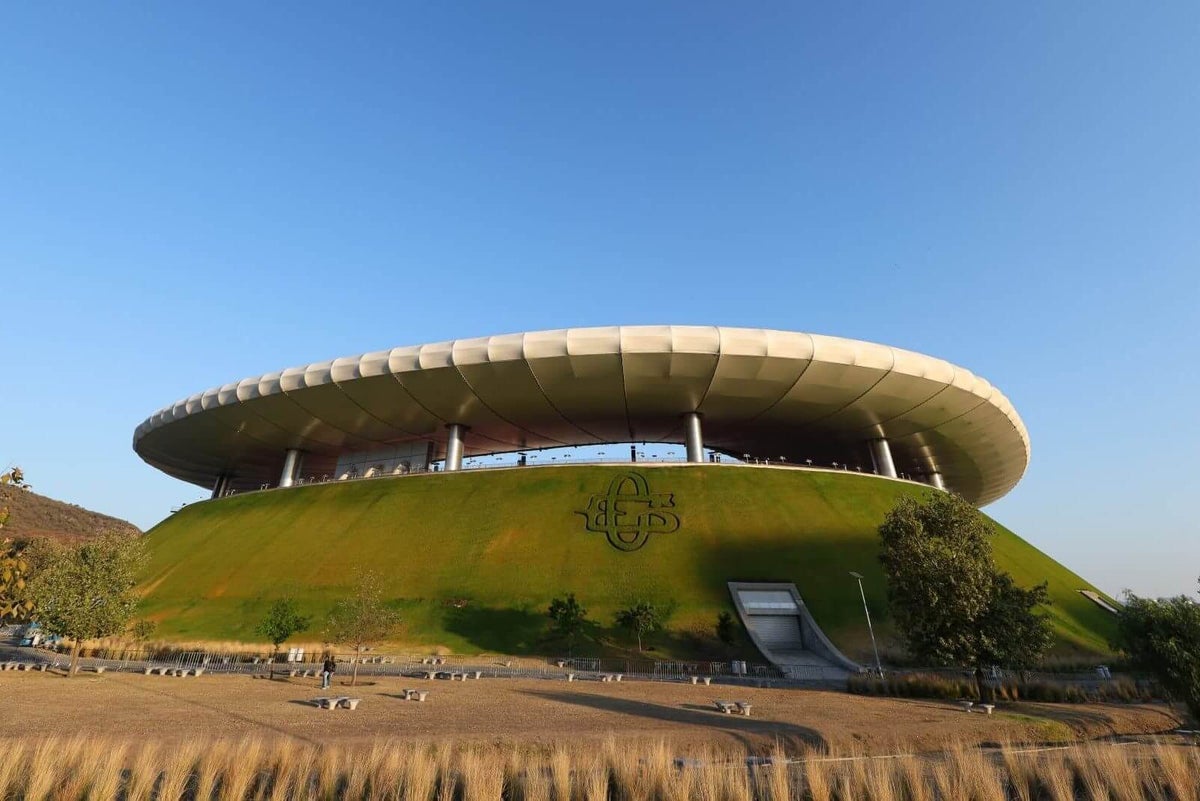
Built to resemble a volcano and boasting a futuristic crater-esque ring as a roof, Guadalajara’s Estadio Akron is one of the most unique-looking venues of the tournament — and its atmosphere is liable to explode when Mexico plays its second group-stage game against South Korea this Thursday.
Johan Cruyff was responsible for introducing its grass pitch in 2012 — he was working as a sporting adviser to hometown team C.D. Guadalajara, also known as Chivas, who are notable for only selecting Mexican players.
The city bills itself as being “the most Mexican” host at this tournament, and the joy was unbridled during the World Cup’s second game, South Korea’s 2-1 win over Czech Republic, as South Korean fans went viral for their spirited interactions with local supporters ahead of the game.
Like other venues in Mexico, its edge-of-town location can make getting there a little tricky on matchdays — while there were long queues to get through security around two hours before kick-off. There was also some slightly concerning overcrowding in the concourse after last Thursday’s game, though it dissipated after a short wait.
Ratings
- Matchday experience 7/10
- Match atmosphere 8/10
- Transport and location 5/10
- Aesthetics 8/10
- Suitability for soccer/football 8/10
Total: 36/50
Jacob Whitehead
11. BC Place

(Richard Heathcote/Getty Images)
Vancouver’s BC Place is a bit of an outsider when it comes to World Cup stadiums — geographically, it’s far removed from most of the other stadiums. It needed a new grass pitch. It’s big but doesn’t feel as big as some other stadiums.
It’s still a fine venue to take in games, though. Its curved nature and closed roof mean the sounds of fans chanting become piercing. And in true British Columbia fashion, there’s plenty of room to move around, whether in the concourses or seats. You never feel boxed in inside BC Place.
The downtown stadium’s location is darn near perfect. It only misses out because fans are being forced to travel to a SkyTrain station further away from the stadium instead of the regular station. However, the 15-minute walk (depending on crowds) is still pleasant because of the views around False Creek.
Where the stadium lacks is looks: the world’s largest retractable roof will remain closed on game days. FIFA wants to avoid shadows on the pitch for TV audiences. But with the pleasantly moderate June weather in the city, not having an open roof for afternoon kick-offs feels like a letdown.
Ratings
- Matchday experience: 7/10
- Match atmosphere: 8/10
- Transport and location: 9/10
- Aesthetics: 6/10
- Suitability for soccer/football: 7/10
Total: 37/50
Joshua Kloke
10. Lincoln Financial Field

(Emilee Chinn/Getty Images)
‘The Linc’, as everyone calls it here, was one of the best stadiums in the NFL when it opened in 2003.
That was when the City of Philadelphia knocked down the multi-purpose Veterans Stadium and built The Linc for the Eagles and ‘The Bank’, which is across the street, for MLB’s Phillies.
Two decades is a lifetime in U.S. stadium history, so it has slid down the rankings since then, but is still a perfectly decent sports ground. It’s big, loud, has perfect sightlines, and a nice view of the Philly skyline from three sides of the stadium.
I will admit I did not recognise the stadium’s “eagle” architectural motif until I read about it later, but I can kinda see it now… ish. I did spot the ‘Eagles Nest’ party deck in the northwest corner, though. Invites are welcome.
Compared to many NFL venues, the stadium is well-served by public transport (kudos to SEPTA Metro’s staff for getting 68,000 Ecuador fans safely to and from Sunday’s opening game), and the whole place has loads of previous as a football venue. I am a fan.
Ratings
- Matchday experience: 8/10
- Match atmosphere: 8/10
- Transport and location: 7/10
- Aesthetics: 7/10
- Suitability for soccer/football: 8/10
Total: 38/50
Matt Slater
=5. Arrowhead Park

(Jamie Squire/Getty Images)
Arrowhead Stadium, Kansas City, holds the Guinness World Record for the loudest stadium after Kansas City Chiefs fans reached 142.2 decibels during a game against the New England Patriots in 2014. To put that in context, the loudest crowd noise recorded at a European football stadium was 132 decibels at Vodafone Park, home of Turkish club Besiktas, in 2007.
That record reflects the passion of the Chiefs fans but also the stadium’s design, a steep bowl with an angled upper deck that is said to deflect the noise back down towards the field.
It was a source of disappointment, covering Argentina’s game against Algeria on Tuesday, to find that the press box, right at the top of the upper deck, was behind glass. But that is only a journalistic gripe, so it doesn’t affect the public experience or the rankings at all. Even from behind the thick glass, you could tell it was loud — and yes, of course, Lionel Messi helped with that.
It was surprising to learn that the Chiefs plan to relocate to a new $3 billion domed arena when their lease at Arrowhead expires in January 2031. It has been in use since 1972, making it the third-oldest stadium in the NFL, but by European standards it feels perfect for tomorrow’s needs, never mind today’s. It looks great, the facilities are great and — providing you are not watching inside in a sealed glass box — it sounds great.
One complaint: access. Arrowhead is served by a single bus route and, while there were extra buses laid on from the city centre and the fan festival, the pre-match traffic was still horrible. Many of those travelling by car preferred to get out and walk for the final mile in the heat. A flip-side of those access issues is a famous tail-gaiting tradition, which would ideally play to Argentinian asado culture, but it’s hard to bring a barbecue when you’re not a local. Traffic issues aside, a great stadium.
Ratings
- Matchday experience: 9/10
- Match atmosphere: 10/10
- Transport location and location: 4/10
- Aesthetics: 8/10
- Suitability for soccer/football: 9/10
Total: 40/50
Oliver Kay
=5. Estadio Azteca

(Photo: Carl DE SOUZA / AFP via Getty Images)
Mexico’s iconic national stadium is dripping with history. To watch a game there in Mexico City is to be transported back to 1970 and 1986; there is just something about the grandiose sweep of the concrete bowl, the haziness of the light, the mountains in the distance. It is not a conventionally beautiful structure from the outside, but its brutalist concrete struts have a charm to them. Inside, the sheer scale of the thing takes your breath away.
The atmosphere is hard to fault, even if you get the feeling that many regular Mexicans have been priced out this summer. Throw in genuinely great food stands, mariachi bands and more costumes than Broadway, and it’s hard to know what more you’d ever want from a World Cup stadium. Maybe non-apocalyptic traffic, to be fair — you really do have to plan your whole day around getting there on time — but the rest more than makes up for it.
Ratings
- Matchday experience: 8/10
- Match atmosphere: 9/10
- Transport and location: 3/10
- Aesthetics: 10/10
- Suitability for soccer/football: 10/10
Total: 40/50
Jack Lang
=5. BMO Field

(Photo: Vaughn Ridley/Getty Images)
BMO field, as it is normally known, with its temporary extra stands that look like they are built from giant scaffolding, is not a beautiful stadium from the exterior. What it does have that makes it beautiful to fans of a certain age is a throwback feel to the old style ‘ground’ rather than modern ‘stadium’. A rectangular venue in Toronto, with clearly defined ends, to suck the ball towards or defend with your life, remains the best vibration to have while watching football. Bonus points for the gaps in the corners between the four stands, which give a view of the city beyond. It was built to be soccer-specific, so no surprise that it felt more authentic than something converted from an alternative sport.
Being so centrally located, it was easy and cheap to get to on local transport, with parks and places to hang out within walking distance — the fan marches for both Canada and Bosnia fans added to the sense of occasion. Because it was a game between hosts and “fanaticos” who travel well, all in all there was a great atmosphere. Some Canadians were critical of BMO being used and advocated for using the bigger space in Vancouver for all their nation’s matches. But with its old-school charm, Toronto was a winner.
Ratings
- Matchday experience: 8
- Match atmosphere: 8
- Transport and location: 9
- Aesthetics: 7 (6 external, 8 internal)
- Suitability for football: 8
Total: 40/50
Amy Lawrence
=5. Estadio BBVA

(Photo: Carl Recine/Getty Images)
Estadio BBVA in Monterrey really is as visually impressive as the photos suggest.
It is a state-of-the-art venue with a futuristic design reminiscent of the Bernabeu, albeit the $200million ground was actually opened four years before renovation works got going on the Real Madrid stadium. The iconic view of the Cerro de la Silla mountain makes for striking surroundings too — although this is only fully visible if you’re sat on the north side.
You can’t fault it for atmosphere either. For the host city with arguably the four least appealing games of the tournament, the noise made during Sweden’s 5-1 win against Tunisia on Sunday was deafening. Swedish fans played a big role in that, but so too Tunisians and local spectators. Given the number of Mexico shirts on show for that match, it’s a real shame this is the only place in the country not hosting El Tri this summer.
The drawbacks are to do with accessibility and the matchday experience. Long queues formed outside the stadium with an hour and a half to go until kick-off, with fans having to pass through airport security-style gates. One Swedish fan told The Athletic there were 30-minute waits inside to buy a drink and complained about the long walk back to the nearest metro station afterwards.
Ratings
- Matchday experience: 6/10
- Match atmosphere: 10/10
- Transport and location: 5/10
- Aesthetics: 9/10
- Suitability for soccer/football: 10/10
Total: 40/50
Tomas Hill Lopez-Menchero
=5. NRG Stadium

(Photo: Mark Felix / AFP via Getty Images)
The NRG Stadium in Houston looks like a gigantic aircraft hangar when you approach it on the train, with the support structures required for its retractable roof dominating the skyline. It sort of looks like a budget version of the San Siro from a distance, which carries an element of comfort for a European at an American World Cup.
It’s hard to overstate how vast it is inside, and if you’re right at the top and you have vertigo, all the best. It was built 26 years ago, and there are elements of it that are starting to fray around the edges, and certain parts inside look like an ageing convention centre, but it’s actually really well suited to football, once you get past the strangeness/slight novelty of the roof being closed. That roof means the noise inside echoes a bit, which can be quite a weird experience.
Unusually for some stadiums in the US, there is a metro line that drops you right outside, so getting there is pretty straightforward, which is a bonus when the weather in Houston appears to oscillate between blazing sun and monsoon-esque rain.
Ratings
- Matchday experience: 8
- Match atmosphere: 7
- Transport and location: 9
- Aesthetics: 7
- Suitability for football: 9
Total: 40/50
Nick Miller
4. Gillette Stadium
The 218ft-tall lighthouse, stationed behind one of the goals, is an iconic sight. With a 360-degree observatory, it is the first thing your eyes are alerted to as the stadium appears in the distance. That it was only installed three years ago is the biggest surprise.
Built in 2002, the arena in Foxboro somehow possesses the character of a throwback stadium while looking more modern. That feels like a pretty healthy balance.
Parts of the facade look a little indistinct with lots of offices and annexed buildings attached in different places, but it is mighty in scale.
The walkways on the outside of the stadium offer terrific panoramas, and there are a good variety of food vendors and beer stalls to meet demand.
It may not have been designed to host football but it translates well. The stands are steep and amplify sound, as the Scotland and Norway fans have demonstrated. The pitch is also not set too far back that the game feels disconnected, and the giant curved screen at the far end adds a bit of theatre.
What counts against it is the location. Located 30 miles south of Boston, it feels a little isolated. There is Patriot Place shopping area, but there are not streams of bars and restaurants in neighbouring streets for fans to pile in from or spend hours in before kick-off.
There is a limited flow of trains from Boston and Providence, with the prices bumped up to a prohibitively high cost of $80 for a return trip. Travelling by car towards Boston after the game is guaranteed to end up in a standstill with a narrow motorway reduced to one lane in places. So much so, two Norwegians took it upon themselves to walk along the highway instead.
Ratings
- Matchday experience: 9/10
- Match atmosphere: 9/10
- Transport and location: 6/10
- Aesthetics: 8/10
- Suitability for football: 9/10
Total: 41
Jordan Campbell
3. SoFi Stadium

(Photo by Luke Hales/Getty Images)
To start, it was noticeable that traffic in the area was not bad in the hours leading up to the game. There are options via Metro and buses that transport fans from remote parking locations. It was actually quite easy getting into the stadium parking in a car for media members. Long lines formed to get in four hours ahead of kickoff, but once the gates opened, fans seemed almost to disappear as they moved quickly through security and into the building.
The stadium itself is gorgeous. Really a marvel. The grounds are easy to navigate, even despite FIFA’s fenced-in areas. Walking around the concourse before the game, fans seemed thrilled to be there and able to find seats easily. Views from the very top section are fine, with the enormous screens there to help you take in the action. While it’s a bit tight around the outside of the pitch, the field played brilliantly, and the crowd for USA-Paraguay was everything you could ask for. The U.S.’s 4-1 win helped make it a celebratory mood, of course.
Ratings
- Matchday experience: 9/10
- Match atmosphere: 9/10
- Transport and location: 8/10
- Aesthetics: 10/10
- Suitability for soccer/football: 8/10
Total: 44/50
=1. Lumen Field

(Photo by David RYDER / AFP via Getty Images)
What a place. There are two things I loved about Lumen Field. The first is its location, right in the centre of downtown Seattle. There is so much that is great about this, but primarily it means the city feels alive wherever you are on a match day. Nobody stresses about arriving at the stadium. Local organisers have done an excellent job at providing a carnival around the venue, with the Pioneer Square area bouncing ahead of Egypt’s game with Belgium. It was great to see independent bars, pubs and restaurants embracing and benefitting from being a host city.
Then there is the stadium’s design. This is not an identikit bowl that could be anywhere. Each stand is shaped differently but it is known especially for the Hawk’s Nest, which offers views of downtown and beyond. I cannot think of a stadium in the world that feels so connected to the city it belongs to.
Ratings
- Matchday experience 9/10
- Match atmosphere 8/10
- Transport and location 10/10
- Aesthetics 10/10
- Suitability for soccer/football 10/10
Total: 47
Simon Hughes
=1. Mercedes-Benz Stadium

(Photo: Mattia Ozbot/Getty Images)
It’s downtown. It’s indoors. It’s gigantic. Mercedes-Benz Stadium (or Atlanta Stadium, according to FIFA) is the type of ground you sketch out on a piece of paper when your art teacher says, “No rules. Draw an imaginary stadium.” It has restaurants, bars, shopping and more. Getting there is easy on public transport. It’s home to the NFL’s Atlanta Falcons and Atlanta United of MLS. The Benz, as locals call it, is a big-event venue, regularly hosting high-profile college football games and A-list musicians.
It hosted the 2019 Super Bowl and will do so again in 2028. Perhaps best of all, it’s indoors and air-conditioned, which allows concert-goers and sports fans to escape the hot Atlanta weather and the city’s unpredictable winter conditions. The acoustics are fine-tuned, making it an incredibly loud arena that can leave you with a sore throat after 90 minutes. It also features the most fan-friendly concession prices in America.
Ratings
- Matchday experience: 10/10
- Match atmosphere: 9/10
- Transport and location: 9/10
- Aesthetics: 9/10
- Suitability for soccer/football: 10/10
Total: 47/50
Felipe Cardenas
