ST. PAUL, Minn. — There will be a lot of talk this week — and this summer, quite frankly — about the Minnesota Wild trying to take a big swing on the trade front.
They’re certainly interested and in the mix for Detroit Red Wings captain Dylan Larkin, who requested a trade this offseason. The Wild made a big offer for Ottawa Senators captain Brady Tkachuk, who ended up getting dealt to the Panthers on Sunday.
Minnesota president of hockey operations and general manager Bill Guerin has the aggressiveness, motivation and cap space to go big-game hunting. There’s one big question.
Does he have the pieces?
Why the Senators traded Brady Tkachuk to the Panthers in an NHL blockbuster
Julian McKenzie
The Wild’s prospect pool is pretty thin, depleted by the blockbuster trade for Quinn Hughes in December. They went from No. 2 to No. 23 in The Athletic’s Scott Wheeler’s prospect pool rankings, largely due to the graduation of prospects Jesper Wallstedt and Danila Yurov, plus trading Zeev Buium and Liam Ohgren for Hughes.
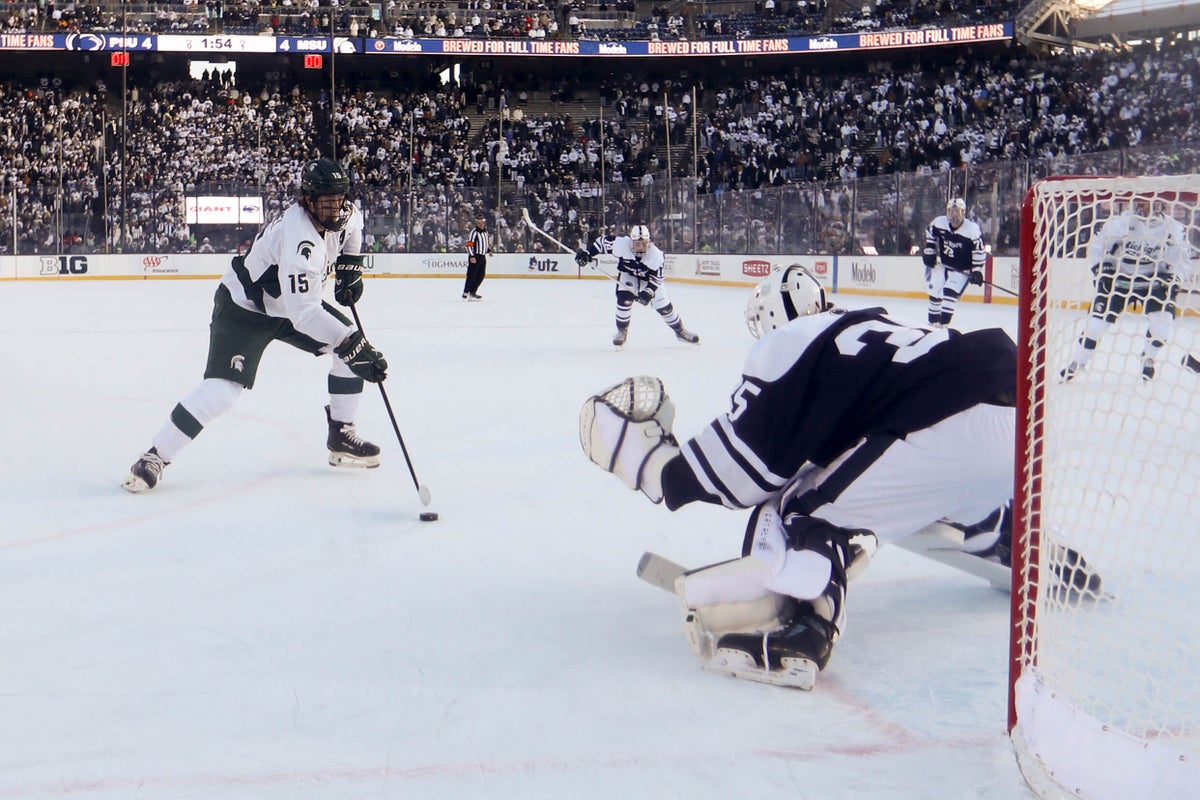
“I don’t think they have an A or even potentially a B-plus prospect,” Wheeler said on “Fellowship of the Rink” podcast two weeks ago. “(Charlie Stramel) has gone from a C to a B-plus in the last year. He had an excellent year, though (he was) playing with Daniel Russell and Porter Martone, who are two excellent players. That was one of the best lines in college hockey (at Michigan State), and he was a big reason why.
“Now he gets to go pro, and we’ll see what he is.”
But if Stramel, a former first-rounder, is the centerpiece of any deal, it doesn’t seem like enough for a blockbuster. He’s not a Buium, the touted top prize of the Hughes deal, nor is he Marco Rossi, a proven top-six NHL center. The Wild could also be reluctant to move Stramel, considering how high they are on him.
One NHL scout, whose club was looking at the Wild, like other teams, for potential trade targets, said he saw Stramel as the only “elite” prospect — defined as a top-four-quality defenseman or top-nine-quality forward.
“None are really a lock to play,” the scout said.
The Wild’s best trade chip is Wallstedt, though it’s unlikely they’d move him as he’s looking like a No. 1 and Filip Gustavsson is expected to be out until early November after offseason hip surgery.
Danila Yurov, coming off a solid rookie year, will also be dangled and likely would be a part of any major deal. The 2022 No. 24 pick is a strong two-way player with some similarities to Joel Eriksson Ek’s game. Yurov is a smart, conscientious player and does all of the things management typically begs young players to do. And the Wild believe there’s more offense there than the 12 goals he scored as a rookie.
“Yurov has been fine. He’s been solid,” said former NHL GM Craig Button, TSN’s director of amateur scouting. “Is he a center or is he a wing? Can he give you offense? Is he a second-line center or a third-line center? He isn’t a first-line center. He might be a 3A or 2B. And there’s nothing wrong with that.
“(Anton) Lundell is a hell of a player, and he’s a two-slash-three. Yurov is not as good as Lundell. Stramel is not as good as Lundell. (Jordan) Staal was a third-line center on a Cup team. If either of those guys turn into a Jordan Staal, you’d be doing the happy dance. Nothing wrong with a third-line center.”
But the Wild’s biggest need is a No. 1 center or top-six wing help.
Tkachuk could have been that, and it’s encouraging for the team to know it was on his approved trade list, as they are for Larkin. The Panthers acquired Tkachuk for three first-round picks (Nos. 9 and 25 in 2026, plus one in 2029) and a 2030 second. Tkachuk has a full no-move clause and, no doubt, would have preferred to play with his brother, Matthew, in Florida, which would have likely put the Panthers over the top even if the Wild’s offer was similar. An obstacle for Minnesota is that it has no first-round pick this year to offer and no second-rounders for the next three seasons.
The Panthers’ move for Tkachuk likely takes them out of the Larkin sweepstakes, though, which could help the Wild. They just have to see if Red Wings GM Steve Yzerman will be swayed by what they have to offer. Minnesota could also add a rostered player to a Larkin package, like Ryan Hartman or Yakov Trenin.
“Larkin, an elite player in the National Hockey League, for Charlie Stramel and Yurov? Come on,” Button said. “When other teams can offer so much more, that’s the problem Minnesota has. It’s not that those guys aren’t decent prospects. It’s that the other teams have more. They have better prospects.”
With that in mind and a reality check on the trade chips the Wild could put in play, let’s take a look at the team’s prospect pool, with insight from Wheeler, Button and AHL Iowa GM Matt Hendricks.
Top tier
Charlie Stramel
It’s amazing how much difference a couple of years makes. Stramel, the team’s first-rounder in 2023, looked like a lost prospect through early struggles at the University of Wisconsin. But a transfer to Michigan State two years ago rejuvenated his young career as he became a top-line player for the perennial power.
Stramel, a 6-foot-3, 215-pound center, still doesn’t profile as a high-end player in the NHL, but he does provide quality value.
Wheeler: “The question with Stramel has always been, ‘Can he be a stud 3C, which is a very valuable player, or is he going to be just a good fourth-line center? Is he a 25- to 30-point guy, or can he be a 40- to 50-point guy? Can he be a consistent 20-goal guy, or is he a 10-goal guy? That’s the range that we have to figure out now that he makes the adjustment to pro hockey. He’s a very, very competitive player. They called him ‘Big Rig’ at the U.S. National Team Development Program. He’s got some skill — not great skill — but is a good skater for his size. He can look a little slow and a little choppy at times. We’ll see. It’s very early. But the graduation of Yurov and Wallstedt means he’s their top prospect right now.”
Hendricks: “I don’t think it’s fair right now to put a ceiling on any of that. I’ll tell you, I do like a lot the package, for sure: the size, the strength, the skating ability, the right shot, the ability to win faceoffs, play in all situations, both power play, penalty kill, five-on-five, things like that. But he’s, he’s the real deal, and he’s, he’s here to push for, for not only an NHL job, but for more opportunity up that lineup.”
Adam Benak
Benak, the Wild’s fourth-round pick in 2025, was immediately thought of as a potential steal because of the Czech forward’s talent level. Those who coached him in junior believed he had a first-round skill set, but his size (5-foot-8, 163 pounds) was a knock. Benak was a top player in the OHL this past season, scoring 28 goals and 77 points in 48 games for Brantford, but he had only three goals and 11 points in 18 playoff games. He plans to play for Western Michigan University next season.
Benak is the Wild’s second-best prospect, according to Wheeler. Button feels the same way, pointing out how size has never really held Benak back because of his skating, smarts and competitiveness. There’s been some comparisons to Mats Zuccarello in terms of how Benak might have to play at the next level, relying on his vision, hockey IQ and playmaking ability.
Wheeler: “He was one of the best players on one of the best teams in junior hockey. I was still disappointed by his playoffs. I know he was a little nicked up, but he wasn’t himself in the playoffs. He didn’t have the impact in the playoffs in the OHL I expected and, frankly, he should have. But during the regular season, he made a ton of plays. … He made his linemates better and did everything Adam Benak has always done.
“Now he’s taking the college route, and I’ll be fascinated to see how it works out for him. He’s a tremendous skater and thinker, and that can carry you, even if you’re 5-7, 5-8, 5-9. That can carry you a long, long way. He’s a borderline elite skater. When you have the feet and you can think or slow it down or play at different paces, that allows you to do a lot of different things. He’s a capable forechecker because of his speed. He’s a capable penalty killer because of his speed. He’ll always get pushed around when the game gets into the mud, but he doesn’t shy away in those areas. I’ve always been intrigued by him. He’s exactly the kind of talent you take a swing on in the middle rounds of the draft.”
Second tier
David Spacek
Of the eight defensemen the Wild have taken from rounds 2 to 4 since 2020, Daemon Hunt has made the biggest splash in the NHL, including getting some action in this past year’s playoffs. The pending restricted free agent is expected to be on the team this season, perhaps with a regular role if there are other trades. But it’s been interesting that Spacek, a fifth-rounder in 2022, might be the best of the rest, ahead of first-rounder Carson Lambos, second-rounder Jack Peart and second-rounder Ryan O’Rourke, who is no longer in the organization.
Spacek has been strong in his international play for Czechia, including at the Olympics. Also a pending RFA, the 23-year-old played two NHL games this year, and that gave him confidence that he could play at that level. There doesn’t seem to be room on the roster for him, especially if Zach Bogosian is re-signed, so he is likely to be dangled in trade talks.
Wheeler: “Spacek has a strong track record internationally, and I think he’s also going to establish himself as a full-time guy at some point in the next year or two.”
Hendricks: “David has that same type of professionalism in the way that he kind of carries himself. He goes about his game. From the moment he walks into the arena to the moment he walks out, he’s always looking to improve. And if you look back three years ago, when he was a rookie, he spent some time in the (ECHL), and he’s taken the longer development route, but he just keeps getting better and better.
“I’m very happy where his game is. He’s a bigger, stronger, more mature individual. I do think the schedule and the travel and combined with the Olympics, it kind of bit into him a little bit down the stretch with us, in terms of consistency in those last couple of weeks. But again, for a young player, he’s played a lot of hockey over the last few years with the World Championship, Olympics, all that stuff, and his game is in a good spot. A reliable 200-foot defender plays well for us at the offensive blue line and is one of our go-to guys (on the) penalty kill and defensive zone (and at) five-on-five, as well.”
Hunter Haight
Haight, 22, a second-rounder in 2022, was the organization’s most impressive forward prospect at the pro level this past season after Yurov, earning enough trust to play nine NHL games. He looked and acted like a pro from the moment he joined AHL Iowa for the 2024-25 season.
The 5-foot-10, 173-pound center has really good speed, a strong shot and can play in all situations. He is expected to push for a spot in training camp, along with Stramel and Bobby Brink, especially with Marcus Johansson signing in Sweden and Zuccarello’s and Vladimir Tarasenko’s futures still in limbo.
Wheeler: “Hunter is going to become a top-12 guy at some point, if he’s not already. He’s that tweener that coaches like. He’s not a tweener who comes up and has to play a specific role. He does a lot of things well — a lot of things average or above average. He has the smarts to stick and hang.”
Hendricks: “He’s getting on the right side of the physical side of things, right? He’s bigger, he’s stronger, he’s faster, more powerful — all that stuff that naturally comes with a little bit of time. He showed up and he was a true pro. He was a really good pro his first year, and that improved over the course of this season. There was a little bit more to his game on his call-ups this year. There’s a little more trust and comfortability with the stuff here in Minnesota and what he can offer. They really felt comfortable throwing him over the boards.”
Riley Heidt
Heidt was one of the most productive players in the WHL over three seasons, a skilled center and captain who could drive play. But the big question was how he’d adjust to the pro game, and there were some growing pains last season with AHL Iowa, where he had just eight goals in 71 games. Then-coach Greg Cronin worked with Heidt on getting his 5-foot-11 frame to the scoring areas and finding ways to create at that level.
A second-rounder in 2023, Heidt could still end up as a middle-six NHL guy, whether that’s at center or wing.
Wheeler: “He had a bit of an up-and-down season. He’s a 6-foot center that’s probably a winger at the NHL level. He can make plays and has some feistiness. He’s very smart. Inconsistency has been the worry about Heidt, both in the WHL, where he was one of the most productive players over three seasons, but also turning pro. What is he? What is his identity? I’d like him to lean into being a competitive playmaker for his identity. I think that’s who he is. He’s never played with a ton of pace, and coaches and scouts always had mixed feelings on him, and Hockey Canada ran hot and cold on him. He fits as a B prospect. Based on his production, he looks like a B-plus prospect, but as a player, in terms of his adaptability, he’s more of a B.”
Said Hendricks: “He’s a facilitator. He likes to make plays with the puck, but I think the difference for him fro the Western League to the American League is it’s a lot harder to get the puck, up against the bigger, stronger, physical players in the AHL level. I did see growth. It was a slow start, and the details that were expected from him weren’t there – junior habits, things he could get away with at that lower level. But as the season progressed, he took big steps in that regard. His legs were driving. He was fighting for pucks. His wall work improved. He’s one of those guys that, at the end of the year you sit down with him and you’re like, ‘Wow, he’s grown.’”
Other prospects
Carson Lambos
Lambos has played one NHL game in four pro seasons
Wheeler: “I think Carson is probably a No. 8 at this point, and I’m not sure you can reasonably expect him to be more than that. I don’t think even a No. 7 you carry on your roster all year. I don’t think he’s shown enough to be that. He can be a first or second injury call-up guy, and that’s the caliber of player they have here.”
Ben Dexheimer and Viking Gustavsson Nyberg
Dexheimer and Gustavsson Nyberg joined the Wild as college free-agent defensemen out of Wisconsin and UConn, respectively.
Wheeler: “I like Dexheimer more. I think he has a real chance to play. There have been a couple defensemen who came out of college hockey the last few years in the Dexheimer mold that have made it work — that have been smaller defenders who aren’t elite offensive guys and still found ways to be competitive, effective depth defensemen. That’s your hope when it comes to him: a sixth or seventh defenseman who can make a good first pass, has leadership qualities, who can fit in an NHL game. He has a higher likelihood to become a full-time defenseman (than Gustavsson Nyberg). If either of them are playing in the top four in the NHL, I’d be surprised.”
