Editor’s note: As the World Cup continues in the United States for the first time since 1994, The Athletic is looking back at college sports in the 1990s and how much has changed since then. Join us for a couple of weeks of offseason football and basketball nostalgia.
During his enrollment as a freshman at the University of Texas in the summer of 1995, Ricky Williams purposefully chose a prescient handle for his school email address: heisman@utexas.edu.
Three years later, Williams held in his hands the most celebrated individual award in college football as the 64th Heisman Trophy winner.
Williams set or tied a whopping 21 Division I records in his time in burnt orange. He broke the NCAA’s all-time rushing record during a banner senior season that culminated in a Heisman win that, at the time, had the largest percentage of first-place votes (43 percent of 920 voters) in the history of the award. But at the outset, he was a kid from San Diego who was entranced by the allure of Texas football.
During his four years in Austin, Williams transformed from a hard-hitting fullback with the nickname “Little Earl” derived from a Longhorn legend into one of the sport’s most accomplished and mythic figures.
John Mackovic, former Texas head coach: He was sought after by many, many, many, many colleges. But he didn’t pay a lot of attention to it.
Bucky Godbolt, former Texas running backs coach: He wanted to be a full-time running back and linebacker. I said, “Dude, you can’t do that.”
Earl Campbell, former Texas running back and 1977 Heisman Trophy winner: I remember someone bringing him up to the old office on Sixth Street across from the Driskill (Hotel). I just kind of felt like I was looking at myself when I was a high school teenager.
Godbolt: When we all met with Earl, I asked Ricky, “What do you want to come here for?” Ricky said, “I’m coming to win the Heisman Trophy.”
Dan Neil, former Texas offensive lineman: We were practicing down in our own end zone running plays and it was a light day, like a walkthrough. They handed the ball to Ricky, and he ran 100 yards to the other end of the field. Does a little dance thing. And then jogs all the way back. I’m like, “Who the hell is this guy?”
Godbolt: Wherever we lined it up, he would go to the other end zone.
Mack Brown, former Texas head coach: He scored a touchdown every time he touched the ball. We had to start moving his drills closer to the end zone so he didn’t kill himself.

(Courtesy of Texas Athletics)
Godbolt: It took him about a year to get on Central Time. That took him a long time. More than any other kid I’ve ever coached to get that time thing down.
Priest Holmes, former Texas running back: Ricky didn’t struggle with Central Time. He was operating on Ricky Time.
Godbolt: Mackovic would have me getting up at 6 a.m. to make sure he ran the stadium steps because he was always late to these team meetings.
Mackovic: I always remember his first game. Freshman year and we’re playing in Hawaii. It was third-and-forever. I just called a draw play. Figured we would get a few yards, punt the ball and be on our way. He took it to the end zone.
Godbolt: At the beginning of the fourth quarter, we had the game in hand. And he asked me if he could go sit in the stands and sit with his mother. He was like, “It’s no big deal, right?” I said, “Yes, it’s a big deal. Hell no, you can’t sit with your mom!”
Williams didn’t arrive in Austin as a starting tailback. He was a lead blocker for Holmes, Texas’ star back. And Williams enjoyed taking on the other team’s best players. He wore the No. 11 jersey his sophomore and junior years.
Kevin Blackistone, former columnist for the “Dallas Morning News”: People forget he was a fullback his first two years at Texas.
Holmes: The little things that separate good players from special players. Ricky had all of them from day one.
Neil: Ricky would often get tasked with taking on the other team’s best linebacker, and he’d always say, “Oh, that sounds fun.”
Godbolt: I still think Ricky’s best game he’s ever played was his first Big 12 championship against back-to-back national champions Nebraska in 1996. He had to block for Priest and protect us against Grant Wistrom, an All-American. This guy could’ve wrecked our whole game plan, and I remember Ricky saying, “I got him. Don’t slide anybody. I have him.” I said, “All day?” He said, “All day.”
Holmes: In 1996 you could already feel the foundation being built. Texas football was changing, and Ricky was at the center of it.
John Bianco, senior associate athletics director of communications at Texas: Ricky was a non-scholarship athlete at Texas. Which is hilarious. The Philadelphia Phillies paid for his scholarship. (Williams was drafted in the 8th round, 213th overall, in the 1995 MLB Draft).
Neil: We got one hell of a deal on that.
Bianco: He’s playing for the Batavia Muckdogs in Western New York out in the middle of nowhere.
Blackistone: Just an insane athlete.

(Courtesy of Texas Athletics)
Bianco: He took out the second baseman to break up a double play. I was with a writer from the Dallas Morning News doing this feature on Ricky and we wanted to go find that guy and he’s sitting out in front of the locker room with an ice bag on his neck and he obviously had a concussion. The writer asked, “Would it be OK if I asked you a couple of questions about playing against Ricky Williams?” He goes, “Of course. I just got taken out by a future Heisman Trophy winner. This is going to be the coolest moment of my life.”
Godbolt: On Sundays, he would go to the training room, come out, grab something to eat and then come over to my house to watch NFL games. All the kids in the neighborhood would stand out on the street when his car pulled up and he’d play football with them for hours.
Mack Brown: Yeah, that sounds like Ricky.
Godbolt: Here’s Ricky Williams — just played a game yesterday — and he’s falling all over in the street, getting all scraped up. The next day on Monday the trainer would come up to me and say, “Hey, Ricky’s got some scrapes. I didn’t see this after the game.” I said, “He got that from playing with kids in the street.” He had swollen elbows and jacked-up fingers.
Mackovic: He just loved to run with the football no matter where he was.
Blackistone: When I think of Ricky, I think about a number of things, but I think about his junior year. I wrote a column saying he should win the Heisman Trophy. And he should have. But Texas had a terrible year. They were 4-7.
Bianco: Ricky mailed Kevin Blackistone a signed jersey after reading the column saying he should’ve won the Heisman.
Blackistone: He sure did. It’s an autographed No. 11 jersey in a closet somewhere.
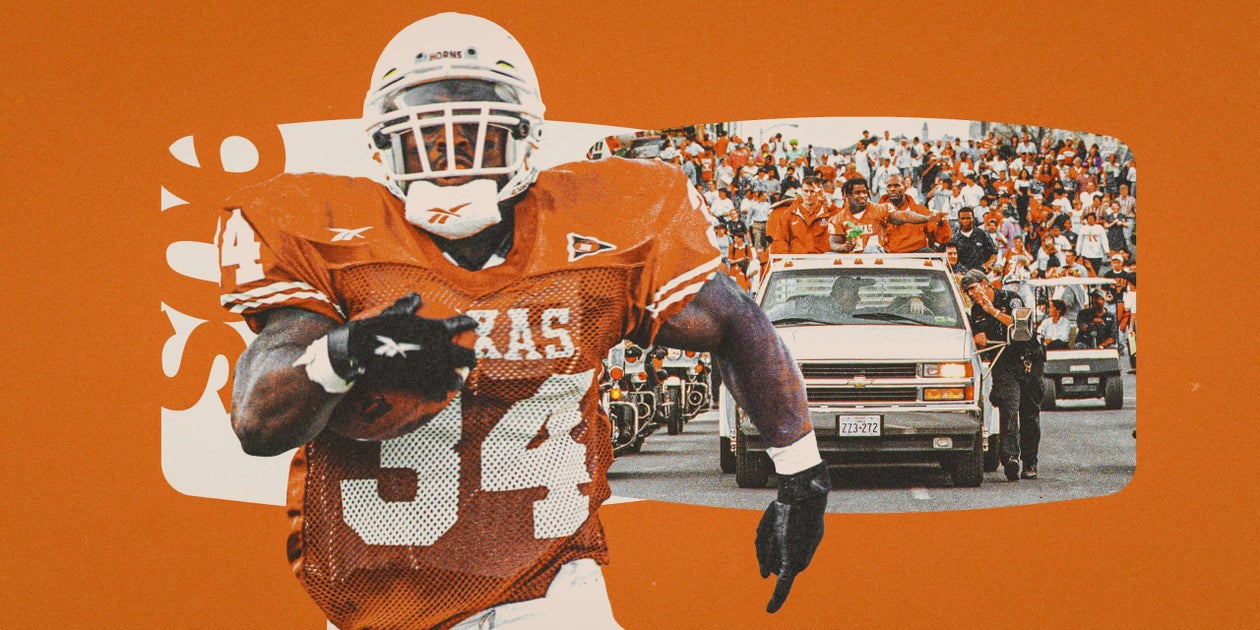
After Texas fired Mackovic, the Longhorns hired Mack Brown. Williams was coming off a year in which he led the country in most statistical categories as a junior, and there were rumors he was off to the NFL. To the surprise of some, he returned for the 1998 season, and with a new jersey number: No. 34.
Mack Brown: When we had our first team meeting, Ricky sat in the back and he sat up and walked out. He didn’t come down and say hello, so I figured he was leaving.
Suzanne Halliburton, former Texas beat writer for the Austin-American Statesman: The night before the deadline to decide if he’s going to declare for the draft (in January 1998), Ricky calls me and he just goes, “I just want to let you know that I’m leaving.” I said, “You are?” He said, “Yeah, don’t quote me, but I can be your anonymous source.” Turns out, Ricky was playing a stupid game. I wrote the story and John Bianco calls me a little later and said, “I don’t think that’s right.” I’m like, “Ricky’s the one who told me!” It went to print and then Ricky had a press conference at Memorial Stadium and says, “Guess what, I’m staying!” I go up to him and say, “Dude, Ricky what the f—?” He goes, “I’m so sorry.”
Bianco: He said Suzanne had called him and said that she heard he was going to announce that he’s coming back. He was like, “I want the world to be surprised. I don’t want this to be just any old press conference.” So then he said, “Well, I guess the only way they wouldn’t know is if they thought I was leaving.”
Mack Brown: I said, “Why would you come back?” He said, “We were 4-7 last year and I didn’t come here to be 4-7.”
Campbell: Being a star does not matter. Some damn good ball players have played at Texas, done well and chased their dreams. Every time you step in between those lines, you are getting everyone’s best shot. They want to see if you are as advertised. Are you real?
Ricky Williams on Johnny Manziel’s podcast in January 2025: My senior year, I came back and it just started off bad.
Godbolt: He was a very shy guy. He didn’t like confrontation.
Ricky Williams: My girl started dating the quarterback. Like, the starting quarterback. And so I was just in a really bad spot. We played Kansas State and I had like 43 yards and I was hurting. I was just like: Why the hell did I come back for this s—?
Mack Brown: In 1998, it was a full year where he was under a whole lot of strain just from attention. And he didn’t care for it.
Ricky Williams: I was just in a low, low spot. My roommate, he was a smoker and he just slid me his bong and he was like: “You just need to chill.” I remember going upstairs in the loft and I was just looking at the ceiling. I noticed it was the first time in weeks I wasn’t obsessing about all the s— that was going on. And in that clear space I started to imagine myself playing better. The next two weeks, I had back-to-back 300-yard rushing games and my season was back on track.
Mack Brown: We’re at Nebraska. They had a 47-game home winning streak. In an interview on TV earlier in the week, Ricky told Lee Corso: “They’re going to have trouble stopping me.” I brought him in and I said, “What’re you doing? You just challenged them to stop you.” He said, “No, I’m challenging our team because I believe we’re going to win.”
Bianco: He told me, “I think it would be really fun if I got a flak jacket and one of our U-T police officers gave it to me going into the interview. If the Black Shirt defense is taking aim at me, I’ll take aim at them.” The cop that travels with us actually handed him a flak jacket and he did the interview with a flak jacket on. It was priceless.
Mack Brown: After the game, I told Ricky to put his helmet on and keep your head down because there’s probably going to be things thrown at you. As we were leaving the field, it was the best sportsmanship moment in sports I’ve ever seen: They gave him a standing ovation and started chanting the word “HEIS-MAN! HEIS-MAN! HEIS-MAN!” It’s the coolest moment I’ve ever seen. (Williams rushed for 150 yards on 37 carries in the 20-16 win on Oct. 31, 1998).

(Courtesy of Texas Athletics)
Bianco: That’s the game that put him in the Heisman Trophy lead.
Ricky Brown: He was an absolute freak.
Blackistone: Then there’s the season-ender against Texas A&M.
Halliburton: That’s the run everyone remembers.
Blackistone: He only needed a few yards to break Tony Dorsett’s all-time rushing record.
Mack Brown: Before the game I told him, “Man, we’re going to have trouble getting you 64 yards because A&M are going to be all over you. That’s a top-10 defense.” And he said, “I hear you.”
Blackistone: He broke off this signature 60-something-yard touchdown run.
Brown: After that long run, he came over, patted me on the butt and said, “I’m good.”
The 1998 season all but guaranteed Williams the Heisman and made him a cultural phenomenon. Kids all over Austin begged their parents for dreadlocks to wear on their heads so they could dress as Ricky Williams for Halloween.
Mack Brown: We had a policy at North Carolina that you couldn’t wear dreadlocks … Ricky said, “I hear you won’t let me keep my dreads.” I said, “Well, our policy at North Carolina has been it’s harder to get a job because you’ve got older white people that are hiring and some really look at it as a negative. My job is to try and help you prepare you for life.” He said, “Well I really don’t need a job because I’m going to be playing pro football.” I said, “Well, what about the Heisman? There’s a lot of older, white voters.” He said, “If the voting is more about my hair instead of the type of football player I am, then I don’t want to win the Heisman.”
Ricky Brown: He did not want to fit in.
Mack Brown: He said, “What you need to do is look at somebody’s heart instead of their head and start making decisions on who people really are.” I said, “Can you give me a reason why you wear them? Is it religious?” He said, “No. I just like Bob Marley.”
Halliburton: He just liked to be different. I would do one-on-one interviews with Ricky and he would shoot rubber bands at me.
Ricky Brown: (Mack) changed the rule as soon as Ricky realized he wasn’t going to change his hair. That was the way Ricky would often force the issue.
Mack Brown: Coach (Darrell) Royal and I went on the Jumbotron during the A&M game with dreadlocks on. In his honor. That’s how big a heart he has and how he charms.
Holmes: What Ricky Williams brought during that time was bigger than statistics.
Mack Brown: When we were at the Cotton Bowl, we had to put him in a different room than was registered to him. We slipped him out of the back of the hotel because he couldn’t get to the bus. We had a police officer take him to practice every day.
Godbolt: He was always trying to please you with his time, but he didn’t have it.
Blackistone: After games, he wouldn’t take his helmet off for postgame interviews. He was never obligated to speak to the media, but he always did. He certainly didn’t seem to have any ego. It was more a part of Ricky being Ricky.
Campbell: He is before his time in a lot of areas. Which means his purpose is bigger than ball and that is a good way to have it.

(Courtesy of Texas Athletics)
Mack Brown: We decided very early in the season that the Heisman would be a team award. We actually got permission from the Heisman Trophy board to put the Heisman insignia on every ring after the Cotton Bowl. He wanted it to be a team award.
Mack Brown: Sally (Mack’s wife) actually slipped him off one day and took him shopping, put a hat on him, just without any of us knowing it. They didn’t recognize him with her. So he went and had fun in New York, not as the Heisman Trophy candidate that he was.
Bianco: He was so nervous. He kept wringing his hands. You could see how relieved he was when he won. That night, he was king of the town. I remember he was starving and he kept saying how he hadn’t eaten anything all day. So he had a huge steak at Tavern on the Green. And whenever we went to events, he had a huge sweet tooth … and he’d have me asking other tables if he could finish their desserts. So he’d have maybe five or six desserts.
Mack Brown: We were shocked that, even in New York, he was such a hero. He couldn’t go anywhere without flocks of people stopping for autographs and pictures.
Campbell: I can imagine things were crazy. He made it out alive. He might have been relieved. It probably wasn’t enjoyable at times. I have been in his shoes. I was and still am damn proud of him.
Blackistone: What Ricky Williams was, he was iconoclastic, he was independent, he was his own person … his own guy.
