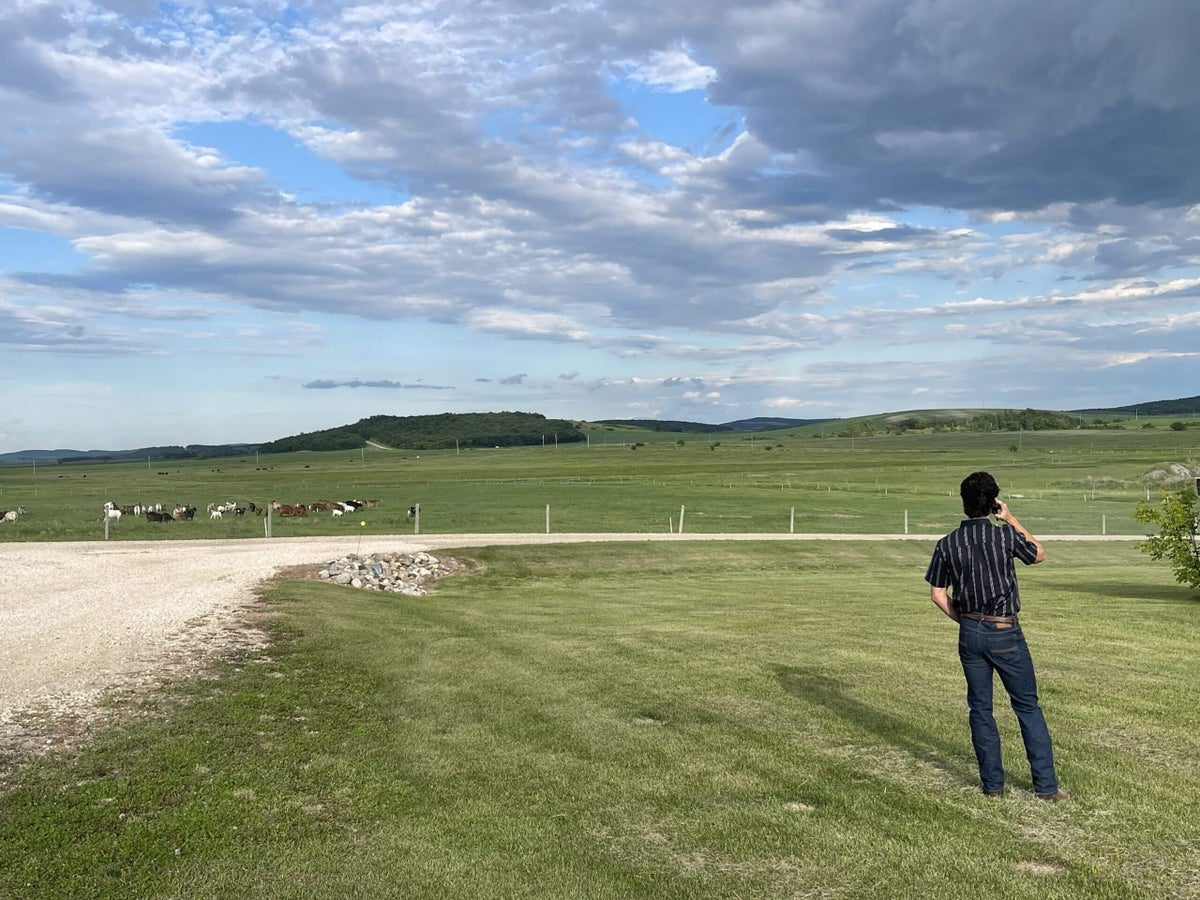
“Tryin’ to remember what my Daddy said / … He said we’re going back and I’ll show you what I’m talking about / Going back to Cypress River, back to the old farmhouse.” — Neil Young, “Prairie Wind”
CYPRESS RIVER, Man. — To the left of a flatscreen television filling the frame of an open garage door, smudges and dents from years of misfired pucks line the wall. The 18-year-old who left them sits in a plastic lawn chair. Nervous. Dressed in a new western dress shirt and cowboy boots — gifts from his agent for the big day — Carson Carels taps both his feet against the concrete.
Around 70 loved ones are stationed behind him, including many camping off the back of pickup trucks. All are lasered in on Sportsnet’s telecast of the NHL Draft, there to support Carels, a 6-foot-2 defenseman who had 73 points in 58 games last season with the WHL’s Prince George Cougars.
A thousand miles away, the Calgary Flames are on the clock with the No. 6 pick.
Carels’ fellow top prospects have all gathered on the draft floor in Buffalo, but he made the unusual — though not unprecedented — decision to spend Friday night at his family’s 2,500-acre working farm in the Manitoba prairie, just under 100 miles west of Winnipeg. But when the Flames make their pick, he doesn’t hear commissioner Gary Bettman call his name. Instead, Cole Waldie — the Cougars broadcaster currently moonlighting as an iPhone cameraman for draft footage — breaks the news.
“It’s done!” Waldie says.
Carson Carels watches as he is chosen with the No. 6 pick in the NHL Draft
Peter Baugh
Cheers spread like a wave across Carels’ family and friends. He stands, turns to his left, and pulls his mom, Stacy, in for a hug. Then comes his dad, Ryan, followed by his four siblings.
“I think I’m still shaking right now, honestly,” he says minutes later, before sneaking off to take a call from Flames general manager Craig Conroy.
Carels is happy with his destination. Ryan calls Calgary a perfect fit: a youth-focused team that will be easy to travel to. And he’s happy he found out here, on the land that raised him, in sight of his goats and cows.
As the celebration continues, someone hands Carels an unopened bottle of champagne. He shakes the bottle once, trying to pop it, then again, looking around as if in need of guidance. He’s never done this before, and he finds it’s harder than it looks on TV. A third attempt similarly fails, but after the fourth he’s able to pry the cork off. The bubbles pour out, splashing Carels and landing on the concrete in front of him. Everyone around him cheers. By night’s end, the population of the nearest town center — 175, according to the Cypress River and Area Foundation — will be rivaled by the number of people who pass through his family farm.
Soon, with his competitive edge and two-way potential, Carels will be a key prospect on a team trying to build its way back to contention. The Flames will fly him to development camp within days, and he and the organization will have to decide whether it’s best for him to play a year of college hockey at North Dakota or turn professional right away. The potential for fame and life-changing money awaits. So does the pressure that comes with it.
For a day and a half leading up to this triumphant moment, Carels and his family offered The Athletic a peek behind the scenes as he spent the NHL Draft in the place where he’s most comfortable: under the wide prairie sky.

Carels is shown on the screen at the NHL Draft in Buffalo after the Flames selected him at No. 6. (Bruce Bennett / Getty Images)
On Thursday afternoon, Carels’ nerves were calmer than he anticipated they would’ve been if he were in Buffalo alongside his fellow top prospects. That morning, he’d moved a group of cows up a hill so they could graze fresher patches of grass, opening a metal gate and making sure they all meandered through. A few hours later he headed back out, leading me on a tour in a John Deere utility vehicle. Mikko, one of the family’s four dogs, sat between us, slobber pooling on his lip.
“When we’re trying to sort cows he tries to help, but his helping is more biting and trying to get himself killed,” Carels said wryly. “He’s pretty stupid sometimes.”
Carels drove the John Deere slowly toward the cows, who were packed together in the pasture in search of a breeze. There are around 520 in this group: a mix of mothers, heifers (females that haven’t given birth) and steers (castrated males). The Carels used to own dairy cows but shifted their focus to beef around seven years ago. The heifers are raised to breed, and the steers will eventually be bought and sent to feed lots for meat production.
On the other side of the house, separated from the larger herds, some 20 breeding bulls packed together in the sun. Around 800 cows total currently live on the farm, and all the mother cows have their calves. Generally they’re “easy calvers,” Carels explained, referring to the birthing process, but sometimes human assistance is required if they’re having trouble. “Get your hand in there and help out,” he said.
In addition to the cows, along with 20 or so chickens and a handful of outdoor cats, the farm has 150 goats. The goats are Carels’ favorite. When mother goats deliver a litter of three or four babies, they aren’t able to take care of them all, so Carels hand-feeds some. “There are some bottle babies that love you,” he said. “Really close with them.”
When Carels’ Western Hockey League team, the Prince George Cougars, bussed to Brandon for a road game in February, they took a detour so the prized prospect could show off his home. Most players napped on their way through the snowy Manitoba prairies, but Carels was too excited to sleep. He’d missed Christmas at home for the World Junior Championships, so he hadn’t set foot on his family’s land since the previous summer. He relocated to the front of the bus, chatting with his coaches for the final hours of the drive.
“He was just gleaming,” recalled Mark Lamb, the Cougars’ head coach and general manager.
The pride goes back generations. The family has lived in the area since his great-great-great-grandmother emigrated from Belgium to Manitoba around the turn of the 20th century. They picked up the Carels family name the next generation, and Carson’s grandfather Paul bought the first chunk of property on the current property in 1980.
The family added Ryan’s current plot when he and Stacy had his oldest son, Ethan, now 25. They lived in a mobile home before building their current house — a light brown bilevel with a basketball hoop in front and a hockey net out back — when Carson was 2.
The surrounding area includes plenty of other family members. Paul still lives in the same house just across the road, close enough for the family dogs to roam between houses. Carson’s uncle lives over the hill, and Ryan estimates around 50 or 60 relatives live within 20 miles of the farm.
“Everyone kind of calls this area Carels’ country,” Carson said, steering the John Deere between plots of farmland, “just because everyone is a Carels who lives around here.”

Carels steers around his family farmland, which is full of steer. (Peter Baugh / The Athletic)
Farm boys are nothing new to the NHL. General managers will always welcome humility and a blue-collar work ethic from players, and strength gained through physical labor doesn’t hurt, either. As an NHL team scout previously told The Athletic when discussing Carels, speaking anonymously in order to candidly evaluate this year’s prospect pool, “We’ve got a lot of rich kids playing hockey now. Give me a farmer all day.”
Farm boys skipping draft festivities isn’t new, either. Last year, No. 5 pick Brady Martin of the Nashville Predators took the same route as Carels, watching from his family’s sprawling farmland in Elora, Ontario, so more loved ones could be with him. Martin and Carels played together for Team Canada at this past season’s World U18 Championship and the World Junior Championship tournaments, and the Predators forward isn’t afraid to chirp his buddy over their similar roots.
“(I) tell him he has a fake farm,” Martin told The Athletic with a chuckle. “(I) tell him he wants to be like me.”
Calgary Flames take a great fit in Carson Carels at No. 6
The Athletic Hockey Show
Most of the Carels’ acreage is dedicated to work, but there’s plenty of fun behind the house: a trampoline from when Carson’s dad was a kid, cornhole boards and a small playground. Later on Thursday afternoon, in front of the garden, Carson picked up a wheel-like plastic ball — part of his grandparents’ Belgian bowling set — and tried to guide it across the grass. The game, which originated in Flanders and is popular in the Manitoba prairie, involves opponents rolling the ball as close to a target as possible. Carson’s attempt veered off course before toppling over halfway, far from its goal of reaching the wooden peg jammed into the grass.
“Stick to hockey!” Paul called out.
Carels rebounded when he and his girlfriend, Mersaya Hughes, picked up a couple cornhole wins against his cousins, 17-year-old Josh and 15-year-old Lucas, both in town from Alberta. The two boys are Oilers fans, and when Carels asked if they would root for the Flames should they draft him, they replied that they couldn’t.
It was warm and sunny — Mikko and Keeta, another of the family’s dogs, took refuge in a shady patch under the porch — but the bonfire was going. A speaker blared country music.
Fresh off his cornhole triumphs, Carels walked up to his father and made a peculiar request: a tarp. When Ryan asked why, Carson responded simply: to fashion a slip-and-slide.
“You’re not 2 anymore!” his mother called out.
Carels, Hughes, and the cousins pivoted, loading a pair of kayaks and a boxed paddleboard into the trunk of a pickup. After changing his black Hockey Canada shorts into pink swim trunks, Carels got behind the wheel and followed his dad’s truck to a small lake, part of his great-uncle’s property not far from the house.
Carels pulled off the road at the northeast corner of the lake and parked at the base of a small hill. The family will start haying — the process of creating bales for feed — after the draft, which won’t leave much time for relaxing afternoons like this. He sipped on a glass bottle of Coca-Cola. Carels and Josh carried a two-seat paddleboat to the muddy edge of the water. They climbed inside and, with a push from Ryan, were off.
When they reached the middle of the lake, Carson made an ill-advised attempt to switch spots with Lucas and climb into the kayak. As he tried to cross over, both the paddleboat and kayak flipped, sending the three boys into the cool water. Their laughter rang across the lake, into a nearby patch of trees and over the gravel road.

Carels represented Canada at last year’s World Junior Championships, winning a bronze medal. (David Berding / Getty Images)
Carels’ skating looked good — his edge-work sharp and stride smooth — but he was struggling to elevate his shot. It was Friday afternoon, five hours before the start of the NHL Draft, and he was at a small rink in Brandon, the second-biggest city in Manitoba and about an hour’s drive from home.
Another perk of watching from the farm: Carels wouldn’t have been able to get a skate in had he been in Buffalo for the draft. Instead he was able to both keep his training schedule intact — he was on the ice four times this week — and give himself a distraction from the enormity of the day. Draft day anxiety had sunk in, and someone who knows what it’s like reminded him of it on the ice.
“He’s in his own head!” Flyers defenseman Travis Sanheim, a 2014 first-round pick, called out after a low Carels shot. “He’s got the big draft tonight!”
There were only three players on the ice, and all were left-shot defensemen: Carels, Sanheim — a Manitoba native — and Carels’ primary defensive partner from Prince George, Bauer Dumanski, who was in town for the draft party. They rotated through a series of drills with a skills coach: work behind the net playing pucks off the wall, edge work, breakout passes, shots along the blue line and shots from the slot. For Carels, the rhythms of on-ice work were a surefire way to clear his head.
After a little over an hour of work, which included time studying video clips from the session on an iPad, Carels headed to the exit, needing to get back to Cypress River. Sanheim spotted him leaving, halted preparation for a drill and charged toward the bench. The veteran caught up to the prospect and gave him a stick tap. He wished the prospect luck and told him he wanted him on Philadelphia.
But the Flyers weren’t scheduled to pick until No. 21. Sanheim is no fool: He knew Carels would be off the board by then.
Soon, Carels would be preparing for pre-draft supper at the house — and, then, for the biggest leap of his life. But he made it clear that he doesn’t intend to change. He loves the life of a farmer. Asked how he wants to spend his first NHL pay check, he said he’d love to buy land to continue the family tradition.
Hockey is his first dream, he said. But he “can almost guarantee” he’ll either be back on the Carels’ farm or starting one of his own when his playing days are done.

Carels, who was gifted a custom NHL Draft belt buckle by his parents, will fit right in in Calgary. (Leah Hennel / Getty Images and Peter Baugh / The Athletic)
In the foyer of the Carels’ home, a pizza-sized sticker jumps out from a white wall. “Hockey lives here,” it reads, with the silhouette of a player skating between two maple leafs. The draft starts in an hour, and Carels is up a small flight of stairs at the dining room table. His mom, sensing his stress, had placed a tray in front of him packed with candy, including Nerds Gummy Clusters, Sour Patch Kids and Sour Skittles.
Dozens of guests pass through the house to serve themselves dinner (brisket, predictably). A group of visitors from the Cougars sit with Carels: Dumanski, his billet parents from the British Columbia town, a pair of equipment managers, the athletic trainer and Waldie, the broadcaster. Someone asks if Carels has begun researching any of the potential cities that could draft him. Not yet.
Research or not, his outfit suggests he’ll fit right in in Calgary. Along with his boots, he’s got a new belt buckle, a gift from his parents. The front features an outline of Manitoba’s borders and “2026 Draft,” and the back is complete with a personalized message. “Hockey can show you the world, farming will show your roots. Proud of you Cars,” it reads.
The watch party tenses after the first three picks. Buffalo, picking at No. 4, gives the audience its first shock, selecting Daxon Rudolph, widely expected to be the fourth or fifth defenseman off the board, not the first. Carels wheels around and looks at his agent Tobin Wright in surprise. Some guests start filming when the Rangers pick at No. 5, but they go with Latvian Alberts Šmits.
Finally, Calgary brings multiple generations of farmers to tears. Grandpa Paul, who wouldn’t have been able to share this moment if Carson had gone to Buffalo, cries almost instantly. Ryan struggles to hold back his emotions when reflecting on the time he spent driving Carson to skates and skill sessions.
This is a family achievement.
“So many hours in the vehicle,” he chokes out. “Hours and hours of driving together.”
The two hours after the pick are a blur. Conroy, the Flames GM, calls and describes holding his breath, hoping Carels would be available at No. 6. Hall of Famer Lanny McDonald — a former farm boy himself — also dials up Carels to welcome him to the organization. Calgary forward Jonathan Huberdeau reaches out, and so does Zach Whitecloud, a fellow Manitoban. Carels handles various media calls — he wasn’t at the draft for in-person availability, after all — and records a message to Calgary fans, sharing his excitement.
When all that’s complete and before he returns to the party outside, Carels takes a moment to catch his breath. He and Mersaya sit in his bedroom, soaking in the magnitude of it all: the dream realized and the opportunity ahead. He can’t stop smiling.
Hours later, well past midnight, he’s back outside with his friends. Their shouts, as well as the scent of a bonfire, carry through the farm, over the sleeping cows and goats as the celebration continues under the moon.
