For those who have watched every single World Cup match from start to finish — 73 in all, spanning across almost 110 hours of football — congratulations, you have seen precisely 1,000 different players take to the pitch.
Some have left more of an impression than others. Most spectators are following the remarkable scoring exploits of Lionel Messi, Kylian Mbappe, Erling Haaland and more, while keen observers might have been impressed by several promising youngsters and breakout stars, from Morocco’s all-action midfielder Ayyoub Bouaddi to the Ivory Coast’s Yan Diomande on the wing.
But what about those players whose impact has been a little less celebrated, lost in the blur of games? Those with distinct tactical roles, or who have quietly made the difference while their teams have slipped under the radar or into the last 32?
To spread the word, The Athletic’s data and tactics team have shared notes to pick out an underappreciated XI.
Get free access to the most comprehensive World Cup coverage in The Athletic app
Goalkeeper: Dominik Livakovic, Croatia
This has been the tournament of the underdog goalkeepers; from the heroics of 40-year-old Vozinha to Eloy Room’s 15 saves for Curacao in a goalless draw with Ecuador.
How about Patrick Beach and his extraordinary clean sheet against Turkey on just his third appearance for his country? Or even Alireza Beiranvand, the Iranian shot-stopper with a Guinness World Record, who ran away from home aged 12?
All are incredible stories, but in terms of shot-stopping impact, few have been quite as eye-catching as Croatia’s Dominik Livakovic on his way to another World Cup knockout phase.
Though he conceded four to England on the opening game, Livakovic was still impressive; originally saving Harry Kane’s penalty before conceding the retake, while making an eye-catching double-save to deny Nico O’Reilly and Anthony Gordon from a corner. He got the clean sheet he deserved against Panama six days later, making two sprawling saves to clinch a crucial three points in a 1-0 win.

Livakovic has history at the World Cup, famously making three penalty shootout saves against Japan to help them through the round of 16 in Qatar, before denying Rodrygo from the spot in the following round.
With Portugal, and then potentially Spain to come, his country will need him once again.
Left wing-back: Keito Nakamura, Japan
That’s right, we are going with a back five for this team; a tribute to some of the towering centre-backs to come, but also to the dangerous wing-backs — such as Keito Nakamura — who have picked their moments to get forward expertly well.
Still only 25, Nakamura plays his football in France’s second tier, relegated with Reims in 2025. He has played all across the front line, hitting 11 league goals in consecutive seasons, including a four-goal haul on the final game of the season from a roaming centre-forward role.
He makes up for what he lacks in power with agility, ducking and diving between outstretched legs with body feints and little touches to keep the ball moving left and right. Most impressive has been his timing to drift inside, taking a shot inside the box in all three of his group games after chopping onto his strong right foot.

Stepping in for the injured Kaoru Mitoma, Nakamura has grabbed his World Cup opportunity with both hands and will surely be playing top-flight football by the time the domestic season begins.
Left centre-back: Andres Andrade, Panama
Panama were already eliminated by the time they faced group winners England in New Jersey on Saturday, but they might have felt a little hard done by, given the sharp, high-tempo possession football they had played up until that point.
Thomas Christiansen’s side controlled almost 62 per cent of the ball in their opening match against Ghana, conceding only four shots on target across both games as they fell to back-to-back one-goal defeats. Andres Andrade was the beating heart of their build-up, moving the ball forward with incision from his role on the left side of defence.
No player attempted more line-breaking passes than the 27-year-old in the group phase, constantly looking to find advanced midfielders with searching balls inside. He was comfortable switching the play with pinpoint crosses to the opposite flank, found several dangerous runs in behind, and also defended his space well, alert to sweep up possession and strong to win his duels in the air.

Andres Andrade impressed for Panama in the group stage (Kevin C. Cox/Getty Images)
Andrade’s passing ability was platformed perfectly by Panama’s ball-heavy approach this summer, proving himself as an expansive distributor from the back. Having spent six seasons at Austrian side LASK, he could be an option for a team in the market for that precious left-footed centre-back profile.
Central centre-back: Mbekezeli Mbokazi, South Africa
Across a win, a draw and two agonising defeats for South Africa, bustling centre-back Mbekezeli Mbokazi racked up 31 clearances, made four crunching tackles, and popped a ball after hitting it so hard.
Only 20 years old, snapped up by MLS side Chicago Pirates after barely nine months with the first team at South African champions Orlando Pirates, Mbokazi is a joyously old-school defender. He throws his body on the line in the box, uses his upper-body strength to muscle strikers off the ball, and loves a pop from distance. All four of his efforts on goal at this World Cup have come from at least 30 yards away from goal.
But Mbokazi is also capable of a splitting pass from that hammer of a left foot, whether he is smashing it cross-field for a winger to take down on his chest or wrapping it through the lines.
Here he is against the Czech Republic, put into a difficult situation as the opposition lock on man for man. With a neat drag-back, he evades the pressure before fizzing a pass into Oswin Appollis high up the pitch.

Mbokazi is uniquely assertive with and without the ball, and his decision-making will only improve with age.
Right centre-back: Alessandro Circati, Australia
Two goals scored, two conceded, and two clean sheets to finish second in Group D; Australia can be satisfied with their defensive organisation so far. Soaking up pressure in a well-drilled 5-4-1 shape, while dangerous on the break with the energy of Jordan Bos and the pace and trickery of Nestory Irankunda, they look like the kind of team that can grind out a result against anyone on their day.
One player who epitomises that grit is the tough-tackling Alessandro Circati, a rock-solid presence on the right of defence. He enjoyed a stellar campaign in the Italian top-flight for Parma, starting 31 league games and establishing himself as a starter after four promising years in the second tier.
Throughout the World Cup, Circati has proven his ability to stand his ground, difficult to shake off once he senses an opportunity to nick possession.
He is prepared to jump out of Australia’s back five and follow runners into midfield, keeping his eyes firmly on the ball as dribblers twist and turn. Here he is against Paraguay, just one part of his recurring battle with Julio Enciso, sticking to the attacking player, staying on his feet and averting the danger with minimal fuss.

Circati’s defensive maturity and decision-making are all the more impressive given his age — still only 22 and having been sidelined for almost seven months with an anterior cruciate ligament (ACL) tear. That has understandably impacted his explosive pace, but he has shown himself capable of keeping up with sprinting strikers, notably recovering to block a shot from Folarin Balogun after the defensive line was caught up the pitch.
Comfortable out wide, even better in the box, Circati emerges from this World Cup with his reputation firmly enhanced.
Right wing-back: Daniel Munoz, Colombia
Daniel Munoz is already well-known to Premier League fans, but his role as a box-crashing full-back for Colombia has been too intriguing to ignore.
No Premier League defender has racked up more goals and assists since he joined Crystal Palace two-and-a-half years ago, so perhaps his storming start to the World Cup should be no surprise.
Still, it is hard not to be impressed by Munoz’s energy and stomping forward runs down the right flank, as tenacious in his defensive battles as he is committed to joining the attack. Only seven players have made more offers to receive passes in behind the defensive line — impressive numbers for a full-back — while his remarkable finish against Uzbekistan helped to illustrate the technical quality that comes with those elusive runs behind enemy lines.

Munoz scored a remarkably acrobatic goal against Uzbekistan (Carl Recine/Getty Images)
Even when he isn’t popping up inside the box, Munoz is an integral part of Colombia’s swirling right-hand side. While the creative James Rodriguez drops into midfield, the similarly impressive Gustavo Puerta will rotate, creating space for the wing-back to attack with overlapping and underlapping runs.
Keep an eye out for Nestor Lorenzo’s side, who could make a serious run in this competition.
Defensive midfield: Pedro Vite, Ecuador
Ecuador made a slow start to Group E, conceding a late winner to Ivory Coast and falling to a frustrating 0-0 draw with World Cup debutants Curacao, but Pedro Vite never hid away.
Sift through some of FIFA’s advanced metrics for the tournament, and the 24-year-old stands out across the board. Only Turkey’s Arda Guler has made more offers to receive a pass than Vite, indicative of his constant movement to keep providing options for his team. He ranks 11th for distance covered at high speed, while only four midfielders have completed more line-breaking passes.
He is everywhere all at once, a tireless partner for the similarly relentless Moises Caicedo in the heart of midfield. On top of his quality on the ball, Vite’s athleticism helps him to put out fires all across the pitch, racking up 29 defensive contributions against Germany as illustrated below.

Ecuador are a strong defensive team, having only conceded five goals in 18 qualifying games to reach this summer’s World Cup.
If they are to overcome co-hosts Mexico in punishing conditions on Tuesday, they will need the bite and positivity that Vite can also provide in attack.
Central midfield: Jamiro Monteiro, Cape Verde
Cape Verde have been a fascinating story in this World Cup, and while the likes of Vozinha and Pico Lopes have rightly earned their plaudits in the defence, the dynamism and ambition of midfielders such as Jamiro Monteiro, 32, have made them remarkably easy on the eye.
Playing his football in the Dutch Eredivisie for PEC Zwolle, Monteiro was one of six players over the age of 30 in the starting XI for their historic draw against Spain. He dug in without the ball, making the most direct pressures of any player on the pitch per FIFA’s post-match report, while offering a pop of flair whenever he could get on the ball.
He was given more license to drive forward throughout an absorbing 2-2 draw with Uruguay, impressing once again with his box-to-box athleticism. Monteiro loves a flick and a driving run, and his positivity set the precedent for a team that flooded forward at any opportunity.
There is a distinct sense of fun about Cape Verde, and although they will have their work cut out against Argentina, expect Monteiro and his relentless team-mates to relish the occasion.

Jamiro Monteiro’s box-to-box energy has impressed at this World Cup (Carlos Rodrigues/Getty Images)
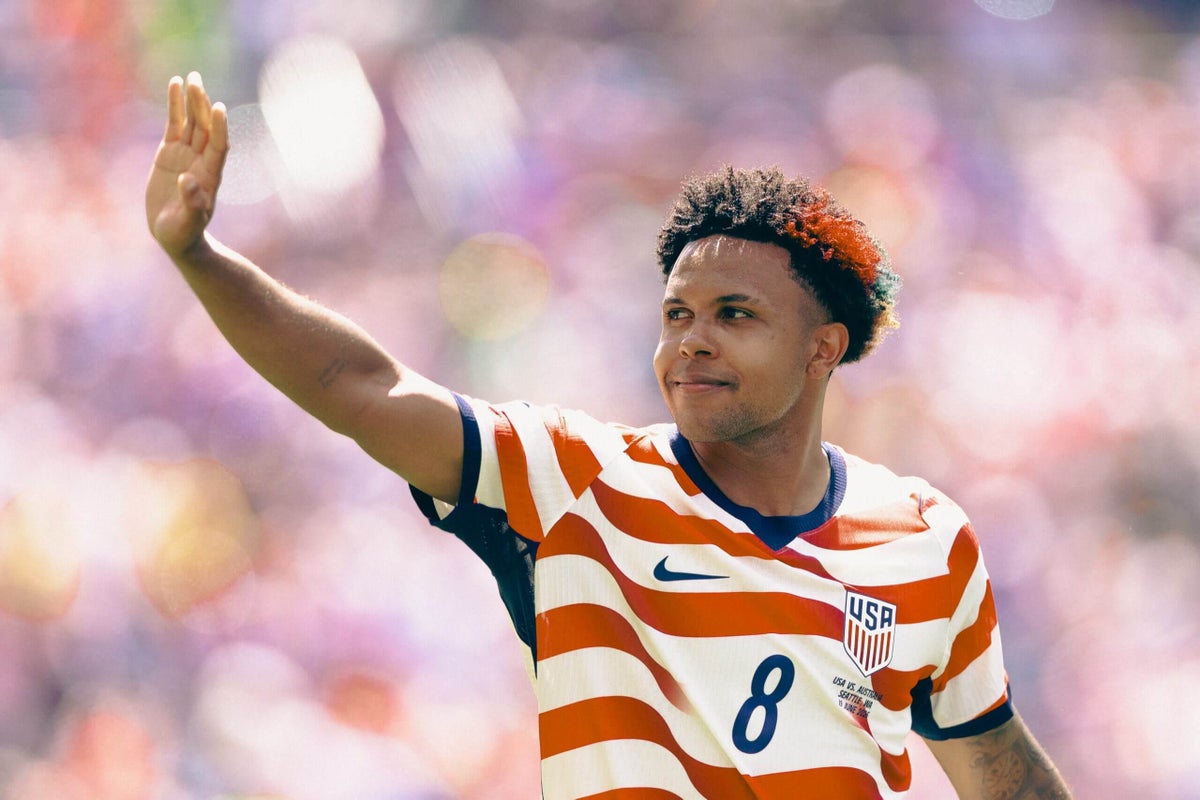
Central Midfield: Weston McKennie, USMNT
It was difficult not to get a little carried away with the United States after their dominant tournament opener against Paraguay. Mauricio Pochettino’s side were energetic, slick in their passing and sharp in their movement as they scythed through a compact defensive unit with ease.
Though he is yet to score or assist this tournament, Weston McKennie’s intelligent positioning has helped to pull deep defensive blocks out of their shape. No team-mate has created more chances or taken as many touches inside the box, frequently drifting over to the right flank to form a dangerous triangle with Alexander Freeman and Sergino Dest, as we can see below.
Keep an eye on McKennie’s darting run, slowing down while the full-back looks away before emerging from his blind spot with a burst of acceleration to receive the pass down the line.

The U.S will not enjoy too many more games with over 60 per cent of the ball this tournament, but McKennie’s fitness will also help to glue the side together in more end-to-end games.
He brings crucial experience and a real sense of rhythm to the midfield.
Forward: Ruben Vargas, Switzerland
The exciting Johan Manzambi has largely stolen the Swiss spotlight this summer, but winger Ruben Vargas has been just as impactful, scoring alongside his talented team-mate in each of their group-stage wins.
Following five seasons in the Bundesliga with Augsburg, 27-year-old Vargas has been scrapping for relegation-threatened Sevilla in Spain for the past year. His pace and directness stand out — rarely flashy but quick from a standing start and able to eat up ground with the ball at his feet.
As we can see from the graphic below, he likes to drive into the penalty area after receiving the ball out wide, consistently surging past full-backs with powerful strides.

Vargas is not typically the most prolific forward, but the venom with which he strikes the ball and his repeated, darting runs into dangerous areas make him a constant threat.
Forward: Deniz Undav, Germany
Granted, Germany’s Deniz Undav is hardly a hidden gem, having scored three times already at this World Cup. But it feels as if his prolific record at club level is still going relatively unnoticed.
Since his move to Stuttgart three seasons ago, he has racked up 46 goals and 18 assists in the German top flight, at a rate of 0.95 goal contributions per game. Across that time, only Harry Kane, Michael Olise and Ousmane Dembele can improve on the regularity of Undav’s decisive moments in front of goal when penalties are taken away.

Remarkably, Undav’s record is even better for the national side, having scored nine times in 460 minutes, just over the equivalent of five full games. He is a technically gifted striker, able to finish smartly with both feet, but it is his cunning movement inside the penalty area that is causing problems from the bench against tired legs.
Undav is yet to start at this World Cup, but he couldn’t be doing much more to get Julian Nagelsmann’s attention.
