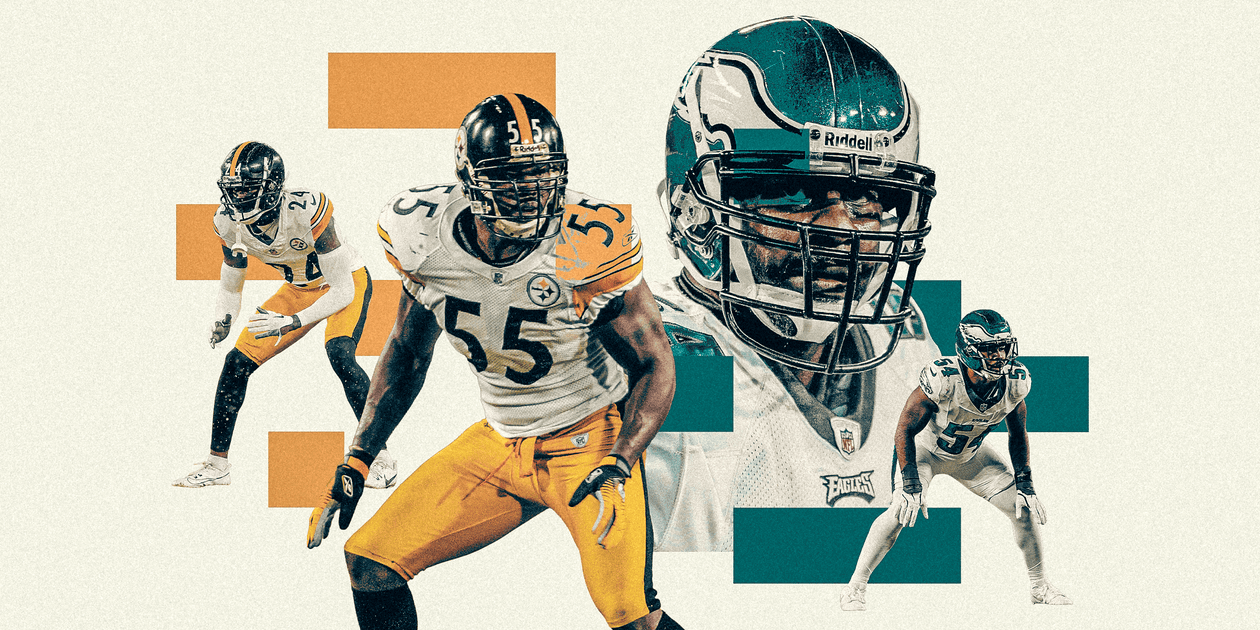
All-Pro middle linebacker Jeremiah Trotter placed one of his massive hands on the belly of his expectant wife and breathed a prayer.
“God,” said Trotter, the heart and soul of the Philadelphia Eagles defense for much of the late 1990s and 2000s, “make my boy big, strong, fast, a little bit crazy — because to play linebacker, or play football period, you’ve got to be a little bit tough-minded at least.
“And God,” Trotter added, “whatever you gave me, give him double.”
Trotter repeated the prayer all the way up to Jeremiah Jr.’s birth on Christmas Eve of 2002. He resumed the ritual three years later while awaiting the birth of a second son, Josiah, in April 2005.
When each of his sons turned 5, Trotter introduced them to football.
“They had no choice,” Trotter, now 49, recalled. “They were playing football. At least until they left high school. Then they could make their own decisions.”
Trotter loved the game of football so much — the competition, the camaraderie, the life lessons — that he wanted his sons to share in those experiences.
“Fortunately,” he said, “they both fell in love with it and they wanted it. They had to want it. I couldn’t want it more than them. … And there was no other position (for them) than middle linebacker. … From the time they started football, I’ve always trained them to go pro. It was never for little league or high school or college. The stuff that I taught them, I said, ‘Listen, what I’m teaching you now, it just don’t stop here. It’s gonna translate to the NFL.’”
In a full-circle moment, the Eagles selected Jeremiah Jr. in the fifth round of the 2024 draft. Like his father, he wears No. 54. As a special-teams standout and defensive contributor, the younger Trotter helped Philadelphia defeat the Kansas City Chiefs in Super Bowl 59. This past spring, the Tampa Bay Buccaneers selected Josiah in the second round. The Bucs hope he can help boost a defense in need of additional young playmakers.
Already members of an elite fraternity as professional football players, the Trotters belong to an even more exclusive club. Of the roughly 2,900 players on NFL offseason rosters, just 66 veterans have fathers who played in the NFL, according to the NFL’s research department and Elias Sports Bureau. That total grows to 74 with the addition of Josiah Trotter and seven other second-generation NFL players who were drafted or signed undrafted free-agent contracts this spring. Another 14 second-generation players who played at least one game last season remain free agents.
Six players (Cooper Kupp, Ted Karras, Jake Matthews, JP Richardson, Hayden Rucci and brother Nolan Rucci) have a grandfather and a father who played in the NFL.
NFL bloodlines don’t automatically punch a ticket to the league. Growing up in a football family does, however, seem to give players a strong foundation and head start over their peers. Consider some of the names of the NFL’s second-generation players: Joey and Nick Bosa, Christian and Luke McCaffrey, Joe Burrow, DK Metcalf and Shedeur Sanders.
Joe Burrow is ‘ready to roll’ for 2026 NFL season
Paul Dehner Jr.
“There’s definitely something to be said of growing up in that environment, because when you’re in this business, it’s different than a regular 9-to-5 job on a Monday through Friday,” said Pittsburgh Steelers general manager Omar Khan, whose team leads the NFL with seven players whose fathers also played in the NFL. “There’s a lot that goes into it, and it’s complex. … I think when you’ve had people that can teach you about those challenges, about the sacrifice that it takes, you’re ahead of the game. From an expectation standpoint, it should alleviate some of the pressures of what goes on at this level. And 100 percent (it helps) football IQ. You can’t help but be at a high level when you’ve grown up around it, and you probably talk about it day-in and day-out with your family.
“It’s just what you know.”
As the sons of NFL players grow up, their fathers sometimes have varying feelings about them following in their footsteps. But once it becomes clear their sons have committed to the journey, the dads turn part-coach, part-adviser, part-cheerleader.
“You’re excited for them to have that opportunity,” said former New England Patriots offensive lineman Todd Rucci (1993-99), the father to 49ers tight end Hayden and Colts offensive tackle Nolan. “It’s amazing, but you also know what comes with that: the stress and the work and the sacrifice. But I think what we are able to do is make them see the process for what it is and what it isn’t, so basically take the shine off of the whole thing, so they can focus on what really matters.”

Luther Elliss, a two-time Pro Bowl defensive tackle for the Lions from 1995-2004, has three sons in the NFL right now. (Tom Pidgeon / Allsport)
Elliss family’s full house
There’s nothing quiet about Sunday afternoons at the Salt Lake City home of Luther Elliss, the former Detroit Lions defensive lineman who has three sons in the NFL and three televisions to watch their games. Kaden is an eighth-year linebacker with the New Orleans Saints. Christian is a sixth-year linebacker for the Patriots. Jonah is a third-year linebacker for the Denver Broncos.
If all three sons were playing at the same time, Elliss originally kept two TVs on mute while focusing on whichever team was on defense. But it became too challenging to monitor the silent contests, so now he keeps the volume up on all three broadcasts, with eyes and ears trained to scan for Nos. 55, 53 and 52.
The Elliss brothers are one of eight sets of siblings active in the NFL (the Bosas, McCaffreys, Trotters and Ruccis, plus Cam and Connor Heyward, Terrell and Tremaine Edmunds and rookies Lorenzo and Sonny Styles). A fourth Elliss brother, Noah, had a brief stint with the Eagles at defensive tackle in 2022, and a fifth (Elijah) is a rising sophomore defensive lineman at Utah, where Luther Elliss is the defensive tackles coach.
There certainly were times when Luther, now 53, allowed himself to dream of having his sons join him as an NFL alum.
“It was something that you kind of hoped for, and knew it’d be kind of cool to see them to be able to do that,” said Elliss, whose sons jokingly credit their mother, Rebecca — a former collegiate swimmer — for all of their athleticism. “Just watching them as they’re growing up, I thought they had really good athleticism. They seemed to pick up things quickly and I thought they might have a chance. But I would say, ‘It’s all in God’s hands. God has a plan for them, and we trust that, and we just walk in that.’”
Elliss took a proactive approach to guiding his sons in the right direction. He preached the importance of a strong work ethic and going the extra mile while also urging them to join him for workouts.
“In middle school, I wouldn’t be able to go play with my friends until I did my workout for the day and read my book of Proverbs for the day, so there were certain things that you had to do,” Kaden Elliss, 30, recalled. “He gave me the blueprint through middle school, like, ‘I’m gonna show you how you have to do it. I’m gonna make you do it.’ And then, when I got to high school, it’s really more of like, ‘If you want it, come let me know,’ and I remember having to go wake him up in the mornings, because it was like he kind of put the precedent on me. And I think that’s really when it took off for me. … So, I really do appreciate our dad for forcing us, at least for a little bit, so that way we would know what it looked like. … You had the path and then you could walk it.”
Luther’s guidance also was helpful during his sons’ early days in the NFL. After his first offseason practice with the Saints in 2019, Kaden called his father, brimming with excitement about how prepared he felt and how well he performed.
“I said, ‘I felt like the best guy out there!’ and my dad said, ‘Calm down; it’s OTAs. The vets don’t go hard,’” Kaden said, chuckling.
Jonah recalls the mental toll repeated injuries took on him in college and during his first season in Denver. He spoke with his father about whether he wanted to continue playing football.
“We talked for a while, and then he said, ‘God’s got a plan for you, and although it’s hard, you don’t really know what it is, why you’re going through this. But there’s a reason for it,’” Jonah said. “I think I’ve grown a lot through that, but I would say the mental strength that he was able to build in us when we were kids really helped me get through those early years of injury and whatnot.”
Early in Kaden’s career, he felt pride when coaches would share stories about how formidable an opponent his father was during their playing days. Now he is experiencing a similar emotion sharing an NFL journey with his brothers.
“Getting to hear when Jonah goes and kills it with Denver on sacks, and Christian kills Jaxson Dart on the sideline, you feel those moments of pride over seeing these people that you worked so hard with to get their success,” Kaden Elliss said. “(It) is really special.”
The Matthews dynasty
It’s one thing to have a father who played in the NFL. But when your uncle and grandfather also played in the league, the NFL truly is all you know, and it’s easy to forget that your norm differs greatly from that of others.
Just ask Jake Matthews, the 13th-year left tackle of the Atlanta Falcons and son of Hall of Fame interior lineman Bruce Matthews. He’s also the nephew of four-time Pro Bowl linebacker Clay Matthews Jr. and grandson of 1950s offensive lineman/defensive lineman Clay Matthews Sr.
“I didn’t realize, in a way, how good we had it,” said Jake Matthews, who has started all 196 games he’s played since the Falcons drafted him in 2014. “Just growing up, getting to go in the locker room, going to games every Sunday, and just watching my dad and the career he had, and how durable and consistent, how long he did it, I was a bit naive. As kids, you think this is what everyone does when they play in the NFL, and then you mature and grow up, you go to college, and eventually get to the league too, and it’s like, ‘Oh, that’s pretty uncommon.’
“(I) just gained that much more of an appreciation and realized how special it really was to have a dad who did it that well, and to be able to lean on him and get advice from him,” added Matthews, whose older brother Kevin also played in 17 NFL games for the Titans from 2010 to 2012.
Jake was 6 when his father and the rest of the Tennessee Titans made their march to the Super Bowl following the 1999 season, a playoff run that featured the Music City Miracle. Around that time, the Matthews boys talked their parents into letting them play football. Bruce Matthews sat each of his sons down and found himself giving the same talk he received from Clay Sr. decades earlier.
“My dad had told me, he goes, ‘Look, you don’t have to play if you don’t want to. Don’t do this because of my history or because your older brother plays. You play because you want to, but if you do play, you aren’t going to quit, and you’re going to go full speed. You’re going to (give) your best effort,’” Bruce Matthews, 64, recalled. “They understood that from the get-go. So it never was an issue in that regard. They wanted to play. It was very apparent to my wife and me that they were all about this.”
Matthews never worried about the physical toll football could take on his sons’ bodies.
“I have a bunch of friends who never played football, who are dealing with health issues, as we all are,” he said. “And yeah, there’s a price to be paid, but my wife and I believe that there were also so many life lessons that they could learn, primarily, you get slapped down and you get knocked on your rear end. How do you respond to that? And that was kind of the approach we took.”
The magnitude of hailing from such a famous football family and upholding the standard set by his father is not lost on Jake Matthews.
“I’d be lying if I said there wasn’t any pressure,” he said. “But that more so came from myself, or maybe from coaches (while growing up) … ‘Hey, that’s Matthews’ kid. Hey, I knew your dad,’ all that kind of stuff. So, there definitely was a history and legacy to live up to. I think my dad’s the greatest offensive lineman to ever do it. So it’s hard to fill those shoes, but the coolest part of it all was the way my dad handled it. He never pushed me to do anything. It was all based on what I wanted to do, and as long as I said the word and asked for the help or the mentorship, he was always willing and able to be there. I really respected that from him growing up.”
It’s impossible not to wonder if a fourth generation of Matthews players will find the path to the NFL. The question evoked a laugh from Bruce Matthews.
“They love watching football. They’re playing flag, and they love playing, they love competing, whatever sport, and that was kind of our deal growing up,” he said. “It was like, whatever you do, it’s just playful speed.”

Joey Porter celebrates the Steelers’ Super Bowl 40 win with his sons Joey Porter Jr. (left) and Jacob. (G. N. Lowrance / NFL Photo Library)
Joey Porter ‘always in my corner’
As the confetti rained down on Ford Field moments after the Pittsburgh Steelers defeated the Seattle Seahawks in February 2006, little Joey Porter Jr. basked in the moment. As his father, Steelers great Joey Porter Sr., and his teammates celebrated, the 5-year-old gathered as much confetti as he could handle and eventually brought the haul to the locker room, where the celebration continued.
That’s the earliest football memory that Porter Jr. — now a cornerback for the Steelers — can recall, and that experience birthed his own football aspirations.
“I remember when my dad used to come home from practice, I’d put on his old equipment and try to just run around the house and tackle him,” Porter said. “And since that age, I kind of already knew football was it for me. But my dad’s main thing was, ‘Don’t do it because I’m doing it. Do it because you love it,’ so he wanted to always just test if I really love the game of football, and he finally let me have my shot of playing at a young age.”
Bearing his father’s name made it impossible for Porter to fly under the radar. When the Steelers drafted him in the second round in 2023, the buzz only intensified. Porter, however, had long learned how to tune out the noise.
“There was a lot of pressure, a lot of noise in the background,” Porter said. “But me and my dad had a conversation earlier in my football career where he just basically broke it down like, ‘We’re going to get compared no matter what you do, no matter what position you play. … Just know that it’s never a competition between me and you.’
“He always wanted me to be better than him, and he wants the best for me. So, once he said that to me, and it got that underlined, it was really no pressure. There was nothing to really stress over, because I had that understanding. He has stayed in my corner the whole time, and is always giving me advice and tips on what to expect, but also giving me space to be my own man and figure stuff out.”
Chargers assistant general manager Chad Alexander knows all about growing up in a football family. His father, the late Hubbard “Axe” Alexander, was an assistant coach for the national championship-winning Miami Hurricanes (1983, 1987) who then helped guide the Cowboys to three Super Bowl victories in a four-year span.
“I saw what the profession looked like every day, and I saw the preparation, the sacrifice and … most of all, the relationships, and the joy that just kind of comes with being part of something bigger than yourself,” Alexander said.
Those lessons helped shape Alexander’s approach as an NFL talent evaluator, and he believes the same applies to the imprints second-generation players have received from their fathers.
“They just know how to carry themselves,” Alexander said about the sons of NFL alums. “Each guy is different, obviously. They each have their own personality, but that respect for the game just shows up in their habits. … Obviously the bloodlines are huge with the athletic abilities passed down, but it’s not just that. It’s really the standards: how to work, how to prepare, handle adversity.”
As Jeremiah Trotter Jr. will attest, much of the mental fortitude necessary to play freely and without fear of expectations stems from the guidance and support of his father.
“I definitely feel that bull’s-eye, and that target of people wanting to come at me because of my name and who my dad was. But it doesn’t deter me in any way,” he said. “I just go out, have fun and try to play my game.”
