The NHL’s skyrocketing salary cap has made it much easier for teams to trade away overpriced contracts — provided the remaining term isn’t too long — compared to the flat-cap era. Gone are the days when a team like Calgary paid Montreal a first-round pick in the summer of 2022 for taking on just the final year of Sean Monahan’s $6.375 million cap hit.
Last summer, underperforming veterans Andre Burakovsky ($5.5 million AAV), Evander Kane ($5.125 million AAV), Viktor Arvidsson ($4 million), Vladimir Tarasenko ($4.75 million), Erik Haula ($3.15 million) and Miles Wood ($2.5 million) were all dumped to new destinations without their old teams having to attach a sweetener. The Penguins were the only team in the league to extract significant value from any cap-dump deal last summer, doing so twice in separate deals that absorbed Matt Dumba and Connor Clifton.
The relatively painless prices for ejecting bad contracts continued at this year’s trade deadline. Anaheim gained a seventh-round pick when it sent struggling 32-year-old center Ryan Strome (only nine points in 33 games at the time of the trade) and his $5 million to the Flames. It only cost New Jersey a third and sixth-round pick to offload the final year and a half of Ondrej Palat’s $6 million AAV to the Islanders.
This isn’t to say every inefficient contract can easily be traded but teams caught with a dicey contract have arguably never had more exit options in the cap era.
Chris Johnston’s trade board already highlighted some overpriced contracts that could be traded this offseason, including Darnell Nurse, Morgan Rielly, Adin Hill, Dougie Hamilton, Jesperi Kotkaniemi, and Elias Pettersson.
But there are more players on overpriced deals — closer to being a “slight overpay” than an “albatross/anchor” of a contract — that teams could consider jettisoning this offseason. Here are 10 to keep an eye on. Note that the contracts on this list aren’t equal; some of them are actually close to being fair value, whereas others are far more toxic.
How to win a Stanley Cup without superstars
Harman Dayal
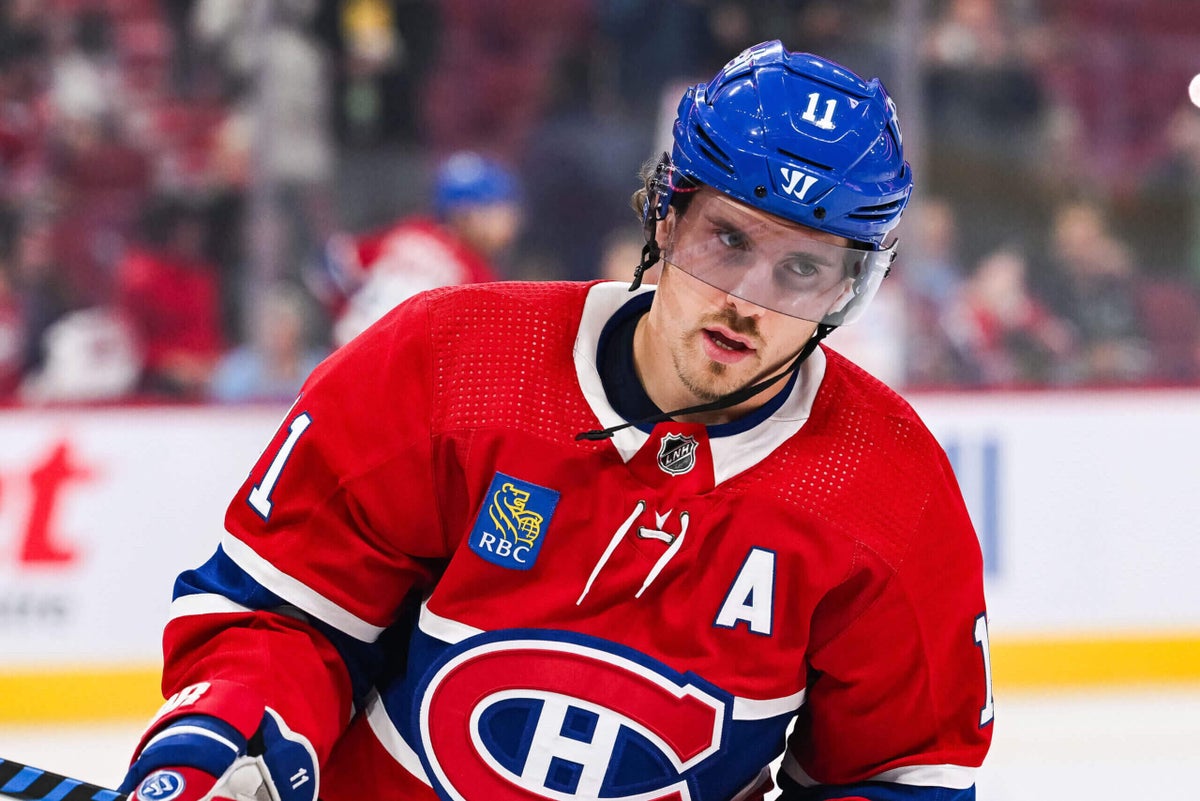
Brendan Gallagher, Montreal Canadiens
Brendan Gallagher broke down in tears when he told local reporters at the end of this season that he’d be moving on from Montreal.
He has spent his entire 14-year NHL career with the Canadiens, but at 34, his game sharply declined in 2025-26, and his role was marginalized. He went from scoring 21 goals in 2024-25 to mustering just seven this season. His average ice time slipped to a career-low 12:21 per game, and he was regularly a healthy scratch in the playoffs, appearing in just three postseason games.
Gallagher simply can’t perform at a high enough level anymore to crack the Canadiens’ stacked forward lineup on an everyday basis. Moving on makes sense for both sides —Gallagher probably doesn’t want to sit in the press box as a healthy scratch for games, and Montreal would gain a critical $6.5 million of cap room.
In the flat cap era, this would have been an expensive contract to move. Gallagher’s impact in 2025-26 was commensurate with that of a fourth-liner; he’s nowhere close to being a $6.5 million player. However, with the rising cap, and because his deal only has one year remaining, it shouldn’t be too difficult to find a taker. Gallagher is an incredibly well-respected veteran with strong leadership skills, which could make him appealing to a young rebuilding team like Vancouver (he grew up in the province and played junior hockey for the Vancouver Giants), particularly if the latter trades its own veterans such as Jake DeBrusk and/or Elias Pettersson in separate moves.
If the interest in Gallagher is unexpectedly weak, the Canadiens could also buy out the final year of his deal, which would create $3.83 million in savings for 2026-27 and come at the expense of a modest $1.33 million dead cap charge in 2027-28.
Ilya Lyubushkin, Dallas Stars
For the second offseason in a row, the Stars are navigating around one of the most complex cap crunches in the league. Dallas has most of its roster spots filled, but the issue is the team’s $11 million in projected cap room won’t even be enough on its own to re-sign RFA Jason Robertson.
That doesn’t even account for promising 24-year-old forward Mavrik Bourque, who also needs a new deal this summer. Bourque broke out with 20 goals and 41 points in the regular season. AFP Analytics projects his next contract to be in the $2.96 million AAV range on a two-year bridge.
Dallas will need to make cap-clearing moves, and Ilya Lyubushkin should be the most obvious piece to ship out. The 32-year-old right-shot defender profiles as a No. 6/7 contributor. With the strides Nils Lundkvist took this season and the deadline acquisition of another big righty in Tyler Myers (who struggled in Texas but is on a significantly cheaper $1.5 million cap hit), Lyubushkin isn’t needed as an everyday contributor.
Lyubushkin’s $3.25 million AAV is overpriced for what he brings to the table, but the Stars shouldn’t have too much difficulty moving his contract since it only has one year remaining, and because he’s a big, physical right-shot, which is the kind of profile that should appeal to at least some teams. It also helps that he has zero trade protection.
Jordan Greenway, Buffalo Sabres
Jordan Greenway is a solid bottom-six winger with an enormous 6-foot-6 frame and legitimate defensive value, but he has two issues as a player. The first is his lack of durability; he’s been limited to just 74 combined games over the past two seasons. If you zoom out, he hasn’t reached the 70-game mark in a single campaign since 2018-19, which was his first full year in the NHL.
He’s also quite limited offensively. Greenway had a strong 2023-24 campaign where he chipped in with 28 points in 67 games, but besides that, it’s been tough sledding over the past few years. He produced just 11 points in 62 games in 2022-23, eight points in 34 games in 2024-25, and only one goal and five assists in 40 games this past season.
Between the injury history and limited offense, Greenway’s contract, which has one year left at a $4 million cap hit, could be a hindrance. Buffalo is in a tight cap situation this offseason because the dead cap charge from Jeff Skinner’s buyout is spiking to $6.44 million next season, which could further incentivize them to shed a pricey contract like Greenway’s. His modified no-trade clause only includes a five-team no-trade list, so the Sabres should have plenty of flexibility in terms of possible suitors.
Anthony Duclair, New York Islanders
The Islanders don’t have as much cap flexibility as you might expect from a non-playoff team, especially one with a superstar entry-level contract contributor. New York has $12.6 million in projected space with 19 of 23 roster spots filled, and it’s looking increasingly likely that captain Anders Lee could hit the UFA market.
This crunch happened in large part because of the club’s aggressive deadline, where they absorbed Ondrej Palat’s $6 million AAV and Brayden Schenn’s $6.5 million AAV in separate trades, in addition to re-signing Jean-Gabriel Pageau.
The Isles have a few bloated contracts they could consider dumping, including Palat (he scored only one goal in 29 games for them) or Pierre Engvall, but the likeliest candidate could be Anthony Duclair.
Duclair has been an awkward fit in Long Island, where he produced just four goals in 44 games in 2024-25 and followed it up with 27 points in 62 games this season. Those are pretty uninspiring numbers considering he’s gotten legitimate top-six chances over the last two years.
The speedy 30-year-old winger has two years left on a $3.5 million cap hit, so this thankfully isn’t an overly long or expensive deal to try offloading. He also owns a 16-team no-trade list. He had a decent track record of middle-six production before coming to New York, though his inconsistency has frustrated past teams.
Joonas Korpisalo, Boston Bruins
Boston doesn’t need to trade Joonas Korpisalo’s contract because it’s not in a salary cap crunch this summer, but it still seems like a sensible move to consider.
Jeremy Swayman bounced back this season as an elite starter, and most critically, he proved he could do so while handling a high volume of starts, as he eclipsed the 55-game mark for the second consecutive season.
Korpisalo, on the other hand, has underperformed. He has posted an .894 save percentage for Boston over the last two years, including a minus-10.3 goals saved above expected rating, which ranks 47th out of 62 goaltenders who’ve played at least 40 games in that timeframe. With Korpisalo locked in at the No. 2 position, the Bruins lost Brandon Bussi, who had developed through Providence, to free agency last summer. Bussi signed in Florida and was eventually claimed on waivers by Carolina, where he had a Cinderella story season.
The Bruins may not want to repeat that lack of opportunity mistake with Michael DiPietro, who’s been elite in the AHL over the last three years, including a sensational .930 save percentage in 2025-26.
Korpisalo has one year left at a modest $3 million cap hit. With how bleak the UFA goalie market is and Korpisalo’s previous pedigree, it wouldn’t be surprising if there was a team willing to roll the dice on him.
J.T. Compher/Michael Rasmussen, Detroit Red Wings
Detroit is spending too much money on depth forwards who don’t produce enough offense.
J.T. Compher, Michael Rasmussen, and Mason Appleton cost a combined $11.2 million against the cap, yet they scored only 23 goals between them in 2025-26. None of them hit the 30-point mark. All three have redeeming qualities beyond their offense, but injecting more skill into the bottom-six should be a priority for a team that ranked 30th in five-on-five scoring this season.
Compher’s status is fascinating. On one hand, the Red Wings have Andrew Copp ahead of him on the depth chart, plus young center options like Marco Kasper and Nate Danielson emerging. Detroit could look at this possible glut of secondary centers and determine that they should cash in Compher as a trade chip, especially given how weak the UFA center market is. Compher has two years remaining at a $5.1 million AAV, which is a bit pricey for his on-ice value, but it’s certainly not an anchor of a contract.
However, Dylan Larkin’s trade request could throw a wrench into the team’s center-ice plans, making Compher, who’s still a serviceable third-line center, less expendable. If that’s the case, Rasmussen, or perhaps even Appleton, could be more realistic cap-dump candidates.
Rasmussen is a massive 6-foot-6 forward with versatility and decent defensive value. He’s limited offensively (14 points in 64 games in 2025-26) and has two years left at a $3.2 million AAV.
Andre Burakovsky, Chicago Blackhawks
Chicago acquired Andre Burakovsky as a cap dump from Seattle last summer to ride shotgun on the first line with Connor Bedard. At first, it seemed like a decent fit, as he potted 18 points in his first 21 games, but the bottom completely fell out in the second half as Burakovsky scored just four points in his last 37 games. However, the issue wasn’t just the lack of production, as Burakovsky’s defensive metrics (on the ice for 3.84 goals against per 60 at five-on-five) were also a major drag.
The idea of possibly trading Burakovsky wouldn’t be driven by any cap-related incentives — the Blackhawks already have over $40 million in space — but rather by creating enough roster spots for their young, emerging forwards. Nick Lardis should be a full-time NHLer next season, Anton Frondell showed tons of promise in the 12 games he played down the stretch, top Russian prospect Roman Kantserov signed his ELC, and Sacha Boisvert could contend for a roster spot, too.
Between Burakovsky, Andrew Mangiapane, and Teuvo Teräväinen, the Blackhawks probably have one too many underperforming veterans occupying forward lineup spots. Burakovsky has one year remaining at a $5.5 million cap hit. It’d be a bit surprising if there were a team willing to absorb the entire cap hit, but the Blackhawks could always retain a portion of it. If there’s truly no outside interest, Chicago could also opt to bury him in the minors.
Yakov Trenin/Jake Middleton, Minnesota Wild
With Kirill Kaprizov’s $17 million AAV contract kicking in next season, the Wild have some cap limitations to work around this summer. After re-signing Michael McCarron to a long-term deal at a $3.33 million AAV, Minnesota is projected to have approximately $11 million in cap room, but with only 17 players signed, including a few key holes up front.
GM Bill Guerin probably needs to make a move or two to create cap room if he intends to make a splash for a center this offseason. He has a few avenues to possibly create more wiggle room, with the most obvious candidates being Yakov Trenin ($3.5 million AAV, two years left), Ryan Hartman ($4 million AAV, one year left), Jake Middleton ($4.35 million AAV, three years left), and Nico Sturm ($2 million AAV, one year left). Hartman, who scored 23 goals in 2025-26, and Sturm didn’t land on this list because they’re on fair-value deals, even though they could just as plausibly be moved compared to the other two.
Trenin had a solid bounce-back campaign and is a very likable bottom-six winger offering heaviness, physicality, top-notch forechecking, and defensive value. His $3.5 million AAV is only a slight overpayment, but the issue for the Wild is that they have a lot of money tied up in heavy bottom-six forwards who don’t move the needle offensively. Together, Trenin, McCarron, and Marcus Foligno will cost $10.8 million against the cap next season, yet none of them cracked double digits in goals or even 25 points in 2025-26.
Middleton’s abysmal playoff run could also complicate his future. He’s a useful No. 5-caliber defenseman with the kind of size that Minnesota’s blue line lacks, but he was forced to play on the second pair when Jonas Brodin got hurt, and was repeatedly torched: Middleton was on the ice for 13 goals against across just five games in Round 2. Middleton’s full no-movement clause transitions to a 15-team no-trade list on July 1. Perhaps the front office will overlook the bad series and bet on a rebound, but Minnesota could also view him as a cap dump if it feels it can adequately replace his third-pair role with a cheaper option.
