Unrestricted free agency may be a dud this summer, but at least the restricted free agent class is stacked. With a growing cap, many teams now have the space to go big and lock up prime years for important players with star-caliber contracts.
From Jason Robertson and Connor Bedard to Zach Benson and Simon Edvinsson, let’s dive into what this year’s top restricted free agents are worth and project their next contracts.
Is Viggo Bjorck the best center in the NHL Draft?
Corey Pronman, Scott Wheeler and more
Jason Robertson, Dallas Stars
There’s no time to level up like a contract year. Robertson answered any lingering questions about his game with his franchise-caliber play. He was one of the most valuable Stars of the regular season. His five-on-five scoring and play-driving were difference-makers all year long, including in Round 1. All of that adds up to a projected market value of $15.6 million over the next eight years.
The number may seem somewhat outlandish given the salary landscape in the NHL. But there generally is a gap between what a player’s worth and what they actually sign for, and that is even more true on a contending team operating on a pretty strict budget.
AFP Analytics projects an eight-year deal worth an $11.9 million cap hit, which is more in line with some top-line winger contracts signed in recent years. Not only are the chances of Robertson providing positive value on that kind of contract higher, it would fit in better with the Stars’ cap picture.

The rest of the market could be a wild card in this situation, though, because there’s obviously room to shoot higher than $12 million, and for some teams, higher than the Stars have the space for. Offer sheets are rare in the NHL, but if there aren’t many paths to adding talent of this caliber, then general managers should be willing to shoot their shots here even if it’s in that $13-14 million range.
Pavel Dorofeyev, Vegas Golden Knights
Like Robertson, Dorofeyev is also in the market for a pretty pricey third contract. But there are a few differences here, like their respective track records, which add more uncertainty to his path forward.
There are signs Dorofeyev could be the next William Nylander, Patric Hornqvist or Alex Tuch. But there is also a chance he progresses like a Loui Eriksson, Andrew Mangiapane or Nino Niederreiter, and that’s what makes his surroundings so important.
Dorofeyev is an incredibly talented goal scorer, and those don’t grow on trees in the NHL. But it takes some support, like play-driving and elite passing, to tee the winger up to play to his strengths. The big question for any team outside of Vegas is whether it has the foundation to help facilitate Dorofeyev’s game. Then there’s the actual dollars and cents of it all.
Dorofeyev projects to be worth about $11 million, on average, over the next seven years. AFP Analytics points to an extension carrying a $9 million cap hit. That would be a massive jump from his current $1.84 million AAV contract, so maybe there is a path to keeping his cap hit below his market value. Maybe that path is stronger in Vegas after Jack Eichel took less than his worth to extend there.
But another team could try to disrupt that with an offer sheet. Even if the team can’t ultimately land Dorofeyev, it could force the Golden Knights to shed more salary and overall make life harder for one of the most ruthless teams in the league.
Connor Bedard, Chicago Blackhawks
While Robertson and Dorofeyev are both in line for career-defining third deals, there are a handful of players looking to cash in on their second contracts. That list of players starts with a franchise cornerstone in Chicago.
Connor Bedard’s growth over the last year has already moved the needle higher. He projects to be worth almost $14 million a year over the next eight years. It may seem like an astronomical raise from his entry-level deal, and risky for a player who hasn’t put together a complete game-breaking season yet, but it’s still in the Blackhawks’ best interest to sign him to a long-term deal in that range.

The more Bedard develops into a superstar, the more his number will rise. Even if he were to sign a short-term deal now, it likely would still be for a high cost. Auston Matthews’ five-year second contract was worth 14.3 percent of the cap in Year 1 (which would equate to $14.9 million in 2026-27). That would just open the door to an even pricier deal down the line.
Is $14 million a realistic number on a long-term deal? Logan Cooley, to compare, is set to start an eight-year, $10 million AAV deal on July 1. AFP Analytics’ projection of $12.4 million per year is a middle ground between those two figures, and would still land Bedard in the upper echelon of the league while carrying an 11.9 percent cap hit in Year 1. That would be reasonable for Bedard, but there is room to push closer to his market value as the Blackhawks’ most important player.
Leo Carlsson, Anaheim Ducks
Bedard is one of three franchise-caliber centers up for an extension this summer, with Leo Carlsson and Adam Fantilli on expiring deals. Whoever signs first could set the market price for the rest, and that ripple effect is an important consideration.
Carlsson, like Bedard, took the leap ahead of schedule as a 20-year-old. But similar to Bedard, his game also ebbed and flowed across a full 82-game season, and both factors are important considerations here.
In the early goings of the season, Carlsson’s top comparables included names like Leon Draisaitl. But after some two-way struggles mid-season, his closest matches ticked down to the likes of Sean Monahan and Kyle Connor.
It’s not to say there isn’t some Draisaitl in Carlsson. Those similarities still exist, especially if he can build up his strength and learn to use his frame to his advantage a little more to take his game to the next level. It’s just that the range of outcomes is a little wider than before. More consistency next season and beyond will add more certainty to reaching his star potential.
Even with a little more uncertainty in the equation, the Ducks should still try to lock in a pivotal part of their future. Even with some lapses as the season went on, Carlsson still has a bright future and projects to be worth almost $13 million a year over the next eight years. The fact he was one of the best scoring chance creators on the Ducks this postseason adds a little more oomph behind that, too.

When comparing where the Blackhawks are in their rebuild to the Ducks, though, Bedard has a little more leverage to push closer to his market value. The Carlsson contract may come in a shade below that — maybe closer to the $12 million mark or AFP Analytics’ projection of $11.5 million a year.
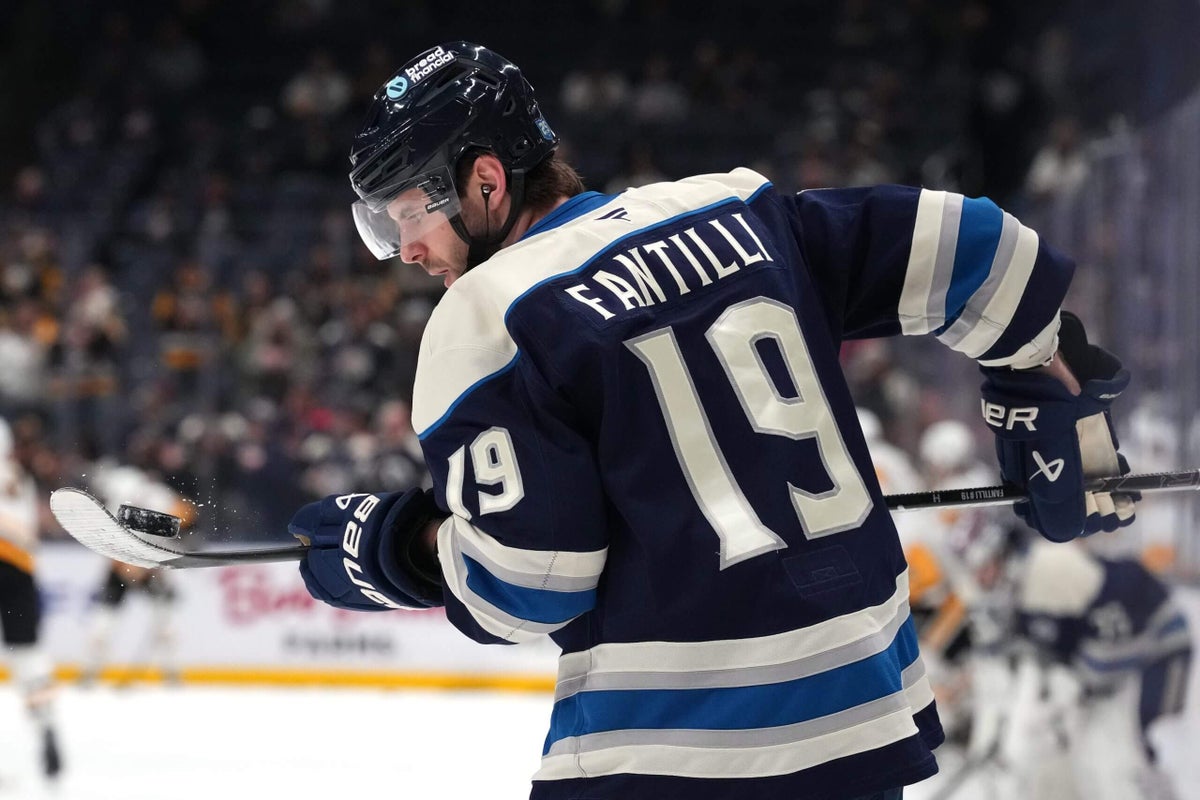
Adam Fantilli, Columbus Blue Jackets
Fantilli completes that group of up-and-coming RFA centers this summer. While he’s shown a lot of progress over the last couple of seasons and stepped up as the Blue Jackets’ No. 1 center when they needed it, he still has to find that next gear. Becoming the next Monahan, Mika Zibanejad or Mark Scheifele is a little different from developing into Columbus’ next franchise forward. That growth is one of this team’s most pressing questions heading into next year. And that obviously factors, on an individual level, into his next contract.

The team could push for a shorter-term contract; a bridge deal could come in around two years, at $6.38 million-ish per season. Fantilli could bid for that too, in an effort to prove himself and maximize future earnings.
But there’s reason to push for a longer-term deal now, even though Fantilli hasn’t popped off yet. There are no franchise players signed long-term in Columbus. Kirill Marchenko only has a year left on his deal, while Zach Werenski is signed for another two seasons. Jet Greaves is also an RFA this summer.
It makes sense to start building that foundation around a 21-year-old center — before Carlsson and Bedard sign their next contracts. That could be management’s best chance to use that Cooley contract as a comp, which is a bit below Fantilli’s current projected market value of $11.2 million over the next eight years.
Cutter Gauthier, Anaheim Ducks
Cutter Gauthier kicks off the class of RFA wingers this summer. Over the last two years, he has shown what a dangerous goal scorer he can be. He shoots the puck a ton and has a lot of finish. It took him just two NHL seasons to hit the 40-goal mark. While he isn’t quite star-caliber on a contender level just yet, the promise to develop into that is there.
Jordan Eberle is a promising comp who showed a lot of similarities to Gauthier at this age. But there’s also the possibility of him jumping up a tier to the Kyle Connors or William Nylanders of the world. The risk is that he fizzles out and only reaches James Neal or Boone Jenner levels at his peak, or becomes more of an empty-calorie scorer like Jeff Skinner.
The Ducks are likely to bet on the former, with a long-term extension this year. The team has about $43.5 million in cap to work with this summer, and a little more than $20 million of it could be dedicated to Gauthier and Carlsson. As a winger, Gauthier likely comes in behind the team’s No. 1 center. He could push for upwards of $10 million and would likely be worth it. But if he comes in below that, around the $9 million range, his contract would be pretty equivalent to what Troy Terry’s was worth in 2023-24.
Zach Benson, Buffalo Sabres
Zach Benson’s game blends elements of a prototypical third-liner with a true top-six talent. He is a total puck hound who pressures opponents and forechecks hard; he’s disruptive defensively, and he can also transition the puck up the ice with control to set up his teammates with dangerous passes. He stirs the pot to draw penalties and frustrate opponents, and he can also unlock a team’s power play.
All of that was clear in Buffalo over the last couple of seasons. But it gained even more traction on the national stage when he elevated his game in a playoff environment.
There are obvious similarities to Brad Marchand here, with rat king energy and two-way skill, but his shutdown play could put him on the Seth Jarvis track, too. Signing the 21-year-old to a long-term deal that extends through his prime should be a top priority for the Sabres.
Benson already projects to be worth a $10 million AAV over the next seven seasons. But unlike some of those franchise centers, that should be thought of as the ultimate ceiling for his next deal. The fact Josh Doan signed a seven-year extension carrying a $6.95 million cap hit only adds to that. AFP Analytics points to a deal in that same range for Benson. Maybe the fact he has developed into such a difference-maker at an earlier point in his career, and now has proof of concept with his playoff performance, could help juice that number just a bit higher.
Simon Edvinsson, Detroit Red Wings
A knee injury slowed Simon Edvinsson down in the second half of the season, but this was still a breakout year for the defenseman. While he has the benefit of playing alongside one of the top two-way defensemen in the game in Moritz Seider, Edvinsson complemented his game to form one of the best shutdown pairs in the league. That should be worth a long-term deal in Detroit, especially considering the team’s current situation.
The Dylan Larkin of it all obviously throws a wrench in the Red Wings’ offseason plans and overall timeline. If anything, it should force management to lock in the core players who will lead this next window of contention. Edvinsson has played his way into that.
There’s still room for improvement — maybe his offensive game could take a few steps to push him closer to the Josh Morrissey path. He already is showing similar traits to shutdown defensemen like Ryan McDonagh, Hampus Lindholm and K’Andre Miller, who is coming off a breakthrough Stanley Cup-winning performance.
Those comps add more substance to Edvinsson’s outlook, which currently projects to be an average value of $9.7 million over the next seven seasons. It’s obviously high for someone who is still pretty green, but the rising tide lifts all boats and defensemen have been earning more and more on the open market.

The real comparable is how this stacks up to Seider’s contract, which could be somewhat of an internal bar. While it would technically be worth a lower percentage of the cap in Year 1, it’s still hard to see Edvinsson jumping out with the highest AAV in Detroit. A number below the $9 million mark could be more plausible.
Data via Evolving-Hockey, HockeyViz, HockeyStatCards, All Three Zones, Dom Luszczyszyn, Natural Stat Trick, CapWages, PuckPedia and AFP Analytics. This story relies on shot-based metrics; here is a primer on these numbers.
