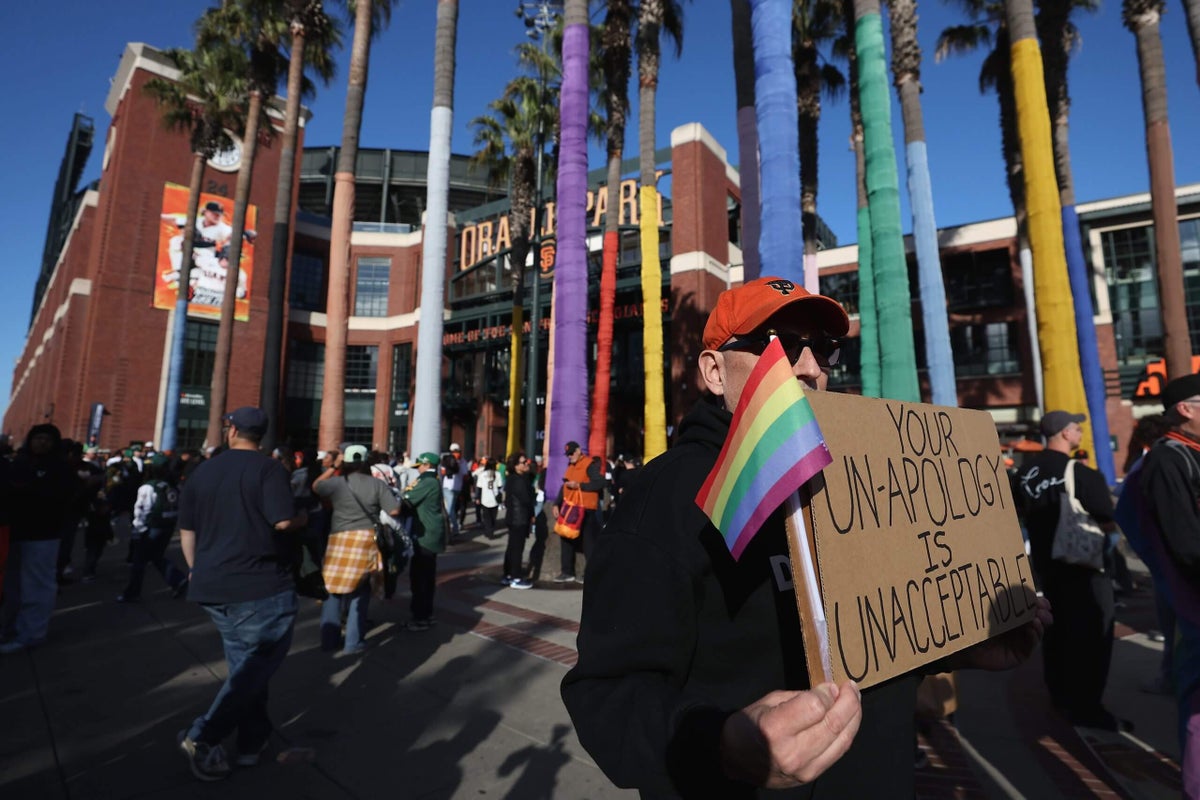
When he was Major League Baseball’s commissioner, Bud Selig publicly touted the league’s role in advocating for social change. Selig oversaw the retirement of Jackie Robinson’s number, the expansion of the league’s outreach to urban youth, and the establishment of LGBTQ+-supportive events.
After retiring, Selig was asked whether MLB remained a pioneer in social change. “I would hope,” he replied in 2019, “because I believe baseball’s a social institution. I’ve said that, you’ve heard it a million times. It is a social institution. And therefore it should take a leadership role in items like this, no question.”
Selig’s sentiment stands in stark contrast to the stance spelled out this week by his successor, Rob Manfred, amid a maelstrom of controversy after the league warned several San Francisco Giants players for writing Bible verses on their Pride-themed caps: “(T)he league does not desire for its players to become messengers for political or social issues while in uniform playing baseball games,” Manfred wrote in a letter, “because many messages have the potential to offend some segment of our fanbase — even if that was not the intent of the player.”
The letter, which largely reiterated and defended MLB’s policies on altering uniforms, was sent to Sen. Josh Hawley (R-Mo.), who had accused the league of discriminating against players professing their Christian faith. Pitchers Landen Roupp, Ryan Walker and JT Brubaker scrawled references to Genesis 9 — in which a rainbow represents God’s promise to never again destroy all life in a flood — beside the rainbow-colored Giants logo on their caps. (A fourth pitcher, Sam Hentges, wore a regular Giants cap.) Florida’s attorney general is investigating whether MLB engaged in religious discrimination by selectively enforcing its uniform code. The Department of Justice referred the matter to the Equal Employment Opportunity Commission. The vice president tweeted about it, too.
All of this — a baseball cap fanning the flames of a culture war — underscores the needle that MLB and other pro sports leagues are attempting to thread in the current political climate.
“Every league, they’re just trying to ride it out,” said an executive in a Big Four sports league, who spoke on the condition of anonymity in order to speak freely on the subject. “Then in four or five years, they’ll all pretend that they’ve always been on board (with diversity initiatives).”
As Pride Month comes to a close, the question becomes how MLB will move forward. Riding it out has been a turbulent strategy, if it can be considered one. Not so long ago, MLB went out of its way to highlight its commitment to the LGBTQ+ community. Today, that commitment is less clear, as what was once promoted as a priority for the league has become more politically fraught.
While 29 of 30 MLB clubs still host Pride-themed events, the league in recent years quietly backed away from allowing most teams to use specialty uniforms and caps with rainbow insignias. That didn’t prevent the latest Pride Night controversy.
An MLB spokesperson declined to answer a list of questions, including one asking whether the league still prioritized LGBTQ+-inclusion initiatives.
In 2022, three Tampa Bay Rays players refused to wear rainbow logos on their caps and uniform sleeves. MLB later adopted a new policy that did not permit special uniforms, caps or equipment to be used on clubs’ designated celebration days — such as a Pride Night — to “avoid putting players or others in an uncomfortable position,” Manfred wrote. The Giants and Los Angeles Dodgers, clubs with longstanding ties to the LGBTQ+ community, were the only teams “grandfathered,” as Manfred wrote, under the condition that no one be required to participate.
“MLB believes in the right of our players and fans to express their religious beliefs, and at the same time supports the communities in this country that are fans of our Clubs, including the LGBTQ community,” Manfred wrote in the letter to Hawley. “We believe that a policy permitting our Clubs to celebrate or honor segments of its fanbase, yet (that) does not require players or other on-field personnel to directly participate in the celebration in ways that make them uncomfortable, strikes the right balance.”
An MLB spokesperson declined to comment on whether the league would restrict future use of the uniforms. Neither the Dodgers nor the Giants responded to questions about whether they’d continue using Pride-themed uniforms or caps. The Major League Baseball Players Association also declined to comment on the larger issue.
MLB has 12 leaguewide “celebration days” in which the uniforms or hats are altered and all clubs must participate — including Mother’s Day, Father’s Day, Sept. 11, Jackie Robinson Day and Roberto Clemente Day, among others. Manfred’s letter indicates that will not change: “We are unaware of any significant complaints from fans or players regarding these celebratory days,” he wrote.
In 2014, Selig’s last season as commissioner, he appointed former big-league outfielder Billy Bean as the league’s first ambassador for inclusion. Bean, an openly gay man who would later be promoted to senior vice president of diversity, equity and inclusion, interfaced directly with players — including those who had expressed reservations about acceptance of the LGBTQ+ community.
Bean died in August 2024 after a yearlong battle with acute myeloid leukemia.
“We are forever grateful for the enduring impact that Billy made on the game he loved, and we will never forget him,” Manfred said at the time.
Earlier this month, on Pride Night at Dodger Stadium, the Dodgers unveiled a permanent mural honoring Bean and Glenn Burke, the first two major leaguers to come out publicly after their playing careers were over. MLB has, as recently as last October, recognized Spirit Day, an anti-bullying campaign focused on LGBTQ+ youth and a cause Bean championed.
Bean’s death left a massive void in MLB’s LGBTQ+ inclusion efforts. The league promoted April Brown to senior vice president of social responsibility and diversity. The word diversity has since been removed from her title; in March 2025, amid a flurry of executive orders from President Donald Trump intended to eliminate diversity, equity, and inclusion (DEI) programs, MLB removed references to “diversity” from its careers page.
The league declined an interview request for Brown. It’s unclear if her role includes the same type of direct communication with players Bean had. She does not have an official bio page on MLB’s website, and the league declined comment when asked about the work she does related to LGBTQ+ inclusion initiatives.
The retrenchments have not gone unnoticed. Retired umpire Dale Scott, who came out as gay after 29 years of umpiring MLB games, was critical of the league’s decision to award the 2024 All-Star Game to the Texas Rangers, the only club without a Pride event on the calendar. If LGBTQ+ inclusion was a priority, Scott said in 2024, the Midsummer Classic would have been played elsewhere. “To me, it’s not a priority (for MLB),” Scott said. “But it is something they don’t want to be criticized about.”
MLB has had multiple high-profile incidents in recent years that have strained ties with the LGBTQ+ community. In 2023, star Clayton Kershaw was the most prominent voice disagreeing with Dodgers leadership over the team’s decision to invite the Sisters of Perpetual Indulgence, a group in which drag performers dress as nuns, to Pride Night. Kershaw told the Los Angeles Times his issue was not with the LGBTQ+ community or Pride but with this specific group “making fun of a religion.”
A week later, then-Toronto Blue Jays reliever Anthony Bass shared an anti-LGBTQ+ post on Instagram. Though he later apologized, the Jays designated the veteran reliever for assignment prior to their Pride Weekend.
In August 2024, Boston Red Sox outfielder Jarred Duran yelled a homophobic slur at a fan. Duran apologized after the game. The Red Sox issued Duran an unpaid two-game suspension and donated his game checks to an LGBTQ+ advocacy group.
The attention drawn by those incidents was comparatively short-lived compared to the players’ Pride Night protest in San Francisco.
In the letter to Hawley, Manfred blamed the Giants’ “inadequate” communication. Giants president of baseball operations Buster Posey refused to answer questions about the topic. It’s unclear whether the Giants players were aware they could choose the regular home cap on Pride Night, as Hentges did, or whether they chose the rainbow cap to protest it. Walker, Brubaker and Hentges later told reporters, including those from the San Francisco Chronicle and California Post, they didn’t feel forced to wear the Pride-themed hat.
“At the end of the day, I don’t think it’s discrimination,” Brubaker said. “It’s just people getting a hold of something and turning it into something. I just wanted to put my message and my beliefs (out there), and that was the end of it.”
“I don’t have any hatred toward anyone,” Walker said. “I have gay friends.”
As the issue crossed into the political realm, MLB stressed that the decision to issue a verbal warning to the players had nothing to do with the content of their message.
The Department of Justice’s referral means the Equal Employment Opportunity Commission, a federal agency tasked with enforcing laws prohibiting workplace discrimination, will review team and league policies to determine whether MLB “properly balanced workplace policies with employees’ religious accommodation rights” under Title VII of the Civil Rights Act of 1964, according to Thomas Ricotta, partner at New York-based employment law firm Ricotta & Marks.
“An investigation doesn’t mean a violation occurred,” Ricotta wrote in a message, “however, employers should take it seriously because these findings can lead to litigation as well as policy changes.”
Kurt Weaver, executive director of the LGBTQ+ advocacy group You Can Play, had a full slate scheduled on Monday. He watched the Argentina-Austria World Cup group stage match at Toronto Pride House, a space for LGBTQ+ fans to watch together. Next, he had a meeting with NHLPA leadership before rounding out the day at Rogers Centre for the Toronto Blue Jays’ game against the Houston Astros.
You Can Play was founded in 2011, created in part to honor the legacy of Brendan Burke. Burke, the son of NHL exec Brian Burke — who was elected to the league’s Hall of Fame this week — came out a year before dying in a car accident in 2010. The group has partnered with the NHL and NHLPA for more than a decade, giving it a front-row seat to the league’s shifting approach to Pride festivities and jerseys. In 2023, the NHL banned all specialty warmup jerseys and prohibited players from displaying “cause messaging” on their equipment after multiple players and teams opted not to wear Pride jerseys. Later, the league reversed course on its ban of rainbow-colored stick tape.
In a way, Weaver said, the NHL pulling back from Pride jerseys was a welcome wake-up call, as it both galvanized the LGBTQ+ community and forced clubs to reconsider how they show their support. “It made all the teams wake up and say: Oh, wait. If we didn’t have Pride jerseys, what should we be doing to show we’re engaged in this? Let’s do some other work.” Weaver now brings that exercise into presentations with teams and leagues: If you couldn’t use rainbow colors, how would you signal inclusion? If you couldn’t use the colors of a country’s flag, how would you market a heritage night? If you couldn’t use the color purple, how would you still show your support for the Hockey Fights Cancer cause?
His point is this: a Pride Night matters, but so does every night at the arena or ballpark.
When meeting with team owners and league administrators, Weaver focuses on the business case of inclusion. Forgot the rainbows, he says, this is a customer-acquisition play. Execs talk about how the hit show “Heated Rivalry” has boosted the NHL’s brand. They crave engagement from the younger generation. Weaver shows them a customer base they aren’t accessing. Hosting a Pride Night, he said, is using marketing dollars, time and energy “to make sure a community feels welcome in stadiums.”
For a Pride Night event to be mostly remembered for a few players’ protest is disappointing, Weaver said. For it to occur in San Francisco and feature the Giants — a city with a vibrant LGBTQ+ community and the club that hosted the first HIV/AIDS awareness game more than three decades ago — is “pretty astonishing.”
“When you have an issue where someone doesn’t wear something, or they write on the thing they’re being asked to wear, it’s a good reminder that there’s a reason this work is being done,” Weaver said. “There’s a reason someone still doesn’t feel comfortable sitting there in that stadium. That means they aren’t a ticket buyer. They don’t buy a jersey. They don’t buy food and bev. They don’t support the team by watching on TV. That’s disappointing. It’s a question of: Which fans don’t you want?”
Weaver once said his five-year goal for You Can Play was that the organization was “no longer needed and no longer here.” That was three years ago. That goal feels far from reach. Still, Weaver chooses to see the landscape through a lens of slow, steady progress. “If, when we started 15 years ago, one player wore a Pride jersey or some stick tape, it would have been the story of the decade,” he said.
Around MLB this month, most Pride Nights have gone off without a hitch. Yet the discourse has been dominated by three players’ ballcaps, an independent ball team’s forfeit and the seemingly inevitable politicization of the moment.
The York Revolution of the Atlantic League canceled a game last week after numerous players refused to wear Pride-themed uniforms. Revolution president and general manager Ben Shipley told NBC News that fewer than nine players were willing to wear the uniform. One who was, ex-Baltimore Orioles farmhand Jacob Teter, attended the team’s Pride Night activities to show support.
Teter responded to an interview request from The Athletic with a text message: “Baseball is for everybody.”
