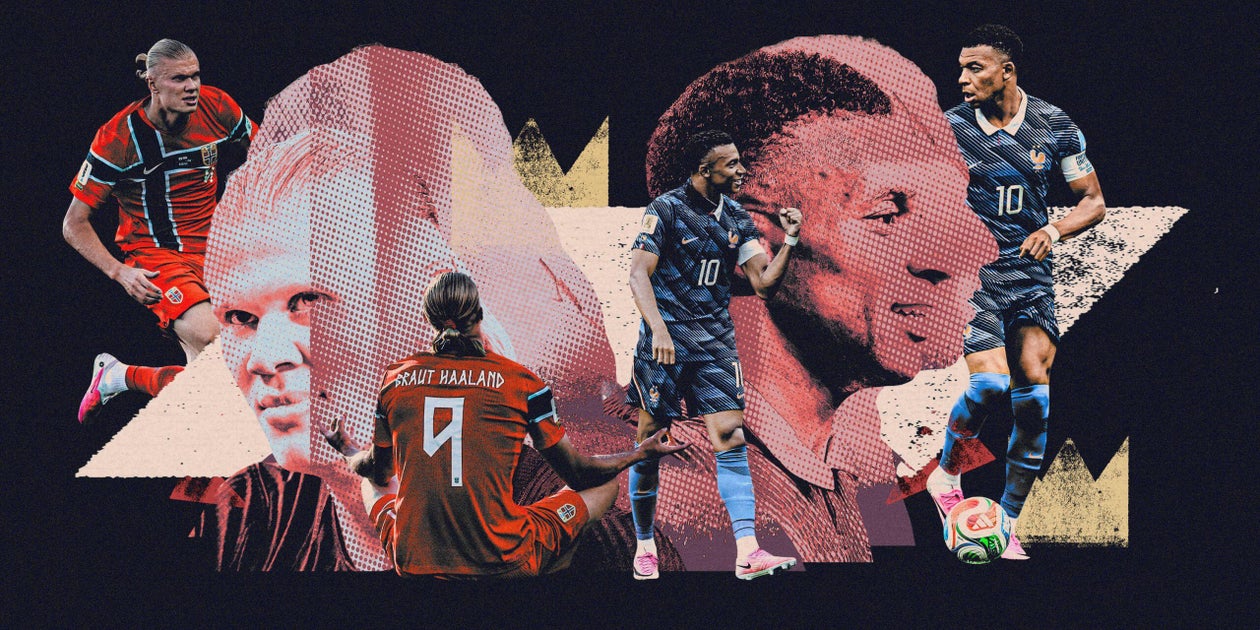
Although you would not put it past the organisers of this World Cup to include a ‘Superstar Showdown’ where the biggest names all play on the same day, Lionel Messi, Kylian Mbappe and Erling Haaland have been smashing in the goals in short succession thanks instead to delightful coincidence.
After just two games each at this tournament, Messi has five goals, while Haaland and Mbappe have four apiece. Since 1978, 10 of the World Cup’s 12 Golden Boot winners reached either five or six goals, which highlights just how well those three have started.
Messi, 39, will have a lot to say about how this summer goes, but on Friday night Haaland and Mbappe, the leading lights of a younger generation, will go go head-to-head as Norway play France in Boston.
“I couldn’t care too much about that game now, they’re (France) probably going to win against us, they’re probably going to win the tournament,” Haaland told Fox Sports on Monday night.
Fair enough… but it promises to be a good match-up and will be another opportunity to see two of the game’s best players and biggest stars.
Both are dynamic, powerful goalscorers; Haaland got 38 for Manchester City last season, Mbappe 42 for Real Madrid. But they are also very different players — and their brilliant performances at this World Cup underline their contrasts and strengths.
What do they do best?
Haaland, 25, is the ultimate penalty-box poacher, whose expert movement means he is regularly in the right place at the right time, scoring the type of goals that look easy — but if they were, everybody would be doing it.
There are often long spells when he is not directly involved with play (and does not look interested in getting involved, either), but his mere presence means the opposition has to adapt to his movements (or the threat of his movements), which can allow team-mates extra space to work in.
Haaland generally finishes carefully crafted team moves, unless he gets the chance to counter-attack quickly, when he can race away and finish one against one.
Mbappe, 27, is much more of a livewire threat all over the pitch, happy to roam around to get on the ball, dribble and shoot from all angles.
He can change games single-handedly from almost anywhere in the opposition half, but is also a clinical finisher inside the box and has the appetite to score plenty of goals, not just aesthetically pleasing ones.

Which is the better player overall is a matter of opinion, but considerations should take into account their presence in the dressing room and qualities as a team-mate.
There is an incredible video of Paris Saint-Germain coach Luis Enrique urging Mbappe, playing for the French club at the time, to add defensive efforts to his vast attacking ability.
“A real leader is someone who, when you can’t help us with goals, helps us with everything defensive,” Luis Enrique yells at him in a documentary released by Spanish broadcasters Movistar in October 2024, by which time Mbappe had left for Real Madrid.
“He leído que te gustaba Michael Jordan”.
“Michael Jordan se ponía a defender como un hijo de p***”.#LuisEnrique 🗣️ Mbappé
📼 Lunes 7, ‘𝑵𝒐 𝒕𝒆𝒏𝒆́𝒊𝒔 𝒏𝒊 **** 𝒊𝒅𝒆𝒂’ Capítulo 2. pic.twitter.com/VSYqtTAIsl
— Movistar Plus Deportes (@MPlusDeportes) October 3, 2024
PSG went on to win the Champions League in consecutive seasons after Mbappe’s departure, with his France team-mate Ousmane Dembele scooping the Ballon d’Or last year after being praised for his pressing ability, meaning that Mbappe has earned himself a reputation as a luxury player, certainly at club level.
It was also claimed on social media recently that, when it came to defensive contributions over last season, Mbappe ranked 6,043rd out of 6,044 active players in the 20 leagues considered the world’s strongest by Opta. Intriguingly, that statistic did not seem to come from Opta, but in this post-truth era it has been taken as fact by many, and has contributed to a negative feeling around the Frenchman.
Even so, he has always been a good fit with his country, playing a key role in their World Cup win in 2018 and scoring eight goals at Qatar 2022, including his hat-trick in their final defeat by Argentina. If it is a question of making certain accommodations for Mbappe, perhaps France have done better than his club sides.
Haaland has sometimes been accused of going missing in the odd game, generally when the Premier League’s relentless and physically demanding schedule grinds the Manchester City man down. Speaking in 2024, Pep Guardiola, Haaland’s coach at the time, urged him to press more, similarly to Luis Enrique with Mbappe.
“This is not negotiable,” the Catalan said. “If you don’t score a goal, it’s fine, but you need to do it.”
In his early days at City, Haaland was sometimes singled out for negative body language by Guardiola, but he was made one of City’s captains by the manager 18 months ago, recognition that his leadership qualities are growing, and he has a reputation as a popular player in the dressing room.
How do they score their goals?
Mbappe already has two long-range strikes to his name at this World Cup, as well as two penalty-box finishes. Haaland has struck all four of his goals from inside the area, but in different ways.
In Norway’s first match against Iraq, Haaland opened his account from the back post, before effectively pressing his second into the goal after rushing to close down the goalkeeper. Against Senegal, he added a one-on-one and a smart improvised finish that served as a perfect example of how he is almost always alert inside the area (explained in more depth a little later in this article).
The graphic below perfectly highlights the areas each player is comfortable working in, where they are taking their shots and scoring their goals.
Mbappe has plenty of shots from the classic striker zones — within the width of the posts and in the ‘second six-yard box’, which extends from the six-yard line to the penalty spot — but he also fires off shots from outside the area, whereas Haaland’s work is generally always done close to the goal and is a major threat with back-post headers.
The graphic also clearly demonstrates that Mbappe is far more involved in his team’s play in different areas of the pitch.

How important is their movement?
It is vital to both players’ success, but in different ways.
In France’s match against Senegal, Mbappe showed off how devastating his movement can be — from a standing start.
Although he often goes looking for the ball, here he waits while Michael Olise and Jules Kounde exchange passes out wide. When Olise gets the ball on his left foot, Mbappe suddenly bursts into life and runs towards the near post. Olise has the quality to find him, and suddenly Mbappe is in for his first goal of the summer.

Mbappe’s latest screamer, against Iraq on Monday, came after he drifted to the right touchline to try to get on the ball. After his pass is cut out, he gets the ball back from Olise in an inside position, and lets fly with his weaker left foot.

For his other goal from outside the box, against Senegal, he initially offered to run in behind the defence twice, before dropping deep to collect the loose ball. Then he turned and shot from 30 yards out.

Haaland, by contrast, opened his account by arriving at the back post. As Norway progressed up the pitch, he did not openly offer to get the ball to feet or make any run in behind — he just headed for the box. While Norway work it wide, Haaland makes a trademark run in the blindspot of his marker, and attacks the ball aggressively when it arrives at the far post.

Haaland’s fourth goal of the tournament, detailed in the images below, is another illustrative example.
When Norway full-back Marcus Holmgren Pedersen gets the ball on the right, Haaland skips in behind Senegal centre-back Kalidou Koulibaly, a trademark move.
The ball is played behind Haaland, which he reacts to, but he collides with team-mate Antonio Nusa. He complains for a second — something Mbappe probably would have been pulled up for — but notices that the ball is still live, so immediately comes back to life and gestures for the pass. He gets it from Patrick Berg, and converts.

The graphic below visualises both strikers’ off-ball movements, and highlights Haaland’s penalty-box focus — he is a target for crosses and a huge threat running in behind opposition defences. Mbappe ranks highly in those two areas, but he is also more involved in the others.

At this World Cup, FIFA has rolled out stats that track how often players offer to receive the ball in various different ways. The definition of this action is as follows: “When a player has actively signalled, changed body shape or made a clear movement to receive the ball from a team-mate.” Data is gathered on when players offer to receive the ball to feet, in behind the opposition defence, between the opponent’s midfield and defensive lines, and a couple of other areas.
By the end of the second round of fixtures, Mbappe ranked 32nd overall at the World Cup when it came to offering to receive the ball to feet, and seventh for offering to receive behind the opposition defence.
Haaland, a little like Messi, often walks or jogs around the pitch, staying in his position, generally not looking to get involved in the play, only to burst into life when the time is right. He ranks 494th for offers to receive to feet, 195th for offers to receive in behind and 557th for offering to receive between lines (Mbappe is 144th on that metric).
But there is probably nobody better at leading, or joining, a breakaway charge on goal than Haaland.
As he demonstrated with his first goal in the 3-2 win over Senegal, the Norwegian is at his devastating best when running amok in end-to-end, open games, something that is generally not possible against defensive, deep-lying teams.
Senegal had taken that approach but in the example below lost the ball in midfield and found themselves with only two defenders back. Haaland initially kept pace with the breaking Martin Odegaard, but sped up to get around the back line. When Odegaard slipped the ball through, Haaland was in a position where he regularly comes out on top.

How do they compare in defensive work?
France and Norway are set up in ways that allow their star strikers to carry out fairly basic pressing duties, a relatively common allowance for gifted attackers.
Haaland has started this World Cup like a train, however, and scored his second goal of the tournament by chasing down the Iraq goalkeeper. In Monday’s game against Senegal, he almost repeated the feat, but hit the post with his shot after charging down on Edouard Mendy and winning the ball from him.


Haaland has stampeded around like a bull at times, showing energy that his manager and team-mates will appreciate. “Imagine a central defender has the ball and he makes a sprint with this body and legs moving,” Guardiola said in 2024. “It’s scary.” Just like this.

He is also a handy presence when defending set pieces, using his height and power to clear away high balls into the box.
Mbappe, put simply, just does not do too much defending. It is not that he never does it — look at the example below where he chases back to win a ball that was intercepted before he received it — but it is well established that others do his running for him. He has not pressed with the same energy that Haaland has at times, but few have, and perhaps there is something about World Cups that brings the best out of Mbappe in all aspects of his game.

At this tournament it has been noticeable that France’s other high-profile, high-quality attackers, such as Dembele and Olise, have adapted to accommodate this reality — similar to, with respect, Argentina and Norway’s more limited players, to get the best out of Messi and Haaland.
That speaks to just how good Mbappe is, with even his brilliant team-mates recognising that he is the go-to man.
Former France striker Olivier Giroud explained on the BBC recently that head coach Didier Deschamps offset Mbappe’s lack of defensive effort by deploying energetic midfielder Blaise Matuidi to cover extra ground during the 2018 World Cup.
What about their link-up play?
During his four years at City, Haaland has generally been asked to not try to get on the ball and focus instead on pinning back the opposition, helping create space for team-mates to exploit in front of the defence. That helps explain his lowly position in those ‘offers to receive’ standings.
He is not the tidiest player, nor does he have the silkiest first touch, but when he does get involved he can be extremely useful, either by holding up the ball with his chest and playing it back to a supporting team-mate, or turning and driving at the defence.
Haaland has created three chances for Norway this summer, including a fine opportunity for Odegaard against Senegal when he cushioned a long ball into his team-mate’s path, only for the effort to be saved.
Mbappe gets involved far more often, either just to keep the ball moving or to generate some danger, for example by offering to take the ball to feet, lay it off and immediately spin in behind.


Who has the bigger ‘star factor’?
Some of the play at this World Cup has provoked an interesting philosophical debate; is it better to pass to a ‘lesser’ team-mate in plenty of space, or to pass to the team’s best individual even if there is a greater level of difficulty involved?
Norway’s opening goal against Senegal, for example, came after Odegaard tried to play a through ball with the outside of his foot around Koulibaly, rather than a seemingly simpler pass to Pedersen who was in space on the right. Pedersen ended up scoring, but only after Koulibaly cut out the intended pass to Haaland and then made a mistake and presented him with the ball.

For Haaland’s first goal against Senegal, Odegaard again attempted the tougher pass, a through ball around Koulibaly, rather than going right to Alexander Sorloth, but managed to perfectly execute the pass. Once he did that, Haaland was one-on-one with the goalkeeper, and by far the most likely player on the pitch to make the most of it.
Earlier on Monday, it seemed that Argentina’s players were trying to play in Messi even more than usual in their match against Austria, perhaps because of his quest to become the all-time leading scorer at the World Cup, and his missed penalty in the ninth minute.
Of course, there is a huge value in giving the ball to Messi at all times, but Argentina did seem to be playing to him almost constantly. That was also the case with Portugal on Tuesday, as Cristiano Ronaldo sought to complete a hat-trick against Uzbekistan.
For Mbappe’s second goal against Iraq, when a mistake at the back presented the ball to Dembele in the box, he squared for Mbappe to have a simple finish, despite Dembele himself having a great opportunity to score (which would have been his first goal at five major tournaments for his country).

As Haaland himself said this week, France are favourites to win their meeting with Norway on Friday and to win the World Cup itself. Norway are simply not part of that bigger conversation.
But it speaks to Haaland’s ability to make the difference that he has scored four goals already, helping send his side through to the knockout phase after two games, for a team that has not been at the World Cup since 1998.
France boast a wealth of talent across the pitch, but particularly up front, and while there have been questions around whether Mbappe’s clubs can truly reach the top level with him in the side, that has never been a problem for the national team, and shows no signs of becoming an issue now.
Both have lit up the World Cup in very different ways, and Friday promises to be the latest exhibition of their talents.
