Two outs in the ninth and nobody on? That’s when the Phillies have ‘em right where they want ‘em. … A team got seven straight hits – and didn’t score a run on any of them? … And a long-lost baseball game from the Herbert Hoover administration is about to roar back from the dead twice in this column?
Yessir. It’s all very weird, very wild and very true. So here come the 10 Weirdest, Wildest Games of June, starting with …
The kings of one strike away
Phillies 5, Nationals 4 — There were two outs in the ninth inning Wednesday when my wife decided it was time to start watching Phillies versus Nationals.
Kyle Schwarber was lumbering toward home plate. The Nats held a 4-3 lead. There was nobody on base. The Phillies’ win probability, according to Statcast, stood at 3.7 percent. So why would my wife have decided this was the perfect time to enter the room?
“I want to watch them do this again,” she said, meaning she somehow believed the Phillies were about to pull off their second straight comeback miracle.
I’ll confess I made a little fun of her. No need to quote that fun. (Survival skill.) But it’s true that the night before, the Phillies had also trailed with two outs and nobody on in the ninth … then, improbably, scored eight runs. So there was no chance they could “do this again.” Right?
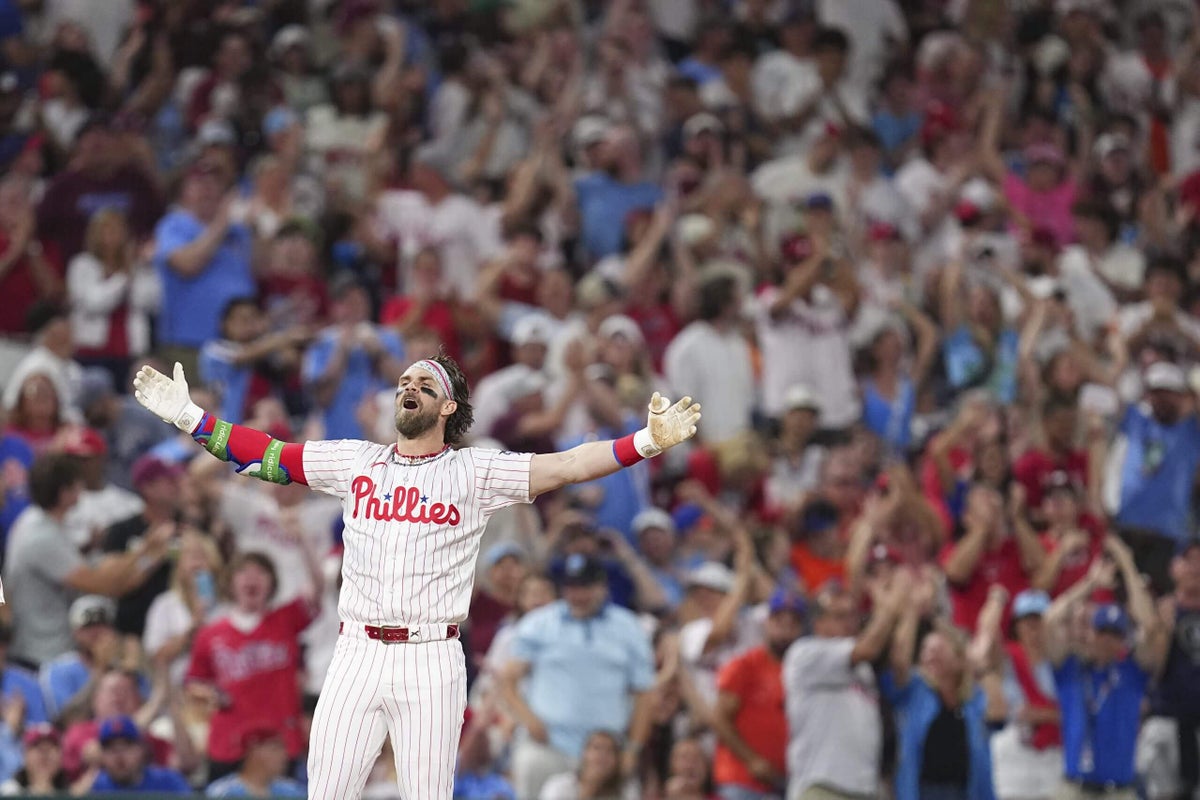
Wrong. One 10-pitch Schwarber walk and one game-upending Derek Hill pinch homer later, this impossible thing had just turned possible. Again.
Down to their final strike!
The @Phillies take the lead in the 9th on a Derek Hill pinch-hit homer 😮 pic.twitter.com/91MKEez0pZ
— MLB (@MLB) June 25, 2026
My phone started buzzing. Had that ever happened two games in a row — to any team? Weird and Wild America needed to know. We now can help answer that vital question:
Of course not.
You’re welcome, America.
Two outs, nobody on in the ninth? Let’s start here. Has any team ever won two games in a row even kinda that way — trailing in the ninth, with two outs and the bases emptier than Nats Park after a 92-minute rain delay? My friends from STATS Perform researched that one deep into the night Wednesday/Thursday.
They did find two other teams since 1900: Andy Van Slyke’s 1993 Pirates (May 8-9, both against the Expos’ John Wetteland) and Junior Griffey’s 2009 Mariners (Sept. 17-18, with the second win on an Ichiro Suzuki walk-off homer versus Mariano Rivera). But were those comebacks really the same as this? Keep reading. You’ll find out.
Two outs, nobody on in the ninth — on the road? First, I blew up my own evening checking every Phillies ninth-inning comeback since 1910. Hey, it beat playing Wordle! So I established that they had never done this.
Then, once I had STATS’ research handy, this got easier. Those ’93 Pirates and ’09 Mariners had worked their late-inning magic at home. So — whoahhh — that meant the Phillies were …
The first team in the modern era (1900 on) to be down to their last out in the ninth, with no runners on base, two games in a row — ON THE ROAD — and win both games.
That. Is. Wild. (And also weird.) Oh, and one more thing. They’re also the first team ever to win both those games, home or road, without needing any extra innings. But hang with us. We’re still not done.
Two outs, nobody on, in the ninth — WITH TWO STRIKES? That might seem, to you, like a simple question: How many teams have ever been one strike away from defeat, with no one on base in the ninth, two games in a row, and found a way to win both games?
Oh, man. You have no idea.
Pitch-counting data only goes back to 1988. So you don’t even want to imagine the only way to research stuff that happened before that — because it means searching game by game, some of that by hand (and microfilm), for hours and hours and more hours.
That’s how STATS’ Sam Hovland decided to spend his night — between just before midnight, when I first reached out to him, and 8 o’clock the next morning. Why? Because this was the ultimate buried treasure, so how could he not Indiana Jones for it! But thanks to his all-night digging, here it comes …
How many teams since 1900 have ever done what those Phillies just did? One strike away from defeat in the ninth, no runners on any bases, twice in two games, and then won both of those games?
Exactly one team has done that. Derek Hill’s 2026 Phillies. Should I tell my wife?
Wait! Then came Thursday night — And did the Phillies have another one of these mad comebacks in them? Somehow or other, this has become a team that thinks an evening at the park isn’t complete without a mad comeback. So yeah, those wacky Phillies did this again.
They were down, 5-0, in the sixth. They’d wiped out that lead by the seventh. So this time, they were only tied (5-5) in the ninth. But Bryce Harper’s go-ahead home-run serenade to his favorite Washingtonians kicked off another five-run what just happened rally — which led to: Phillies 10, Nats 5. Here come two more ridiculous Weird/Wild tidbits:
The Weird and Wild part 1.0 — Three straight games in Washington, the Phillies went into the ninth, trailing or tied. They then scored 15 runs, just in those three ninth innings, and won all three games. Want to guess how many teams in the last century have ever done that — by putting up that many runs over three consecutive ninth innings? That would be (yep) none, according to Sportradar.
The Weird and Wild part 2.0 — The Dodgers have hit two go-ahead ninth-inning home runs all season. The Brewers have hit one. The Phillies just hit three in three days.You don’t see that much — by which I mean you don’t see that ever.
MLB’s Sarah Langs reports that these Phillies just became the first team in the history of this sport to hit a go-ahead home run in the ninth inning of three games in a row. (Hat tip: Elias Sports Bureau.) With half a season to go, it’s mathematically possible they could run that streak to 84 games in a row — but let’s all take the under.
Got all that? Excellent. We now resume our regularly scheduled Weird and Wild programming … by revisiting the first game in this streak.
Watch out for that 8-ball
Phillies 14, Nationals 9 — More Phillies madness. This was Tuesday. It’ll sound familiar. Two outs in the ninth. Nobody on base. Two runs down. One strike from losing. Um, how the heck did the Phillies then score eight runs and win this game?
I spent more time trying to find all the zany stuff that happened in that ninth inning than the Phillies spent scoring all those runs. But here’s what I uncovered:
Two outs and nobody on — and they scored eight times? I went so far down the Baseball Reference rabbit hole to try to answer that question that next thing I knew, an hour of my life had roared by. But sometimes, when you write a column like this, you just have to know. This was one of those times. So …
I looked at every game back to 1910 in which any team scored at least eight runs in the ninth. And this can’t be true, but it is: There wasn’t one other game, in all those years, where any other team scored that many times in the ninth after the first two hitters of the inning made an out. I swear that is a real thing.
Maybe that’s why, when Phillies home-run hero Bryson Stott was asked afterward, “Have you ever been part of a game like that?”, he replied: “I don’t think so. Has that ever happened?” I can answer that now. No!
The ghost of Mitch Williams! It had been 38 years since any team found itself trailing with two outs in the ninth (even with baserunners aboard) and then scored eight times (or more) to win that game. That’s eliminating the two-outs, nobody-on part, just to be clear. So how about this:
The last team to do it was Kevin Seitzer’s 1988 Royals, on Aug. 23, in Texas. Pay attention now because we’re about to connect all sorts of Phillies October ghosts.
Who was pitching for Texas to start that inning? Mitch Williams. If that doesn’t register, just Google “Joe Carter, 1993 World Series.”
And who led off that inning for the Royals with a hit? Who else but George Brett. Philadelphians will understand why I mentioned that. But for those who don’t, just Google “Phillies” and “1980 World Series” and “Dickie Noles knockdown pitch.”
Now let’s bring that Mitch Williams angle home. Aside from serving up Joe Carter’s homer, what was the Wild Thing’s most nightmarish feat in the 1993 World Series? That would be blowing the fabled “15-14 game” (Game 4). We bring that up because Williams entered that Game 4 with a lead of … 14-9.
And what was the score of the Phillies’ game in D.C. on Wednesday? Yessir, 14-9!
Now one last thing: Want to guess how many games the Phillies had played since that 1993 World Series in which they held a 14-9 lead at any point? Right you are. Not a one — until the box-score dust had settled Tuesday in Washington. Unreal.
And also … There were a few other odds and ends. Brandon Marsh and Stott became just the second Phillies teammates in the last 100 years to hit game-tying and go-ahead homers in the ninth inning, both with runners on base. The other: Maikel Franco and Jean Segura, on June 27, 2019 – off Edwin Diaz! You were expecting maybe Ryan Howard and Chase Utley?
Phillies starter Jesus Luzardo fired a never-before Box Score-a-gami: 6.2 IP, 6 H, 5 R, 5 ER, 3 BB, 13 K, on just 104 pitches. It was also just the second time in the pitch-counting era (since 1988) that any pitcher needed that few pitches to cram 13 strikeouts, but also five runs allowed, into a start.
Finally, there was Trea Turner. He got two hits in the ninth inning — but that’s not even the weird and wild part. That part was, he got both hits with two outs in the ninth.
The amazing Kenny Jackelen, of Baseball Reference, could only find one other player who got two hits in the ninth inning of any game since 1910. And it happened as recently as 105 years ago, when Pirates leadoff man Carson Bigbee did it in a nine-run ninth on April 19, 1921.
A trifecta — and almost a bi-cycle
Phillies 15, Mets 3 — Did the Phillies hold a secret team meeting last week and decide their goal was to fill up an entire Weird and Wild column singlehandedly? I’ll go with no — but this makes four times since this 15-3 game last Saturday where somebody told me the latest Phillies madness was like my “dream game,” or something like that.
So what was so weird and wild about Phillies 15, Mets 3? Ha-ha-ha-ha. Thanks for putting this on a tee for me.
Who was the Doris Kearns Goodwin historic player of the game? On one hand, Bryce Harper hit for the cycle in this game. On the other hand, I don’t think he even had the most historically rare game of the night. Because Kyle Schwarber hit three homers — and two of them were 450-footers … in the same inning.
By now, I’m sure you’ve heard about how the only other teammates in history to pair up for a cycle and three (or more) homers in the same game were Lou Gehrig (four bombs) and Tony Lazzeri (cycle), on June 3, 1932. But hold on …
Unlike Schwarber and Harper, those two did not do that while hitting back-to-back in the same lineup. Also, Gehrig forgot to hit two home runs in any inning. So does their game beat this game? Sorry!
It’s Always Sunny in Philadelphia — OK, how about this. That game in 1932 was also played in … Philadelphia. So we had that historical parallel.
But in other news, Schwarber was only the second left-handed hitter in Phillies history to hit two bombs in an inning. The other one did it in — what else? — another Phillies-Mets game, in Philadelphia. That was the legendary Von Hayes Game, when he went deep twice in the first inning of a nutty 26-7 blowout in 1985.
A bicycle built for two — But was Harper done cycling? He almost wasn’t! On Sunday — Phillies 6, Mets 2 — he went single-double-homer, meaning he was a triple away from becoming the first player ever to hit two cycles in a row.
Close enough! STATS dug through the Baseball Reference/Retrosheet box-score annals back to 1898. They found just two other players in almost 130 seasons who had a cycle one game, then made it within a triple of another cycle the next game.
One was Cardinals’ Gashouse Gang legend Pepper Martin, on May 5-7, 1933. But the other? That was a guy on Harper’s own team (then and now) … who else but Trea Turner, in April of 2017. Man, how wild (and weird) is …
Baseball! (In Philadelphia!)
The Rockies’ Figure 8
Rockies 3, Red Sox 2 — Was “8” the magic number of the week? Might want to play 8-8-8 in the lottery, because speaking of “eights” …
Monday night in Colorado, the Rockies found themselves with no runs and just four hits on the board, with one out in the eighth inning. Then this weird and wild thing happened, courtesy of their next eight hitters:
Single
Single
Single
Single
Single
Single
Bunt single
Three-run walkoff triple
JAKE MCCARTHY CLEARS THE BASES AND THE ROCKIES WALK IT OFF!
Aroldis Chapman had allowed just 2 ER all season entering tonight 😳 pic.twitter.com/YZVHsiKK3v
— Just Baseball (@JustBB_Media) June 23, 2026
So … they finished this game with eight straight hits? They did! And how wild (and weird) is that? Fasten your seat belt.
A hit by every one of their last eight hitters? Yep, that … happened. Want to guess how many teams have ended any game like that in the expansion era (1961-present)? That would be exactly one, according to the Elias Sports Bureau: Uh-huh. Just Cole Carigg’s 2026 Rockies.
Eight straight hits, finishing with a walk-off? That … also … happened. The Rockies asked Sportradar to look into how bizarre that was. You can probably guess how bizarre. Since 1920, the complete list of all teams to end a game with that script consists of … (here they come again) only Jake McCarthy’s 2026 Rockies … in that game.
And not just any walk-off, but a walk-off three-run triple? The Rockies are in their 34th season. That’s a lot of baseball. Not only had they not hit another walk-off like McCarthy’s clear-the-bases triple in this game, but … only one other team in the sport had done it in those 34 seasons.
According to Langs, that was Grady Sizemore’s 2006 Indians. The guy who scored from first with the winning run on Sizemore’s three-run triple on Aug. 11: famous ex-Indian Aaron Boone.
But none of that is even the weird and wild part? Nope! The weird and wild part is that while the Rockies may have gotten eight straight hits, they somehow didn’t score a run on any of the first seven hits!
How even? Glad you asked. They got four of those hits in a row in the eighth inning — but avoided scoring by having runners thrown out at the plate and at third. Then they played one-base-at-a-time baseball in the ninth … until that triple.
So how many other teams have ever gotten seven straight hits without scoring a run at any point in any game? That would be … none.
The Baseball Reference play-by-play database is mostly complete back to 1910. And Jackelen reports that no other team had ever even gotten six straight hits without at least one of them scoring a run … because of course not!
Suspended Animation Dept.
Giants 7, Braves 2 — I wait all year for the kind of time-traveling fun that only a good old suspended game can give us. What’s wrong with me? (AUTHOR’S NOTE: Please don’t answer that 100 percent rhetorical question.)
So finally, on Tuesday, June 16 — or was it actually Wednesday, June 17? — our wait was over. All it took was 9.8 billion raindrops descending on Atlanta, in the second inning of a Giants-Braves game. Whereupon that game had to be suspended and finished Wednesday. Which meant that, thanks to the magic of the time-shifting suspended-game rules, all this busted out:
• The box score will always tell us that Giants pitcher Robbie Ray threw a wild pitch on Tuesday — even though Ray’s shoulder would testify under oath that it never threw any pitches that day.
• Did Rafael Devers and Jung Hoo Lee fire off back-to-back homers Tuesday evening? For the rest of their lives, the historians will swear they did — even though I could have sworn both of those balls didn’t come down until Wednesday afternoon.
• And if you were lounging around Truist Park for about eight hours, you would be pretty certain that Wednesday was only the second day all season that Giants shortstop Willy Adames lofted two home runs on the same day. Just don’t check his game logs — because they’ll try to convince you that one of those long balls left the bat on Tuesday. That’s some serious hang time.
Suspended games! Does that rule exist just so we can crim tidbits like these into the Weird and Wild column? What reason would we have to believe otherwise?
First things last
Rockies 2, Pirates 1 — Baseball. It’s the greatest. It can also be the weirdest (and wildest). This column is living proof. But so was this goofy game last Saturday at Coors Field. Let’s review how this game started and ended. It won’t take long.
Leading off, the top of the first … it’s Spencer Horwitz, aiming a home-run ball at the nearest mountain peak.
Leading off the bottom of the first … it’s another leadoff home run, from Jake McCarthy, off Paul Skenes. But this one looks different from that one, because it sailed over zero fences.
The grand finale, with two outs in the ninth … For the first time since the first batter of the night, a Pirate crossed home plate on this, the final play of this game. But did he score a run? Ehhh, don’t get carried away. The runner on second got called for interference. Ball game.
So what’s so Weird and Wild about all that? Seriously, so much weirdness. How many other games in the modern era have begun with a not-quite-matching set of inside-the-park and outside-the-park leadoff homers? That would be one, according to Jackelen. Amazingly, it happened as recently as 2024, when Shohei Ohtani (outside) and Corbin Carroll (inside) did it.
But how many games have ever begun with two leadoff homers and ended on an interfere-off? Ha. There has been exactly one — and it happened last weekend, at Coors Field.
Touchdowns on the first two possessions
Astros 10, Royals 8 — Nothing too weird or wild about this June 12 classic … other than the part where …
The Astros scored nine runs in the top of the first … and then their starting pitcher, Tatsuya (No-Hit) Imai, didn’t even make it through the bottom of the first … because the Royals scored five times in the first themselves.
Only two games in the expansion era (since 1961) have featured more first-inning runs than the 14 these teams scored. But that isn’t even the weird and wild part.
Weird and Wild part 1.0 — Pitches thrown just in the first inning of this game: 98. Pitches thrown that same night by Jacob Misiorowski in a 15-strikeout complete game: 95.
Weird and Wild part 2.0 — So how nutty did these two offenses go after that 14-run first inning? Neither of them scored again until the eighth inning. Perhaps you’re wondering (because I was): How many games in modern history have featured that many runs in the first inning but then no runs until the eighth? If you guessed zero, that’s as stupendous a guess as ever.
Straight A’s
A’s 12, Angels 11 — Did this game — last Friday in West Sacramento — have weirdness and wildness spray-painted all over it? You know that answer. The A’s led, 4-0, after three, then gave up the next 11 runs … and they didn’t even lose.
Ready for the weird and wild part? All those pesky Athletics had to do to win this game was score in the sixth inning … and seventh … and eighth … and ninth … and 10th. So how weird (and wild) is that?
According to STATS, the last time any team trailed in a game by seven or more, then scored in the sixth, seventh, eighth, ninth and 10th to win, it happened as recently as 50 years ago. That was a Big Red Machine special at Wrigley Field, on Aug. 11, 1976. The winning run was driven in by noted Big Red Machinist Tony Perez.
Slam dunked
Rangers 9, Padres 7 — I feel very confident that whatever Rangers ace Jacob deGrom was muttering in the first inning of this June 19 game in Texas, it was not: “Vive la France.” That’s because, before that first inning was even over, this happened.
Yes, that’s a Ty France Slam Diego special in the top of the first … and a five-spot against deGrom … but would you believe …
That wasn’t even the weird and wild part? No, that part was, deGrom coughed up that first-inning grand slam and still came out of this as the winning pitcher. Did you know that the Cy Young Award has been around for seven decades now — and only one other former Cy Young has ever given up a slam in the top of the first and still gotten a win out of it?
That was Barry Zito, for the A’s, on Aug. 11, 2006. The first four hitters that day went HBP-single-walk-slam. After which Zito faced 28 more Blue Jays – and gave up zero runs. WP – Zito, followed by WP – deGrom. Baseball is amazing.
Want a pickle with that cycle?
Cubs 5, Rockies 4 — So many wild Cubs games. We’ll get to them all sometime. But couldn’t skip this one.
The awesome news for Cubs whirlwind Pete Crow-Armstrong in this June 15 game was, he became the first Cub to hit for the cycle at Wrigley since Mark Grace in 1993.
The not so awesome news was that after PCA had finished off his cool Reverse Cycle (homer-triple-double-single, in that order) with the single, this happened.
Pete Crow-Armstrong singled to complete his cycle and then got picked off on the next pitch. 😐 pic.twitter.com/TVVvt1RMNN
— Codify (@CodifyBaseball) June 16, 2026
Oops. So maybe you think the weirdest, wildest thing he has done this month is get called out trying to steal second on a walk.
Pete Crow-Armstrong is ruled out at second base after initially contacting second base and losing possession of the base.
Crow-Armstrong had initially advanced to second base on a walk.
Cubs manager Craig Counsell has been ejected. pic.twitter.com/YlPGeYbmjb
— SNY (@SNYtv) June 24, 2026
I don’t think so!
Why is this the weird and wild part? In the history of cycles, only two other men have ever been picked off in the mid-cycle, according to Jackelen. One was Kelly Johnson, of the 2010 Diamondbacks. But the other one? Wow. This is a weird and wild classic.
It happened on June 3, 1932. And amazingly, it’s not the first time that game, from 94 years ago, has shown up in this column! The Yankees’ Tony Lazzeri got picked off that day, but still made it to second on a throwing error. And honestly, we don’t care much about any of that.
What we care about is that this game was the only time in baseball history that any player hit for the cycle and had a teammate (some guy named Gehrig) hit three home runs (or more). Or at least it was the only game until last Saturday, when the Schwarber/Harper game joined it.
I don’t know what the odds were of a random game from 1932 being brought back from the dead here in 2026. But we always believed in baseball-game reincarnation. We just never expected that game to be reincarnated twice in one column. How could that possibly happen? Oh, that’s right. It’s …
Baseball!
