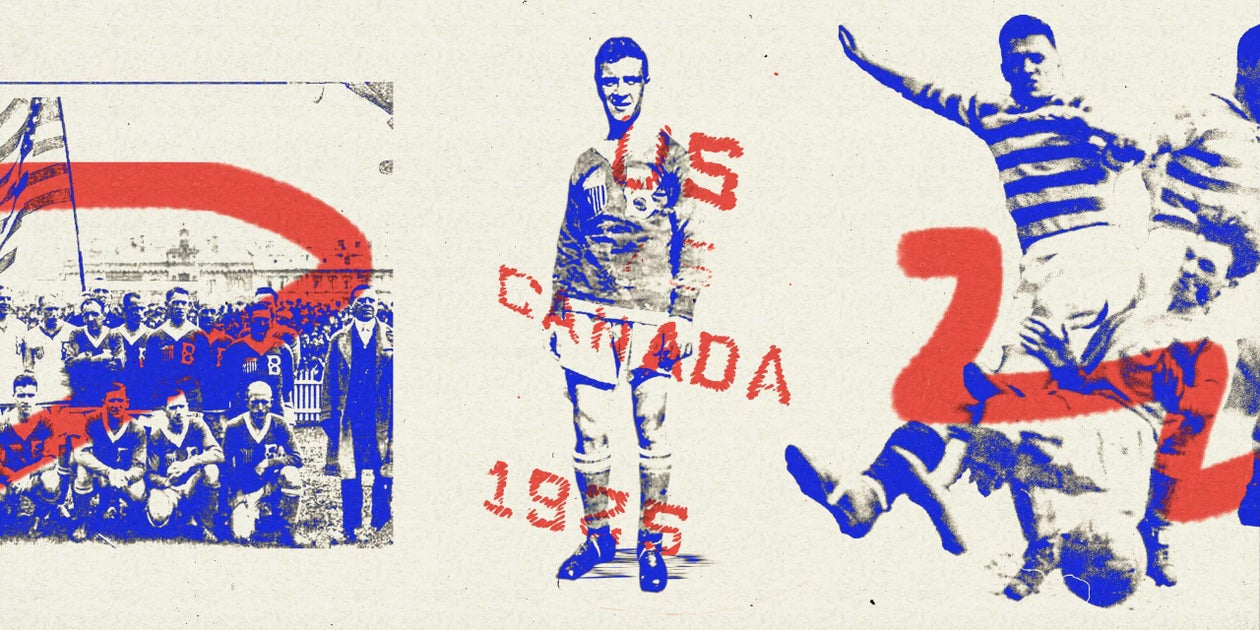
It’s a World Cup tale quite unlike any other. The greatest goalscorer in United States soccer history turned down the opportunity to play at the inaugural World Cup because he was busy opening an automotive business with his brother-in-law.
Tom McCabe smiles as he thinks about that remarkable story, and the trip to New Jersey a few years ago that brought it all alive for him.
“Last time I drove by, there was a little used-car place and then across the street is a diner — it’s this intersection,” he explains. “There’s a bridge going across from North Arlington, which is just north of Kearny, to Belleville, which is another county. You get the sense, ‘Hey, this is one of the places you go to buy a car and Archie’s gonna fix it’.”
McCabe, a football historian, filmmaker and professor at the University of Notre Dame in London, is talking about Archie Stark, the very first player inducted into the U.S. National Soccer Hall of Fame.
A prolific striker across a career that spanned three decades, from 1913 to 1936, Stark was described by Ed Sullivan, one of the biggest stars on U.S. television back in the day, as the Babe Ruth of American soccer. Stark’s record for the most goals scored in a single season — 70 across 46 appearances for Bethlehem Steel in the 1924-25 season — stood for 87 years until it was broken in 2012 by a guy by the name of Lionel Messi.

Messi celebrates scoring at the 2026 World Cup, where he has become the all-time leading scorer in the competition (Tom Weller/picture alliance via Getty Images)
Born in Scotland, Stark arrived in New Jersey as a teenage immigrant and with a trade that would serve him well: goalscoring.
He hit the winner in the American Cup final at the age of 18, got four — possibly five (more about that later) — goals on his second and final international appearance for the United States a decade later and, incredibly, a hat-trick against his adopted country in a warm-up friendly the night before they set sail for the 1934 World Cup finals in Italy.
“Yet a lot of people who love football, and actually love football history, won’t know who Archie is — the name will mean nothing to them,” McCabe says.
The name means a lot to Richard Santos, that’s for sure.
Aged 50, Santos is Stark’s great-grandson. The nine years that the two of them spent together were precious to Santos, even if it wasn’t until a long time later that it dawned on him that the man he used to call ‘Papa Upstairs’ (his grandfather, who lived on the ground floor of the same property, was known as ‘Papa Downstairs’) was a soccer legend.
“He passed when I was in third grade (aged nine), so I do remember him,” Santos tells The Athletic. “He lived five houses down from me, so I would spend time with him. But at that time, I had no idea (about his status as a footballer). He was the guy that me and my buddy would go to see and have cans of Coke and Nilla wafers with — that was the extent of it.
“You kind of heard the stories, but I never realised until my wife and I, before we were married, took a weekend trip and we ended up at the Soccer Hall of Fame in Oneonta (in New York state). You walk in, and the first display was this giant banner of Archie Stark, which referenced ‘The Stark Era’. We both just stopped and looked at each other. It kind of hit home there and then.”

Archie Stark, second from the left, in action for Bethlehem Steel during their 1919 Scandinavian tour, where he was a guest player (US Soccer)
Stark’s story is fascinating, especially when you start trawling through newspapers that are more than 100 years old, looking at the wonderful black and white photographs from that period of time and, perhaps more than anything, reading about all the goals he scored and thinking about what might have been at the 1930 World Cup.
The United States reached the semi-finals at that tournament in Uruguay without Stark. What if – and it’s a huge ‘What if’ – the greatest U.S. goalscorer of his generation had travelled with the team to South America?
Iain Campbell Whittle, a writer, researcher and founder member of the Scots Football Historians’ group, smiles as he contemplates that question.
“He could have been immortal,” Campbell Whittle replies.
It all starts in the Scottish city of Glasgow, where Stark was born at the end of the 19th century.
That choice of words is deliberate — there’s been some debate about what year exactly. But according to the Stark family Bible records, which McCabe has seen, Archie was born on December 21, 1896.
He moved with his family to the U.S. around 1912, by which time Scottish (and Irish) immigrants had long been pouring into New Jersey, finding work in the local textile mills and bringing their favourite sport with them.
It was easy for Stark to quickly feel at home in that respect. He joined an amateur team called West Hudson Juniors, where he played alongside his older brother Tommy and soon impressed.
The two of them moved on to the Kearny Scots, or the Scots-American Athletic Club as they are officially known, and it was there, in a corner of New Jersey that became so synonymous with the sport it would later be nicknamed “Soccer Town”, that Stark first wrote his name into the history books by scoring the winning goal in the 1915 American Cup final.

The Kearny Scots team that won the 1915 American Cup. Archie Stark, who scored the winning goal, is in the middle row on the far left (Tom McCabe)
The match report in the Newark Evening News makes for interesting reading.
“Came Celtics brown, from Brooklyn town, on championship intent. The ‘Scottish’ clan, ‘American’, on winning, too, were bent. Young Stark was near where space was clear and scored as neat as pie…”
Sadly, there was nothing poetic about what happened next. Stark’s football career was put on hold during the First World War, serving in France with the U.S. Air Force.
After returning home at the end of the war and signing for New Jersey’s Paterson FC, Stark was invited to join Bethlehem Steel, a team from across the state line in neighbouring Pennsylvania, as a guest player on a six-game tour of Scandinavia in 1919. The team were scheduled to be away for a total of 15 weeks and, according to newspaper reports at the time, the players were paid $100 a month “travelling money” if they were married men, and $75 if single.

Bethlehem Steel players being put through their paces while on the voyage to Europe (Daniel Paul Morrison)
An article published in The New York Times in July 1919, a few days before the team were due to set sail for Sweden, explained how “arrangements have been made for thorough training of the players aboard the liner, the daily program calling for running, walking, boxing, wrestling and rope skipping contests”.

The Bethlehem Steel squad on their Scandinavian tour. Stark is in the front row, third from the left (Daniel Paul Morrison)
Later that same year, Stark became a naturalised U.S. citizen. By now, he was married to Elizabeth McAllen, the daughter of Irish immigrants, and they had a son, Billy, who would later become a professional footballer, too.
Stark’s football career continued to flourish.
He scored freely for the Erie Athletic Association team in Kearny before joining the New York Field Club in the American Soccer League – a fully professional league that was established in 1921 and where players from England and Scotland could earn more money than they could in the game back home.
But it was in 1924, when Stark officially signed for Bethlehem Steel, that things really took off for him. Owned by the Bethlehem Steel Corporation — America’s largest shipbuilder at the time — the company’s football club had the financial power to acquire the best players, making them a dominant force during that era.
Although it appears to have been standard practice for the Bethlehem players to also work for the corporation, based north of Philadelphia, McCabe says Stark was under no obligation to do so when he joined.
To check that he’s got that right, McCabe searches through pages of handwritten notes he made during a face-to-face conversation with Larry Santos, Richard’s father and Stark’s grandson-in-law, about a decade ago.

Archie Stark in action for Bethlehem Steel, where he spent six years and scored prolifically (Tom McCabe)
Reading from that paperwork, McCabe says Larry told him that he could remember his grandfather telling him Bethlehem Steel said, “You don’t have to work, all you have to do is show up and play soccer.
“He (Archie) said, ‘No, I want to work for my money.’ That’s how he became a draftsman.”
McCabe looks up from his notes: “You were there to train and compete and bring glory and fame to Bethlehem Steel, really. But Archie was like, ‘No, I want to learn a trade’.”
Daniel Paul Morrison, an associate professor at Manor College in suburban Philadelphia, smiles at the story. For more than 25 years, Morrison has painstakingly researched the Bethlehem Steel club, compiling thousands of articles on his website about a team history had largely forgotten and where two of his great-uncles played.
It was an extraordinary labour of love that had him gripped, not least because he read the newspaper reports chronologically, totally unaware of the results, meaning that the past — and we’re talking about matches that took place the best part of 100 years ago — became the future. His emotional attachment to the team and the players as personalities and not just footballers shines through when he describes Stark as “a good egg”.
But what about this idea that Stark and other Bethlehem Steel players were professional footballers who also worked for a living in the factory?
“It’s a good question,” Morrison says. “I have data on two sides of the question. Archie Stark in the census records lists himself as a draftsman in 1930. There are other players on the Bethlehem Steel team during that period who, on their census record, list themselves as a soccer player. So that’s one piece of evidence.
“We also have records of players missing games because of injuries at the plant, like people losing fingers. So at some period, they are having real jobs there. But I think they had a special status. They had three afternoons off to practise, and they played on a Saturday – and employees normally worked on Saturday.”
Stark earned $75 a week playing for Bethlehem Steel plus living expenses, which was a lot of money in 1924 — the equivalent of about $1,450 (£1,100) a week now. In fact, it makes McCabe wonder if Stark was one of the highest-paid players in the worldwide game at that time.
Whether that was the case or not, Stark’s performances on the pitch were eye-catching. He scored more than 200 goals for the club over the next six years, including four on his debut and eight hat-tricks in his first season alone.

A 1924 match report predicts that Archie Stark is “going to be a prime favorite” with the Bethlehem Steel fans after he scored four goals on his debut (US Soccer)
At 5ft 9in (175cm), Stark wasn’t tall but he was quick, excellent at heading the ball and exceptional at pivoting and shooting in one motion.
“Stark was considered the most artistic and polished centre-forward in America,” Tom Connell wrote in the Newark Evening News in 1950, after the newspaper recognised Stark as the ‘Outstanding Soccer Star of the Half Century’. “As a scorer he had no superior, being able to shoot the ball either dead or from a hook.”
He was certainly not the only gifted player in the country at that time, though.
“This is his big rival — Davey Brown,” McCabe says, pointing to a newspaper article from the 1920s. “They lived around the corner from one another. You always hear good things said about Archie — a gentleman, never red-carded, never fouled anyone, even though people were kicking him. But these guys didn’t like each other, apparently. I got it from the Brown side that they were big rivals.”
McCabe brings up a fantastic black-and-white picture on his laptop. “This is the two of them together, playing for the U.S.,” he adds, showing a team photo that was taken on the day the national team beat Canada 6-1 in 1925.

The U.S. team that beat Canada 6-1 in Brooklyn, New York, in 1925, with Stark, in the centre of the front row, scoring four (Tom McCabe)
“Archie scored four,” McCabe says.
Or five, depending on which newspaper you read, I reply.
McCabe laughs. It’s genuinely hard to establish how many goals Stark scored against Canada at Ebbets Field in Brooklyn, where around 8,000 people turned up to watch a game that was played at a baseball stadium and in terrible weather.

The cap given to Stark commemorating that 1925 appearance against Canada (US Soccer)
“Stark’s work during that second half was as brilliant a bit of individuality as ever was seen on an American soccer field,” Richard Vidmer wrote in the next day’s New York Times.
“He kept his feet in the slipperiest sort of going, he covered the sloppy turf with remarkable speed while the mud gripped at his ankles in an effort to hold him back, and he sent the ball forward on each final shot like a phantom sphere that passed always out of reach.”

Although international games were few and far between during that period, Stark could have played more for the U.S., most notably in the summer of 1930, in what feels like a Sliding Doors moment.
On Thursday, May 8, 1930, two months before the inaugural World Cup was due to start, The Morning Call newspaper in New Jersey reported that Stark was “again on the injury list, having turned his ankle in a game against the Hakoah team a week or so ago”.
But there was another significant line in that article, too. “The latest is that Archie Stark opened a gas station at North Arlington. It is open for business and no doubt many a local fan will pay him a visit. The station is located at the Belleville Pike and the River Road. Should this business go along good, no doubt Archie will leave the pitch for good.”
Stark had no plans to quit playing anytime soon, but it’s also clear that the World Cup was well down his list of priorities. He was in his early thirties and Bethlehem Steel’s team had just folded on the back of the Great Depression, meaning that his car garage, or gas station, had taken on greater importance.
On top of that, this first ever World Cup was a step into the unknown for everyone. Only 13 countries were competing in a tournament that was described in some U.S. newspapers as a South American tour.
“No one really knew what the World Cup was about, so I don’t think passing up that World Cup felt like a big deal at that moment,” Richard Santos, Stark’s great-grandson, says. “It was the first one, and he’d been playing high-level soccer for some time and had great success. This was probably just another tournament in his eyes at that moment — ‘I can’t make it because I have this other obligation’, not realising that it would turn into the tournament of all tournaments for decades to come.”
McCabe agrees.
“I think that’s definitely a factor from the U.S. context. They called it the World Series of soccer. What’s the World Series of baseball? It’s just a bunch of domestic (North American) teams. And from Archie’s point of view, he would have been plugged into the powers of the day — Scotland and England, and they decided not to go.”

The United States’ 1930 World Cup squad. Bert Patenaude, third right on the front row, scored the first World Cup hat-trick in that tournament (US Soccer)
Curiously, though, Stark did go on an overseas tour that summer — to Central Europe as a guest player with the successful Fall River Marksmen team from outside Boston, who, ironically, were missing two of their most influential players, Billy Gonsalves and Bert Patenaude, because of their selection in the U.S. squad for the World Cup, from which they were returning after losing 6-1 to Argentina in the semi-finals.
It’s tempting to think that Fall River tour, which ended prematurely, must have been lucrative on paper.
As for the World Cup, it’s impossible not to wonder what difference Stark could have made to the U.S. team had he accepted their invitation and set sail for Uruguay, not Europe.
“We were butchered (in the semi-final against Argentina),” McCabe replies. “The referee was not calling anything. We were down two men at half-time — broken ribs, busted teeth. Jimmy Douglas, the goalkeeper, was basically on one leg. He had been targeted early.
“I don’t think we would have found a way to beat both Argentina and Uruguay (in the final) on their home patch with Stark. I’m a historian, I don’t deal in the counterfactual. But as a fan, I’d be like, ‘Imagine if they won that first World Cup, what would have happened?’ The Great Depression rips a hole in it, and that’s because of the strong links between industry and sport and football in particular. Without those global world events, football could really have established itself.”
Instead, the final years of Stark’s football career coincided with the demise of the U.S. professional game, amid damaging internal battles within the sport in the country and the wider economic problems that left a quarter of the American workforce unemployed.
None of that stopped Stark playing the game he loved or scoring goals, including a hat-trick against the national team at Clark’s Field, in Kearny, on the eve of the 1934 World Cup.
“U.S. Booters Humbled, 4-0, By Leaguers – Archie Stark Scores Three Goals in Rout” read the headline in the Newark Evening News on May 5, 1934.
Stark was closer to the age of 40 than 30 at that time, and according to an article by Tom Connell that was published in the same newspaper many years later, “Archie didn’t want to make the trip (to the World Cup in Italy) because he wanted to give the younger players a chance.”
After retiring in 1936, he opened a bar in Kearny called ‘Stark’s Tavern’ and served customers there alongside Gonsalves, who was 10 years his junior and a distinguished former U.S. international.

After retiring from playing, Archie opened a bar, Stark’s Tavern, in his hometown of Kearny (Tom McCabe)
McCabe smiles as he shows another photograph, this time of a framed notice that was displayed in Stark’s Tavern.
“This is a physical artefact — I’ve touched it!” he says, his voice full of excitement.

“It’s brilliant. I love it!” Richard Santos says, smiling at the tone and the meaning, and what it says about his great-grandfather’s values and principles.
“I have a wooden crate with all of the bar ledgers of the expenses and everything,” Santos adds. “When you see the prices of certain things, it’s pretty cool to flick through them.”
Not long before Stark passed away in 1985, at the age of 88, he gave a television interview when he reflected on his career and his goalscoring record in particular. In a comment that felt typical of the man, he gave credit to his team-mates for everything he achieved.
“I always had a great bunch of boys playing with me, and they almost put it in your pocket,” Stark said.
Stark’s story makes you think about his legacy, especially at a time when the U.S. is co-hosting the World Cup (the final next month is at New Jersey’s MetLife Stadium, less than 10 miles north of Kearny) and new heroes are emerging in a sport that has a long history in that country, even if that is sometimes easily overlooked.
“I want to connect Archie to the local story of Kearny, New Jersey,” McCabe says. “This special hamlet in the swamps of New Jersey, where soccer is very meaningful and central to this immigrant community — and the Scots are no different than the newly-arrived immigrants from Ecuador or Peru that now come to Kearny. So it’s this long thread of immigrants bringing their ball and their dreams to the United States, and Archie is among those pioneers.
“Archie’s not the first, he’s kind of like the second-generation, but he is the first national star. And if he went to that World Cup in 1930, he would have been a global star.
“Maybe I want to agree with Iain saying that he would have been immortal, or certainly on the Mount Rushmore of American soccer.”
