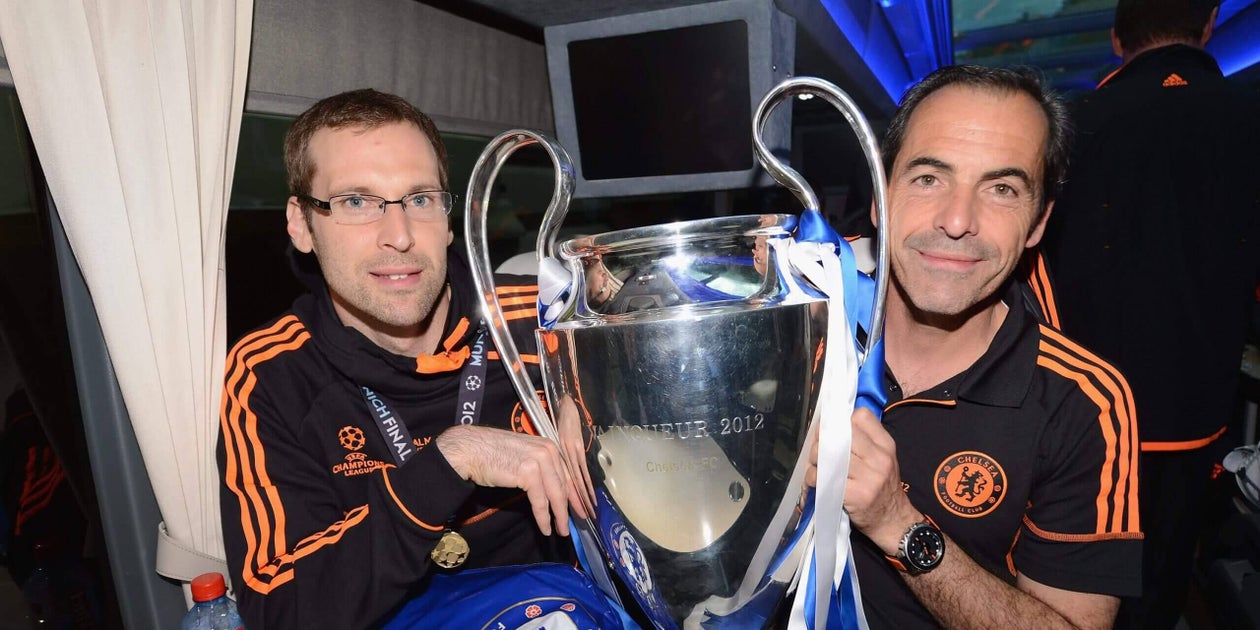
More than 20 years on, Christophe Lollichon still has vivid memories of the first conversation he ever had with Petr Cech in the car park after a Rennes match.
Cech was the club’s No 1 and one of Ligue 1’s most promising goalkeepers. Lollichon was the Rennes academy goalkeeping coach whose training sessions had intrigued him from afar. Once the introductory pleasantries had been exchanged, he sought feedback. “He said, ‘What did you think about my game? I think I played well’,” Lollichon tells The Athletic.
According to Lollichon, his reply took Cech a little by surprise.
“I said, ‘Well, not bad, but you could be more influential on the game. You are very intelligent, your reading of the game is good, but you are not proactive enough. Your influence could be massive if you want’,” he adds. “I saw in his eyes that he was interested, and we spoke more.”
Soon afterwards, Cech asked Rennes to promote Lollichon to first-team duties so they could work together. Blunt honesty had clicked with a relentless desire for improvement, launching a professional partnership and personal friendship that greatly enriched the careers of both men and, in time, would meaningfully alter the course of Chelsea history.
In the first part of this exclusive two-part interview, Lollichon discusses his working relationship with Cech at Rennes and Chelsea, and the preparation that went into Cech’s unforgettable heroics on the run to Champions League glory in Munich in 2012.
Marc Cucurella’s move to Real Madrid from Chelsea
David Ornstein and more
He may not be a household name among Chelsea supporters, but Lollichon is a key figure from the Roman Abramovich era.
As well as working hand in glove with Cech after following him to west London from Rennes in 2007, he was also an enthusiastic internal advocate for signing Thibaut Courtois and Edouard Mendy, and a rather more reluctant voice in the purchase of Kepa Arrizabalaga (more on that later).
Lollichon left Chelsea in May 2022 as BlueCo were finalising its purchase of the club from Abramovich. Now dividing his time between coaching goalkeepers at Ligue 2 club USL Dunkerque and working as a pundit for French broadcaster Canal Plus, he is a charmingly candid source of wisdom and insight on all things goalkeeping.
“The goalkeeper position is the most complete position on the field,” he insists. “He has to use his hands, he has to go in the air, he has to control the depth, he has to play short, he has to play long, he has to communicate for 90 minutes in every game.”
But it is Cech that remains Lollichon’s favourite subject. “This guy is a laptop,” he says. “He helped me to become a better goalkeeper coach.
“How many hours we spent together! My god. In front of the computer, on the pitch, outside of the pitch. Our discussions sometimes were outside of football. Petr is intelligent, he has a lot of interests. He likes the economy, he likes history and I love history, so we spoke about a lot of things.”

Christophe Lollichon and Petr Cech in discussion at Chelsea training in January 2008 (Darren Walsh/Chelsea FC Via Getty Images)
Lollichon had a unique coaching journey. Never a high-level player, he started working with young goalkeepers in Nantes’ academy at the age of 20. Soon he was approached to lead the club’s new goalkeeping academy, and was elevated to first-team goalkeeper coach by legendary manager Jean-Claude Suaudeau — “For me, the French Guardiola,” Lollichon says — before leaving in 1997.
After a spell at Ancenis in the fourth tier of French football, he joined the Rennes youth academy in 1999.
This background informed his unorthodox, innovative coaching style. “I observed a lot of other sports like tennis, handball, gymnastic drills, classic dance, just to complete my knowledge,” he explains. “Goalkeeping training is too mechanical, robotic. The most important thing is to see my ‘keepers thinking about the exercise.
“I want to see them thinking to find the best solution in my training. I want to put them in discomfort, to force them to find the right solution.”
His quest to help Cech become a more proactive goalkeeper began in Rennes’ first pre-season friendly for the 2003-04 campaign. “I often saw Petr turning round during the first half to see where his goal was,” Lollichon says. “At half-time, I went to the ref and said, ‘I need to put something on the pitch — it’s a friendly game, I think you can agree. I want to put a mark with a strap on the six-yard line, the penalty-spot line and the 18-yard line for my goalkeeper to be sure he’s in the right position’. The ref said OK.
“I came back to the dressing room and I said to Petr, ‘You will see something on the pitch. Leave it. That’s your mark’. In the second half he was unbelievable — not his understanding, but his attitude changed a lot.”
Cech’s form secured him a move to a rising Chelsea in the summer of 2004. Lollichon stayed at Rennes but the pair spoke regularly on the phone, analysing his performances in granular detail. Shortly after Jose Mourinho’s departure in September 2007, the invitation came to join him at Stamford Bridge.
Despite a rival offer to return to Nantes, Lollichon could not turn down the chance to reunite with the goalkeeper he affectionally calls “a monster”.

Christophe Lollichon puts Petr Cech through his paces (Darren Walsh/Chelsea FC via Getty Images)
Abramovich’s backing gave Lollichon greater resources to refine his methods. He had a training wall built at Cobham to help with specific goalkeeping drills. He was given carte blanche on the physical preparation of his goalkeepers. He worked with Cech on the efficiency of his footwork and dealing with crosses — as well as the occasional long throw when Stoke City came up on Chelsea’s fixture list.
“Remember the throwing of Rory Delap?” Lollichon says. “Wow. They scored between nine and 12 goals per season from the Delap throw-in.
“Before our first game against Stoke City, I observed Delap’s throw-ins and I saw that no goalkeeper tried to influence Delap. I said to Petr, ‘With your size, with your physical ability, you can destroy him. Change your position. Come on the corner of the six-yard box to show him that if he puts the ball there, you will punch or catch it’.
“We trained for that. I used a big rebound ball — a big net with very big tension. I put a mannequin in the space where Delap likes to throw the ball and I kicked the ball against the net. The ball arrived exactly like the throw-in. I used some defenders and some strikers to make it more realistic, and Petr liked it.
“I remember the first Delap throw-in (of the game), Petr punched the ball. The second from the other side, Petr caught the ball. The third one, Delap turned away and threw the ball to another space. If you work, maybe you can try something and influence the opponent.”

Rory Delap’s throw was a potent weapon in Stoke City’s armoury (Laurence Griffiths/Getty Images)
Then there was the mental side.
“I wanted to develop his scanning, because with perpetual scanning, you have good information,” Lollichon says. “If you have good information, you have good communication. If you understand the play, you can have the best positioning and make the right decision with the right execution.
“We said, ‘Petr, your first target is to avoid touching the ball’. It’s impossible because sometimes the opponents are very strong, but you have to do everything you can to avoid an emergency. You need to scan. If the ball is on your left, you need to see what’s happening on your right. You have to see the small movements of opponents at 30 metres, 50 metres, maybe even 60 metres.
“It’s like the guy at the airport at the top of the (air traffic control) tower. One plane has to wait in the sky, another can come. It’s the same for a goalkeeper.”
Lollichon even took Cech to see sporting vision specialist Michel Guillon at his clinic in London. “We started fantastic work to develop his central vision and his peripheral vision, and Petr loved it,” he adds. “With this, and with Petr’s talent, he became one of the best goalkeepers in the world.”

Christophe Lollichon in conversation with Chelsea owner Roman Abramovich in December 2015 (Clive Mason/Getty Images)
Lionel Messi never scored against Chelsea when Cech was in goal.
It is a proud record that spans six Champions League matches, and was put to the greatest test in an unforgettable semi-final tie against Barcelona on the road to unexpected glory in Munich in 2012.
Heading into the first leg at Stamford Bridge, Messi’s tally for the season was 63 goals. “I remember when Roberto (Di Matteo, Chelsea’s interim manager) presented the game, the whole team was laughing,” Lollichon says. “I analysed every single goal he scored. The direction, the positioning, the attitude in one-vs-one situations, his eyes when he looks at the goalkeeper.
“At the end, I said to Petr, ‘This guy is so quick technically, his central vision is so perfect. He’s waiting for a very little movement from the goalkeeper to kill him. You have to wait, to wait, to wait, and force him to make a choice’. He said: ‘OK, I like it’.
“Messi loves to put the ball between the goalkeeper’s feet, or close to the feet. The goalkeeper always tries something; he moves one foot and Messi immediately reacts. I remember one situation (in the tie) when Messi was very close to Petr and Petr didn’t move, didn’t move, didn’t move.
“In the end, Messi kicked the ball towards Petr’s legs and Petr made an ice hockey save. He stopped the ball with his knee.”

Petr Cech dives to his left to deny Lionel Messi in 2012 (Darren Walsh/Chelsea FC via Getty Images)
Vanquishing the game’s greatest player gave Chelsea the chance to avenge their Champions League final penalty shootout heartbreak against Manchester United four years earlier. Cech had done reasonably well, memorably blocking Cristiano Ronaldo’s kick with his face and almost denying Nani. But he remained some way short of the spectacular spot-kick force he would become in the 2012 final in Munich, with the help of his goalkeeping coach.
From the 2008-09 season onwards, Lollichon watched every penalty taker Cech was in line to face in the Premier League and Champions League. “In the beginning I had six or seven points of observation,” he says. “By the end I had 15 points. I observed the guy when he put the ball on the penalty spot. I analysed his body language, his run back, his waiting position etc.”
That preparation ramped up ahead of the 2012 Champions League final. “I didn’t sleep a lot,” Lollichon admits. “The wall in my home was a giant paper board. My wife said, ‘Wow, that’s not very beautiful’, and I said, ‘It’s just three weeks’.
“I asked the analysts to give me all the penalties kicked by the potential Bayern Munich players from 2007 (onwards). I had 31 minutes of penalty video.
“It was boring, absolutely boring, but I spent time and time and at the end, I made some suggestions to Petr and to the other ‘keepers — Ross Turnbull, Hilario, Jamal Blackman. I gave the guys a synthetic video just to have their opinions on the Bayern penalties. It was a fantastic time because we had this sensation to prepare the final together.”

Petr Cech saves Bastian Schweinsteiger’s penalty in the 2012 shootout (Adrian Dennis/AFP/GettyImages)
The hard work paid off well before the shootout, when Cech saved Arjen Robben’s penalty in extra time. “Didier (Drogba) had made the foul against (Franck) Ribery and was suffering,” Lollichon says. “Petr came to him and said, ‘Didier, calm, I will stop the penalty, don’t worry’.
“We knew Robben perfectly. We knew that when he’s tired, he always kicks the ball on the left of the goalkeeper. Petr is a big friend of Robben, so it was very important to avoid showing Robben that he knew something. He had to stay as long as possible in the middle of the goal, because if he went too early, maybe Robben could change. So he waited and waited.”
Drogba’s winning penalty is the indelible memory of Munich but he immediately ran to embrace Cech, who had saved from Ivica Olic and Bastian Schweinsteiger in the shootout.
“Petr has a top memory,” Lollichon adds. “He didn’t need bottles with each shooter (and their tendencies written on them), everything was in his brain. We had six penalties against us and Petr went to the good side six times and stopped or deflected three.”
In part two of the interview, to be published on Thursday, Lollichon discusses Cech leaving for Arsenal, and his role in the Chelsea careers of Courtois, Arrizabalaga and Mendy, and gives his thoughts on Mike Penders.
