The seeds of the most remarkable game in Canadian men’s soccer history were planted seven months earlier, thousands of kilometres away from Vancouver.
In November 2025, Canada’s men’s national team were gathered in a Fort Lauderdale hotel meeting room before a friendly against Venezuela, the team Canada beat on penalties in the 2024 Copa America quarter-finals — their best result yet under Jesse Marsch.
Canada’s head coach saw an opportunity. In one of the most important team meetings in program history, Marsch asked his players a question.
“What do we want our identity to be at the World Cup?”
Players moved to smaller tables. They shared ideas. They talked about how they wanted to feel after World Cup games.
When Marsch reconvened his team as a group, he was alarmed and proud, all at once. Separately, many players had come to the same conclusion and came up with the same phrase they wanted to define Canada’s World Cup team.
When you play against Canada, it should feel like hell.
“It’s about being relentless,” midfielder Jonathan Osorio said of the phrase and the meeting. “It was interesting to see how similar everyone’s answer was.”
Get free access to the most comprehensive World Cup coverage in The Athletic app.
“We know what we do really well,” remembers forward Tani Oluwaseyi. “It’s important that we use that as what brings us together.”
On Thursday, Canada not only stayed together — they inflicted their version of ‘hell’ upon Qatar on their way to their 6-0 victory, the first men’s World Cup win in their history. Their unique vision was manifested in the most rollicking and finally, cathartic ways.
Since that game, The Athletic has spoken to many of those involved, some on condition of anonymity in order to protect relationships.
This is the inside story of one of the biggest, wildest, and most heartbreaking days in Canadian sports history, told by the people who lived it.
On Thursday morning, there was not a cloud in the Vancouver sky.
Under Marsch’s tutelage, Canada had tried to project calm. And so under the morning sun, the team lived the calm they hoped to show through the biggest tournament of their lives.
Clad in dark black training gear, Canada walked parts of Vancouver’s famed Seawall together around Stanley Park. With the Vancouver Harbour — and just beyond, the Pacific Ocean — as their backdrop, players made jokes and smiled. They walked out their nerves and tried to enjoy each other as people, not just as team-mates.
At this team’s core, they are friends. Players will tell you publicly and privately how little ego there is inside the national team compared to other environments they have played in.
As they strolled, the players would have had no idea how much they would soon have to rely on those friendships.
Before the game, Marsch said Alphonso Davies would be available to play for the first time for Canada since March 2025. But as the team news was confirmed, Davies, who has had a hamstring injury, was on the bench. Would Canada struggle without their iconic star player? Hardly.
Cyle Larin scored Canada’s first goal, his second of the tournament, in the 16th minute and then Jonathan David scored his first World Cup goal, all within half an hour.

Cyle Larin scored Canada’s opener (Fran Santiago/Getty Images)
Canada were flying. They controlled possession and moved the ball around with speed and precision. When they didn’t have the ball, Canada swarmed Qatar players. They played with a spirit fuelled by the crowd.
Canada were both chaotic and determined. Qatar had a player sent off for denying a clear goalscoring opportunity. David scored again. The Vancouver crowd were in raptures.
They had a commanding 3-0 lead at half time. “I had to catch myself,” commented one Canada Soccer employee afterward.
With the game out of reach for the visitors, star midfielder Ismaël Koné took a pass. He wisely then played the ball out of harm’s way, but not before Qatar midfielder Assim Madibo swept in.
Madibo continued towards Koné after the ball was gone, and kicked Koné’s left leg out from under him. Koné hit the pristine BC Place grass.
Despite the 52,497-strong capacity crowd, one of the more raucous crowds Canada has ever played in front of, the sound of Koné’s horrific injury pierced through. Multiple reporters jumped up from their seats and shouted they’d heard a “crack”.
On the broadcast, when it was unclear whether Madibo would be handed a red card (after initially being shown a yellow), a Canada assistant coach was heard shouting: “His leg is hanging off.”
Marsch heard what he called a “snap”. He knew exactly what had happened: the worst possible outcome. Koné immediately looked at Marsch in stunned horror. His leg had been broken.
“I was kind of like, ‘OK’…” Marsch said, struggling to find the right words.
Richie Layrea was incensed. Canada’s bulldog full-back had to be held back from exacting any kind of physical revenge on Madibo.
Luc de Fougerolles looked around in shock and then buried his head into his jersey. De Fougerolles is just 20, the youngest player on the team. He has not experienced team-mates going down with gruesome injuries before. De Fougerolles continued to turn his head, looking for solace.

Luc de Fougerolles looks visibly upset after Koné’s injury (Jared C. Tilton / FIFA via Getty Images)
That’s when he saw Maxime Crepeau. The 32-year-old goalkeeper placed his gloves on De Fougerolles’ head, looked him square in the eyes and stabilized the young player’s wave of emotions.
Crepeau himself was likely being put through an emotional wringer. Less than four years earlier, he had his World Cup robbed from him when he broke his leg in his final club game before the tournament. But helping his team-mate was more important than processing his own emotions.
“Man, it’s so difficult to put into words, but it was a moment to say ‘Hey, you’re not alone, I’m feeling the same thing as you’,” Crepeau said afterwards.
Koné’s leg was strapped and he was taken off the pitch on a stretcher. As he was being carried, he sat up and waved to the crowd.
The team gathered in a huddle. The feeling had turned. Canada had one goal: don’t just win, but win big for their team-mate.
Three more goals came. Qatar looked like they were fighting in a different, lower, weight class. After the final whistle, Canada had secured a bittersweet 6-0 win against nine-man Qatar.
After Marsch and Qatar coach Julen Lopetegui shook hands, Lopetegui had more to say. Canada’s coach tried to walk away. He had bigger things in mind, like being with his team and looking forward to a crucial game against Switzerland. But Lopetegui kept talking.
Emotions boiled over and soon most of both teams — including staff members — began pushing and shoving. Canadians might call it a donnybrook. Crepeau and Tani Oluwaseyi were enraged. But other Canadians in the team, including staff members, wanted to separate their players from the brawl.
“It was all about making sure that none of the (players) got in trouble,” said one Canada Soccer employee who was inside the brawl. “We had almost mathematically secured a spot in the next round, so we had to avoiding any suspensions that would affect the future games. We’re here for a lot more than just that one win.”
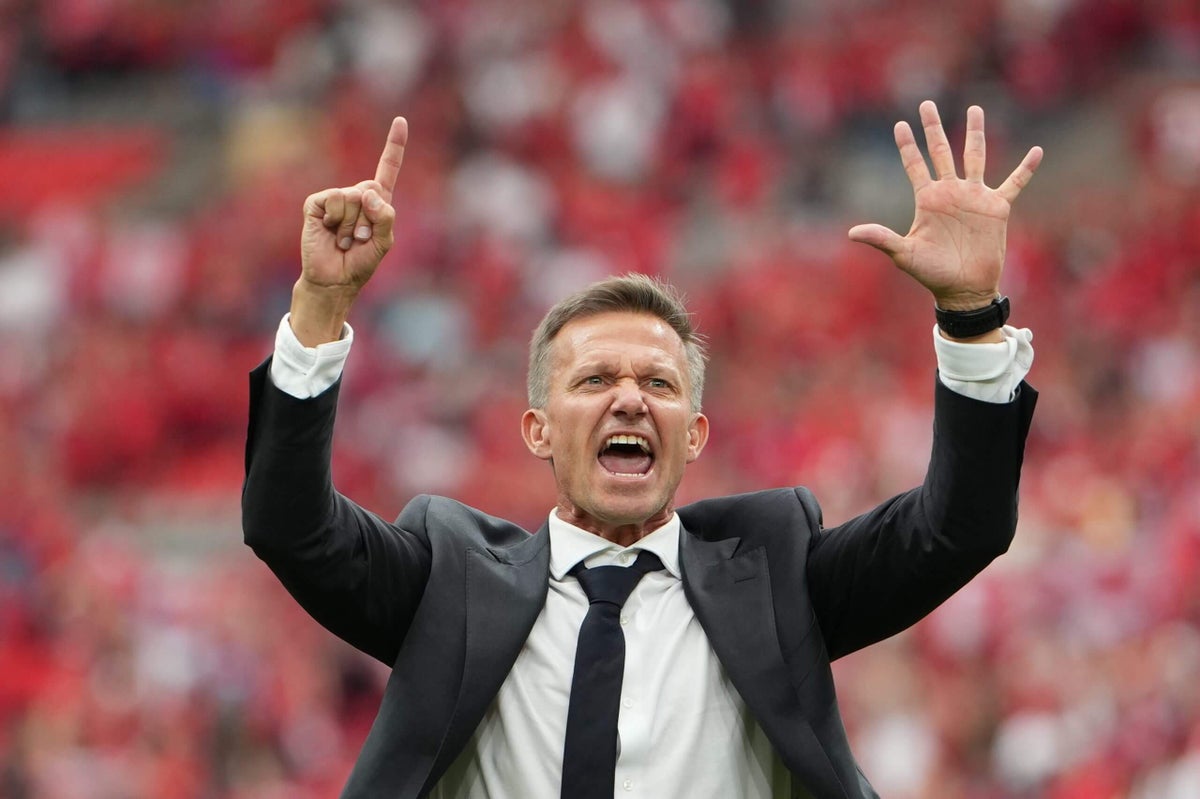
Marsch still wanted to celebrate when he could, and rightfully so. The coach ran to some of Canada’s most fervent fans, and threw six of his fingers in the air repeatedly and emphatically.
“Here in Canada, we’ve been trying to create a movement,” Marsch later said of his celebration. “And this is an opportunity to really galvanize and validate everything that’s been done over the last two years, but also in the lead-up to the last two years.”
Meanwhile, Koné was sent almost immediately to Vancouver General Hospital. There, multiple doctors had been watching Canada’s thrilling win unfold. When they saw Koné go down with injury, they prepared themselves for his arrival. Marsch said the hospital quickly arranged for their “top three surgeons” to arrive and tend to the player.
“By the time (Koné) got there,” Marsch said, “the surgeons were there and ready.”

Koné sat upright as he left the field before being taken to hospital (Ercin Erturk / Anadolu via Getty Images)
Canada Soccer, meanwhile, had to look after the person who means more to Koné than anyone else: his mother, Suzanne.
Staff members found her in the stands and ushered her down to their dressing room.
“She was oddly calm,” a Canada Soccer employee said, “but you could tell she was incredibly distraught.”
In the dressing room, Suzanne sat essentially alone, waiting to be taken to the hospital to see her son. Her next steps were unclear. Chaos was unfolding postgame.
“It encapsulated the other side of the moment for us,” said one member of staff.
When emotions settled and Canada’s group returned to the dressing room, some Canada officials first threw up their hands. Detrimental injuries had been the story of the team’s lead-up to the World Cup, with Davies and influential defender Moise Bombito battling for fitness, and the exciting talent Marcelo Flores tearing an ACL.
But the squad looked to be on the mend once the tournament started. Bad fortunes, however, had re-emerged.
“Why is this happening?” one employee shouted in disbelief.
Every team needs leaders, and that’s when one of Canada’s leaders stepped in. Canada Soccer called the Prime Minister Mark Carney’s office. Carney had planned to visit the team’s dressing room, but the organization was clear, spelling out how shocked the team was and that he should approach with the right amount of gravity.
Carney had briefly interrupted Larin’s postgame interview with Canadian broadcaster TSN to congratulate the forward for scoring again for Canada. Larin and Carney’s smiles were wide. But when Carney then entered the team’s dressing room, the mood turned.
“Let me just begin by acknowledging what you’re all feeling and the nation is feeling, the terrible injury of Ismaël,” Carney said, looking around with purpose at the Canadian squad.
“It’s in moments like that that you see character. He applauds the fans coming off. He shakes the hands of the Qataris. (Nathan) Saliba comes on, steps up and scores, and you hold up (Koné’s) jersey to celebrate.”
Carney spoke slowly and confidently, wearing the same black Canada jersey the players wore underneath a grey blazer. He referenced the records Canada had broken, including that their six goals were the most ever scored in a men’s World Cup match by a Concacaf nation — or indeed a country from outside Europe or South America.

Mark Carney visits Canada’s dressing room (Jared C. Tilton/FIFA via Getty Images)
“You keep your cool, you show the nation,” Carney said. “You didn’t just break the Concacaf record and a bunch of records but you showed a level of character that some people never achieve in their life. And you showed it when the entire country and a good part of the world was watching.”
Players stood, heads high, arms behind their backs. They were being recognized in a way soccer teams rarely are in Canada.
“I couldn’t be prouder as a Canadian,” Carney said. “And on behalf of all Canadians, I just want to thank you for everything you put in to get here, to represent the nation, your family and friends and teach a lesson.”
The lessons, in fact, were many. Canada showed they can win at the men’s World Cup. But more tangible and long-lasting was the lesson Canada showed in brotherhood.
“(Koné) means everything to this team,” Jonathan David said. “If you ask the same question to any guy on this team, they will tell you the same. He is someone that we love a lot.”
He is a warm soul capable of lightening the mood during a long tournament. Almost the entire Canadian squad lit up with grins, laughter and crucially, astonishment, as Koné finished intense fitness testing before the World Cup barefoot. He lapped team-mates without a care in the world. Then, Koné crossed a road that had been victim to punishing North Carolina heat while still barefoot to return to the team’s training base.
He is a player who operates with creativity, daring and playmaking in a way other Canadian soccer players do not. He is a person who brought team-mates to the verge of tears in the mixed zone, where players speak to reporters, well over an hour after the game ended. He is the brother for whom Canada are determined to go deep in the tournament. That was part of the message Bombito delivered in a speech to team-mates in another postgame huddle, as players kneeled around the defender.

Moise Bombito addresses his team-mates after the game (Sarah Stier/FIFA via Getty Images)
Koné is the team’s de facto dressing room DJ. Underground hip-hop blares from wherever the team is stationed thanks to him. And when Canada pulled off what was once their most impressive result, a thrilling win on penalties over Venezuela in the 2024 Copa America quarter-final, it was Koné who pulled a large speaker through the mixed zone playing his tunes and showing off Canada’s new swagger.
After the win over Qatar, Koné’s speaker was housed in a silver case and pushed proudly through BC Place, just as Koné likely would have done.
“It’s the biggest night (in Canadian men’s soccer),” Alistair Johnston said. “It’s just unfortunate that it’s such a bittersweet night at the same time when you feel the raw emotion of that injury for (Kone).”
Tajon Buchanan, who was remarkable during the game, was asked to stop and speak. Buchanan broke a leg during the Copa America two years earlier. The similarities were powerful.
“No, I’m sorry,” Buchanan said when asked to speak, bowing his head and quickly moving by.
Saliba spoke in solemn, hushed tones. He should not be thought of as Koné’s replacement in the game, but his close friend. The pair came up in the CF Montreal academy and the first team together.
Saliba and the rest of the team — not just players, but the entire staff — were on the receiving end of a heartfelt message Koné sent after his surgery.
“Thank you for the love,” Koné said, according to one person close to the team, noting how he did not just thank his team-mates, but every different section of the staff.
It felt fitting.
“Every time that something happens, (the Canadian team) continue to surprise me with how amazing they are and how committed and connected they are to each other,” Marsch said. “It’s a soothing moment when you feel the pain of the situation, to know that everybody here cares and takes care of each other so well. I’ve never been around a team like this.”
And that team had never had a night like Thursday. In the span of a few hours, Canada had been to hell and back.
