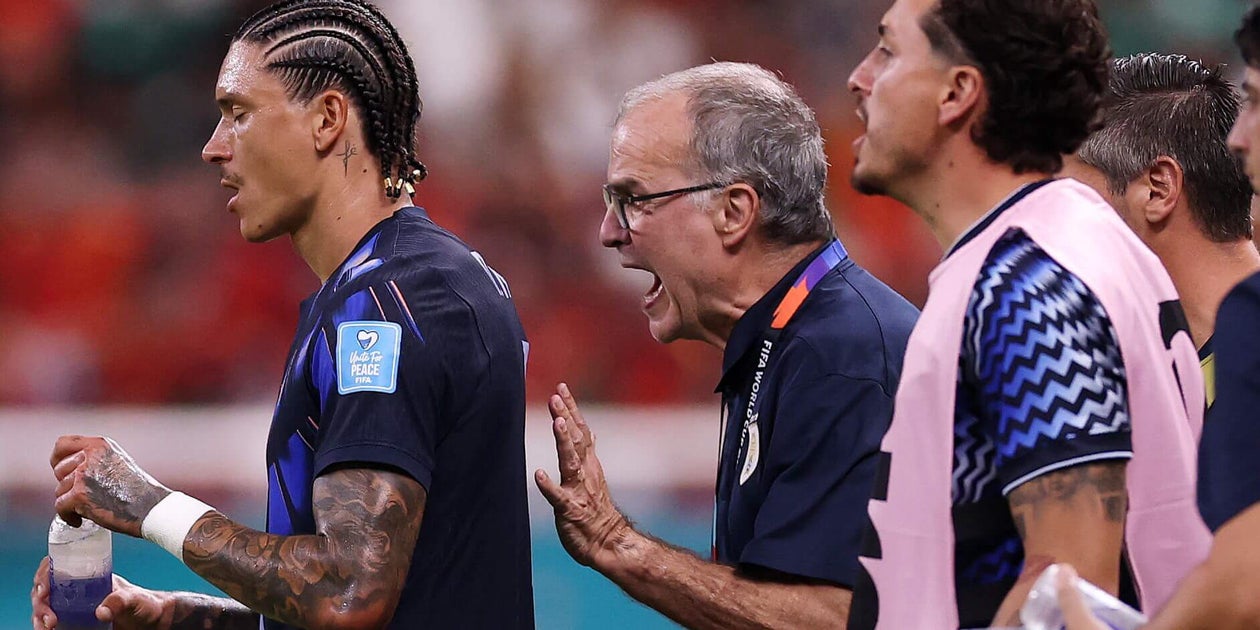
As it ends, Marcelo Bielsa is muttering to himself on his coolbox. Lightning forks overhead while the sky blue shirts fall around him.
Uruguay have just lost 1-0 to Spain after a third major error of the tournament from goalkeeper Fernando Muslera.
Their captain Federico Valverde was substituted after less than an hour; both he and Bielsa ignored each other as the Real Madrid midfielder trudged off. The forward Agustin Canobbio was red-carded in the final seconds after grabbing referee Ismail Elfath’s arm and flinging it away.
“I think we need to be very self-critical, correct many things within the group,” Canobbio told the Uruguay broadcaster Teledoce after the match.
Bielsa watched on impassively. A managerial appointment that began with so much promise concluded in aggression, arguments, and a winless exit from the World Cup. Waiting pitchside for his flash interview, the coach’s face suddenly breaks. “Dale de una vez!,” he yells in Spanish. “Get on with it!”
Marcelo Bielsa couldn’t contain his frustration 😤
The Uruguay boss let his emotions show after his side’s World Cup exit. pic.twitter.com/8pMzCqMCm6
— Match of the Day (@BBCMOTD) June 27, 2026
It was an outburst which summarised a tempestuous reign. Sources with knowledge of the tournament and its preparations, speaking anonymously to protect relationships, told The Athletic that Uruguay’s World Cup campaign fell apart after:
- Long-running issues over Bielsa’s squad management
- Concerns over whether the intensity of training sessions was stretching the players
- Senior players staged an intervention in an attempt to change the style versus Spain
- A final pre-match meeting in which Bielsa failed to soothe his squad’s unease
“If you ask me how my time will be remembered?” said Bielsa in his post-game press conference. “It is a tenure that has left nothing behind.”
Back in 2023, the Uruguayan Football Association were delighted to secure Bielsa on a three-year contract. The Argentine is extremely selective about the projects he takes and had not managed internationally since leaving Chile in 2011. Ignacio Alonso, the president of the Uruguayan Football Association (AUF), had been tasked with finding a big name — and succeeded, with Bielsa available after a remarkable four years at Leeds United.
A legend of both the club and international game, including successful spells with Argentina, Chile, and Athletic Club, Bielsa’s uncompromising and fearless brand of high-tempo attacking football has made him one of the most influential coaches of the past 50 years.
After three months of negotiations, his contract would make him the most expensive coach at the 2024 Copa America.
Before taking the Uruguay job, Bielsa had interest from clubs including Bournemouth, Crystal Palace and Athletic Club, coming extremely close to joining Everton — as well as hearing out an approach for a sensational return to Leeds, before the West Yorkshire club appointed current manager Daniel Farke.

Bielsa being presented as manager in 2023 by the president of the Uruguay Football Association, Ignacio Alonso (Sandro Pereyra/Getty Images)
In his first comments, Bielsa said he had been attracted by the qualities of the squad — including players such as Valverde, Manuel Ugarte, Darwin Nunez and Rodrigo Bentancur, though still boasting an older core of Luis Suarez, Edinson Cavani, and Diego Godin.
His first squad, and subsequent switch to 4-3-3, immediately ended the international careers of many of the latter group — though Suarez remained through until the end of the 2024 Copa America.
Early results justified Bielsa’s evolution of the squad. Uruguay scored twice as many goals as any other side in the first six rounds of CONMEBOL qualifying, a purple patch which included a 2-0 home win over Brazil and a 2-0 triumph in Argentina, their first away victory over their neighbours in 12 years. The development of players such as Maxi Araujo and Sebastian Caceres, both viewed as Bielsa projects, also strengthened the coach’s reputation.
“He deserves so much respect for what he believes; it is a different style, a different game and a different intent,” Valverde said at that stage. “I have greatly improved my psychological equilibrium playing under him.”
The 2024 Copa America, however, had its difficulties despite an impressive third-place result. After their 5-0 win over Bolivia in their second game, Uruguay stopped scoring, managing just a single goal in their next three games as they were eliminated by 10-man Colombia in the semi-finals. That game was marred by violence between Uruguay’s players and opposition supporters after full time.
Though on board with his ideas, Bielsa’s blunt and cursory management style also jarred with several players. Canobbio had a major fallout with the coach, telling Uruguayan radio station Carve Deportiva that he felt disrespected.
“He belittled me in front of the whole group in practice,” Canobbio said, who would later be left out of the squad for almost two years, only returning before this tournament. “Another example, because I had both legs resting on the chair legs, he started criticising me, saying it was disrespectful, rude. He was attacking my family’s upbringing.” Bielsa insisted in the aftermath that he “never stopped considering” Canobbio for selection.
Suarez, a legend of Uruguayan football, disclosed some of the issues within the squad after his post-tournament retirement.
“There were situations that occurred at the Copa America that hurt to see, that I didn’t talk about for the good of the group,” he said at a press conference.
“It’s going to continue to happen. The players are going to reach a limit and explode. At the Copa America, there were players who told me, ‘Luis, I’ll play the Copa America and then I won’t play again.’”

Suarez cried during the press conference announcing his Uruguay retirement in September 2024 (Ernesto Ryan/Getty Images)
Alleged issues included Bielsa’s lack of warmth towards players, unreasonable behaviour towards support staff, and separate training sessions for starters and substitutes. Suarez claimed he only trained against then-Liverpool striker Nunez once. He also brought up an incident the previous autumn in which Bielsa reduced Nunez to tears after a half-time dressing down.
According to Suarez, who said he comforted Nunez in the tunnel, Bielsa believed that his own blunt intervention had been responsible for the second-half improvement. Suarez went on to claim that Bielsa’s comments — including calling tournament organisers a “plague of liars” — and coaching methods had been legitimised by the AUF’s leadership.
“It pains me to say this, but (president Ignacio) Alonso and (manager Jorge) Giordano allowed it,” says Suarez. They were the ones who gave him the authority to treat the staff that way.”
Notably, no players publicly leapt to Bielsa’s defence after the Copa America, with former captain Godin stating that Suarez had tried to address the issues internally. The current captain Valverde also failed to dampen the fire, telling reporters in Uruguay that: “What Luis said is all true — he never lied, he never said anything that wasn’t the case. He didn’t exaggerate, he said things as they are.”
“I am not unaware of what happened and I know that my authority is affected in some way,” Bielsa said before the subsequent World Cup qualifiers. “But I prepared for the match with the utmost seriousness and the players’ response was the same as when I started working here. It did not alter the conviction with which the match was prepared in any way.”
Other anecdotes paint Bielsa in a better light. Last February, the coach made a surprise appearance at the funeral of Guillermo Varela’s mother. “He simply gave me a hug, and I was truly happy, as was my family, with that gesture,” the fullback told Radio El Espectador. He was also viewed favourably for regularly sitting alongside ordinary fans at league matches, praising Uruguayan citizens for their “civility”.
Increasingly, however, Uruguay’s camp was becoming unhappier as results stagnated. A run of 12 games between July 2024 and June 2025 brought just a single win, with the side unable to score in nine of those fixtures. High-profile players, including Valverde, Bentancur, Ugarte, Nunez, and Facundo Pellistri, all appeared significantly below their best while wearing Uruguay’s sky-blue jersey.
After a 5-1 friendly defeat against the United States last November, the self-aware Bielsa admitted to some of his difficulties in managing the squad. “I’m toxic,” he admitted. “Being around me makes people worse.”

Diego Luna celebrates the United States’ fourth goal against Uruguay in November 2025 (Dustin Markland/Getty Images)
One source close to the squad, speaking anonymously to protect relationships, told The Athletic that the AUF considered sacking Bielsa around this period, aware of the ongoing issues with the squad. Ultimately, with the World Cup just months away, the AUF decided not to make the change.
Another long-running issue among players, according to multiple sources with knowledge of the sessions, was Bielsa’s intense approach towards conditioning and training sessions owing to the incredible demands of his all-action style — a critique which had been raised in previous jobs.
Compared to the modern recovery methods at many of their clubs, Bielsa’s Uruguay camps were a throwback. Barcelona centre-back Ronald Araujo, one of the squad’s key players, arrived at Uruguay’s pre-tournament camp with a minor calf issue that worsened during training. Before leaving Barcelona, he had been warned not to partake in certain drills at full effort yet.
“Thanks for injuring players just days before the World Cup,” Araujo’s brother wrote on Instagram in a subsequently deleted post.
Araujo’s injury drowned another controversy which had been brewing in the Uruguayan cycle, after versatile veteran Nahitan Nandez, a virtual ever-present during Bielsa’s reign, was omitted from the final squad.
The 30-year-old was not told directly by Bielsa; instead being texted by an assistant on the coach’s behalf. Defender Jose Maria Gimenez expressed his surprise at the decision, defending Nandez against reports that he had been dropped by Bielsa for disciplinary reasons.
Suarez had also signalled his willingness to return to the national side, but his omission, given his comments about Bielsa’s management, was unsurprising. Instead, the surprise veteran selection was goalkeeper Fernando Muslera, who turned 40 during the tournament. This was his fifth World Cup squad after an excellent season for Argentine side Estudiantes.
Bielsa opted not to play warm-up games ahead of the World Cup, preferring instead to spend the time developing his side’s tactical shape. While he explained his decision in detail before the tournament, it marked Uruguay apart from every other serious contender.
“If there’s one thing I criticise, it’s that we didn’t play any preliminary matches to see some things before the World Cup; perhaps we gave them a slight advantage in that respect,” said respected former Nacional manager Alvaro Gutierrez.
In their first match against Saudi Arabia in Miami, Uruguay fell behind after an error from Muslera, who was unable to hold a routine catch from a corner, allowing Abdulelah Al-Amri to tap in.

Saudi Arabia take the lead against Uruguay after the mistake by Muslera (Reuters/Amanda Perobelli)
Their attacking difficulties of the past two years also came to the fore, with Bielsa’s side unable to create from open play despite dominating possession — only a late 80th-minute rebound from Maxi Araujo rescued a point. Despite their time in camp together and a squad which has been relatively settled for the past two seasons, Uruguay appeared to lack chemistry.
Six days later, against minnows Cape Verde, many of the same issues arose. For all their intensity, Uruguay could not avoid self-inflicted errors. Muslera was beaten by a free kick from over 30 yards for Cape Verde’s opener, and though two quick goals from diagonal balls put Uruguay in the lead, a poor mix-up between the goalkeeper and centre-back Mathias Olivera led to an embarrassing equaliser.
Bielsa publicly defended his goalkeeper after the mistakes but after Uruguay’s exit, he admitted that his decision to pick the 40-year-old over Sergio Rochet, Uruguay’s starter at the last World Cup, should be reviewed.
“When I selected Muslera, I went through an exhaustive process,” he said. “I cannot deny that there should be an evaluation into Muslera’s participation. But he came from having a magnificent (club) season. He has a lot of experience and personality.”
Regardless, Uruguay had played themselves into a corner. Whilst a win in their final game against European champions Spain could still have seen them top the group, or a draw secure progress in either second place or as one of the best third-place teams, a loss guaranteed their exit.
In the days before the match, concerned with Uruguay’s performance so far in the tournament, some of their senior players asked to speak with Bielsa. The group included the team’s entire starting midfield — Valverde, Bentancur, and Ugarte — as well as goalkeeper Rochet, who all hold formal or informal leadership positions within the team.

Valverde before the game against Spain in Miami (REUTERS/Eloisa Sanchez)
Believing they were speaking on behalf of the dressing room, they told Bielsa that they wished to play a different style against the dangerous Spanish side. Rather than press high and aggressively, the players expressed a preference to set up in a low block and counter-attack.
According to sources with knowledge of what was discussed, speaking anonymously to protect relationships, they also brought up the intensity of training sessions as a factor, referencing their fatigue.
This was a significant step.
Bielsa is both one of the most ideological and uncompromising managers in world football, who also demands fierce loyalty from his squad — as several players during his Uruguay reign have discovered. For the players involved, they justified the intervention as an attempt to correct the side’s course rather than to blow things up.
In response, Bielsa held a meeting with the entire squad in an attempt to explain his rationale for Friday evening’s crucial game against Spain. At the end of a lengthy discussion, led by Bielsa, several members of the squad were no closer to understanding their approach against Spain — though it had been made clear that refusing to press was not an option.
Uruguay actually competed well with Spain for the first 30 minutes at Guadalajara’s Estadio Akron. Ugarte was tasked with dropping into defence as a third centre-back when out of possession, turning Bielsa’s 4-3-3 into a 5-4-1.
Initially, their physicality also shocked Spain, with referee Elfath allowing the game to flow. On two occasions, a Spanish player remained on the floor after being strongly dispossessed, with Uruguay fashioning chances for Nunez, reintroduced to the starting line-up as Bielsa’s only change after the Cape Verde draw.
However, the game’s key moment came after 42 minutes. Muslera should have easily saved a weak shot from Spain’s left winger Alex Baena, but with his feet slow to move, he could only palm it into his own bottom corner.

The ball bounces over Muslera for Spain’s goal in Miami (Reuters/Raquel Cunha)
The mistake meant that Muslera is the only goalkeeper since data records began to commit three errors leading to goals in a single World Cup. Recalling him to start over Rochet was one of Bielsa’s biggest calls entering the tournament — and it was a decision that went catastrophically wrong.
Muslera was replaced by Rochet for the second half, with Bielsa’s post-match comments unclear as to whether this was the goalkeeper’s choice, his own, or a decision taken by the player that he decided to sanction.
“(He) decided to come off at half-time,” Bielsa said in his press conference. “The decision I took was not to undermine Muslera’s confidence, but rather to maintain it.”
Remarkably, this was not his most controversial substitution of the evening. A suspected anterior cruciate ligament injury for Ugarte in the build-up for the goal had led to the introduction of Flamengo’s Nicolas de la Cruz, who joined Bentancur and Valverde in a midfield trio.
Valverde was not at his best against Spain, just as he has failed to perform for Uruguay throughout this World Cup. Nevertheless, it was still a shock that the Real Madrid midfielder was withdrawn by Bielsa after just 57 minutes — the earliest that the side’s best player has ever been taken off while playing for the national team.
“I subbed off Fede Valverde as I wanted more presence in attack,” Bielsa said post-match as his only justification.
Bielsa and Valverde did not exchange a word as the midfielder walked off. The 27-year-old walked straight to the bench where he shook himself free from the embrace of an assistant coach, covering his face with the bottom of his shirt in an apparent attempt to air his frustrations without being lipread.


One half-hearted shout for a penalty aside, Uruguay never came close to scoring the equaliser they needed — a goal that would have sent them into a last-32 tie against Argentina. Just as occurred after exits at the 2022 World Cup and 2024 Copa America, the match ended in a blur of violence and aggression.
It was ironic that Canobbio, recalled to the national side ahead of this World Cup after his argument with Bielsa, was the final individual to battle against the dying of the light. He was deservedly sent off after a reckless foul on Pau Cubarsi, before grabbing the referee’s arm and tossing it to the side in indignation.
Post-match, no Uruguayan player consented to provide a FIFA-mandated interview in the mixed zone, though three players stopped later, with a tournament official telling The Athletic that they had refused owing to the manner in which the match ended. The official added that Uruguay may now face a potential sanction.
The squad had arrived as one unit on a charter plane — on the way home, they would scatter their own ways, back to their respective clubs. A source close to one of the players stated there was no communication between Bielsa and several of the Uruguayan squad, to their knowledge, after the defeat. It was an ugly end.
The AUF did not comment on points made in this article when contacted by The Athletic.
Before the tournament, AUF president Alonso had set a target of reaching at least the quarter-finals, aiming to demonstrate the two-time World Cup champions were one of the 10 best sides in the world. He had hired Bielsa to take them there and empowered his coach. They had got nowhere near.
Bielsa was always expected to leave after the tournament, stating publicly in May that his “job ends with the World Cup”, though he rowed back somewhat on those comments at the beginning of June. One source close to Bielsa indicated to The Athletic that they believed this could be the 70-year-old’s final major job, owing in part to how his Uruguay spell unfolded, but added that the coach typically never explains his thinking fully.

Bielsa’s official FIFA portrait for the 2026 World Cup (Michael Regan – FIFA/FIFA via Getty Images)
Much of Uruguay’s core are currently at their peak: Ugarte is 25, Maxi Araujo is 26, Nunez, Valverde and Ronald Araujo are 27, Bentancur is 28. Though all have the potential to play another World Cup, Uruguay already had the 15th-oldest squad of all 48 teams at the tournament, with no player aged younger than 24.
Where are the next generation coming from? Uruguay won the Under-20 World Cup in 2023 but none of that crop have managed to establish themselves in the senior side.
Bielsa was criticised in Uruguay for playing several of them out of position during Olympic qualifying but, in his defence, very few have either established themselves in Europe or at top South American sides.
But little of this mattered at the Estadio Akron.
“I am responsible for this disappointment,” Bielsa admitted after the defeat to Spain. Though several players were undoubtedly below their best in North America, Bielsa refused to share the blame. It leaves Uruguay in need of rebuilding once again.
“I leave nothing to Uruguayan football,” concluded Bielsa. “Any contribution I might make to a country where I have worked for three years fails to take root if results aren’t achieved.”
