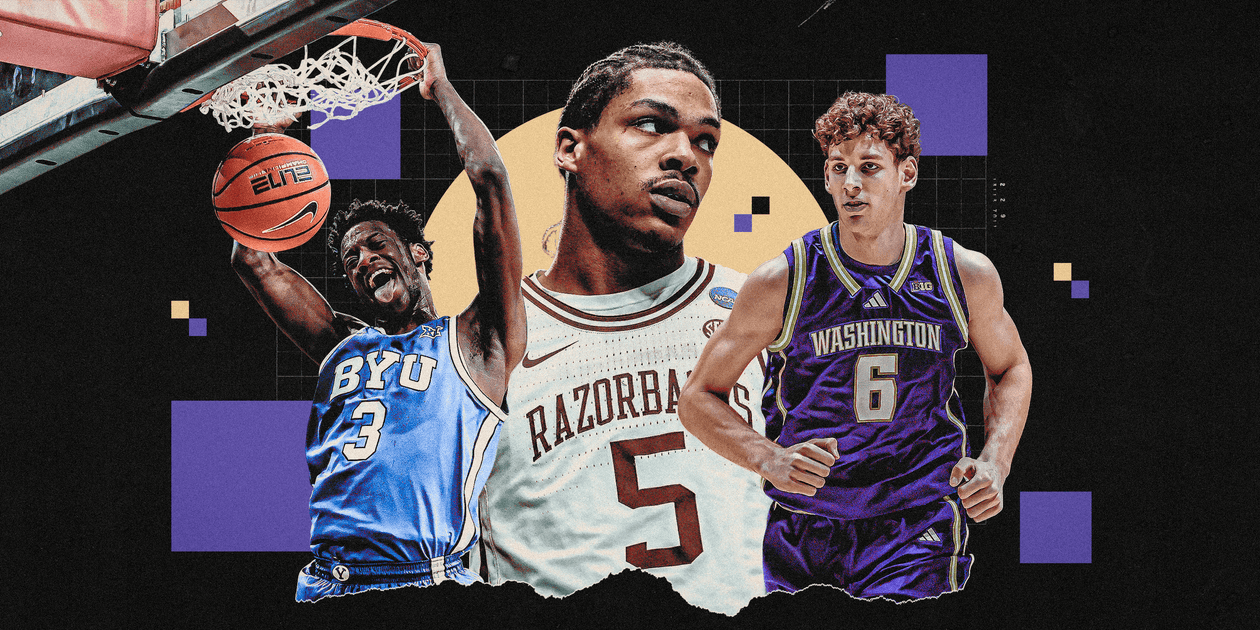
We’re less than a week away from the 2026 NBA Draft, and as I’ve said in the past, while the depth of the group is loaded, there isn’t a singular LeBron James or Victor Wembanyama at the top.
In fact, my No. 1 choice deviates from consensus, and four players — BYU’s AJ Dybantsa, Duke’s Cameron Boozer, Kansas’ Darryn Peterson and North Carolina’s Caleb Wilson — can make a credible claim to the top selection. Beyond those four, an almost overwhelming class of point guards, including Illinois’ Keaton Wagler, Houston’s Kingston Flemings and more, makes for a difficult game of splitting hairs.
Last month, a couple of days before an NBA Draft Lottery that saw the Washington Wizards finally emerge with the No. 1 pick, I unveiled my top 15 prospects in this year’s class, with Boozer leading the way. You can find much deeper analysis on each prospect here, but as a refresher, here’s a snapshot of that board:
Tier 1
Tier 2
Tier 3
Tier 4
Tier 5
After another month of evaluation, here’s how the rest of my board looks, from No. 16 to No. 75, with a late addition to the top-five tiers. (Ages listed are as of draft night; heights are rounded measurements without shoes from May’s NBA Draft Combine.)
Why Cameron Boozer produces and wins at every level
Sam Vecenie
16. Allen Graves, forward, 6-8, Santa Clara
Drafting Graves means accepting high outcome variance, but this is the point in the draft where I think that makes sense. I like a lot of the players still on the board, but none of them have the outlier characteristics Graves has. It’s possible that he’s too foul-prone and his game is too weird to find a true spot in the NBA, but he does a lot of things that really translate — passing, rebounding, getting his hands on tons of balls — and blew up analytical models.
Playing against mostly minnows in the West Coast Conference as a redshirt freshman, Graves is an unusual case. Scouts would have liked to see more games against elite competition, and ideally, a transfer to a Power 5 league to evaluate him as a possible 2027 lottery pick. He did a lot of damage against the weakest teams on Santa Clara’s schedule, although his 17-point, seven-rebound NCAA Tournament game against Kentucky eased some nerves.
Graves is a high-IQ player who averaged 2.5 dimes for every turnover, shot 41.3 percent from 3, had an insane steal rate for a big with seemingly modest mobility (4.9 percent!) and feasted on the offensive boards.
That said, haters won’t lack material. He’s the most athletically underwhelming player in my top 30 — not that adept at creating his own shot, not that springy in the paint and without a pure defensive position. His finishes are below the rim, his shot takes eons to load up, and in a weak league, his foul rate was an eye-popping 7.9 per 100 possessions.
It’s a bit of a high-risk, high-reward scenario. But Graves’ feel and hands may be so elite that they completely negate his being a meh athlete and turn him into a starter anyway. Here’s where I’m comfortable taking the plunge.
Tier 6
17. Morez Johnson Jr., big, 6-9, Michigan
I’m a bit surprised to see Washington’s Hannes Steinbach getting more shine than Johnson. I went to the Washington-Michigan game in January, and Johnson owned that matchup. Sure, it was three vs. one in the frontcourt, but Johnson had a monster game on the glass with 16 boards.
Of course, one game does not make a prospect, but Johnson’s consistent production in a secondary role bodes well for what he can do as a third big at the NBA level, likely toggling between power forward and center. I’m not over the moon about his shooting form, but he made 78.2 percent from the line and shows promise as somebody who can make 3s from the corner as he develops.
Defensively, Johnson’s switchability has perhaps been overrated; he’s not prime Bam Adebayo, but he’s decent. That’s sort of the whole thing with Johnson: He doesn’t stand out in one category, but he’s solid across the board and should be playable immediately. It would help if he could be a full-time center, but at 6-9 in socks with an 8-11 standing reach, he may be a little short for that role.
Nonetheless, it’s pretty easy to see him fitting in as an Isaiah Stewart-type big, and the right tail outcome offers the upside of turning into an Al Horford-type big who can start at both power forward and center.
18. Ebuka Okorie, guard, 6-1, Stanford
As a freshman at Stanford, Okorie averaged as many points per possession as AJ Dybantsa on greater efficiency. He did so with more assists and fewer turnovers, with a higher 3-point percentage and with twice as many steals and a worse supporting cast.
Dybantsa is projected as the No. 1 pick, and people are barely talking about Okorie. That’s partly because Okorie wasn’t on the hype list entering the season, partly because he is only 6-1 and partly because he plays an archetype (scoring point guard) that makes people nervous.
Offensively, he didn’t have a lot around him, but he also missed some chances to deliver passes and forced up plays at the rim instead; some of his shots were pretty wild. Okorie gets into the paint constantly, but you’d feel more confident about a guard of this size if he played more as a set-up man. Despite questions about his shooting, Okorie hit 35.4 percent from 3 and 83.2 percent from the line; it’s not a strength, but it’s not a massive liability.
Defensively, he’s small but slides his feet and had a solid steal rate; a 6-7 wingspan helps on this end. In a draft deep with rotation-caliber point guards, I like Okorie a bit better than the next few names on the list.
19. Cameron Carr, guard, 6-4, Baylor
Carr’s electric performance in his one draft combine game showcased why his game should make more impact at the NBA level than it did at Baylor, as he knocked down multiple deep 3s and flew down the lane for transition dunks. Carr’s 38-inch no-step vertical was the second-best at the combine, and he uses it in-game; his 4.0 percent block rate was phenomenal for a 6-4 guard; a 7-foot wingspan helps.
Carr has a thin frame at 184 pounds but still managed to shoot 60.2 percent inside the arc, and his 10.0 percent rebound rate again stands out for a lighter guard.
What stands out perhaps less is his feel for the game, with Carr barely posting a positive assist-to-turnover ratio and missing passes at times to shoot jumpers instead. I’ll note that he can really shoot, getting great elevation on his jump shot while making 37.4 percent from 3 and 80.1 percent from the line. However, his handle is pretty rudimentary, and he mostly operates in straight lines. Defensively, Carr could impact the game with surprise blocks, but he needs to be more consistent in between highlights.
20. Hannes Steinbach, big, 6-10, Washington
Steinbach is an elite rebounder with awesome hands and led the Big Ten in both defensive rebound rate and total rebound rate as a freshman. He also runs the floor well and has the outlines of an eventual floor-spacer. He only made 34.0 percent of his 3s, and some of the misses were brutal, but he shot 75.9 percent from the free-throw line. Watching his form before games, it’s a believable stroke that likely only needs reps to become threatening as a pick-and-pop weapon. He’ll also be functional in elbow actions and as a short-roller, with decent feel as a screener and passer.
Steinbach, however, raises more questions at the defensive end. He’s not a rim protector but doesn’t have the feet to switch onto guards on the perimeter. He will need to show he can hold up in pick-and-roll coverage against elite guards.
That lack of explosion also translates to the offensive end. At 6-10, he doesn’t quite have true center height, and he doesn’t consistently play above the rim. A guy who rebounds like this and has an offensive skill set is going to play in the league, but it’s probably not as a starter.
21. Labaron Philon, guard, 6-3, Alabama
Philon has a lot to recommend him as an offensive player, with as diverse a bag of finishes at the cup as any player in this draft. He also improved dramatically as a shooter, with the jump in percentages backed up by the notably smoother release I saw watching him work pregame.
Philon had a solid assist rate but benefited from an open, pro-style Alabama system that lets pick-and-roll guards cook. Despite that environment, he made some bewildering turnovers with bad passes (4.4 miscues per 100 possessions overall) and will have to improve his decision-making.
Defensively, Philon is a question mark. He’s undersized and didn’t make up for it with any notable instincts for the ball, and his rebound rate (5.7 percent) was poor even for a point guard. With a thin frame on top of it, he may end up targeted too easily to be a starter.
22. Christian Anderson, guard, 6-1, Texas Tech
Anderson can really shoot (40.0 percent career from 3), and the impressive part is how much elevation he gets when he shoots a jumper off the dribble, allowing him to fling often (12.1 attempts per 100 possessions). He’ll be lethal shooting off screens if defenders go under, and he can make the right reads in pick-and-roll.
The issue is whether he has enough size and athletic juice to function as more than a backup. Anderson measured 6-1 in socks at the combine and 180 pounds, and you could feel that when teams pressured him; traps would swallow him up, as he had trouble getting the ball out over size. While he had a strong assist rate and excelled at delivering pocket passes, his limited juice for self-created shots is a concern. In addition to his lack of size, he has limited burst and lacks an overly deceptive handle to show he can beat NBA switches.
Defensively, Anderson’s stats were pretty underwhelming, and the tape isn’t very convincing either, but he also played virtually every minute of every game for Texas Tech, so those breathers on defense were likely a natural response.

Does Christian Anderson have the size and athleticism to be more than a backup guard? (Matt Pendleton / Imagn Images)
23. Isaiah Evans, wing, 6-6, Duke
I’m always going to rank knockdown shooters because they always end up playing, and in Evans’ case, he added enough on-ball juice in his sophomore season to offer some optimism about being more than a floor-spacer. Evans is also taller than many players of this ilk, measuring 6-5 1/2 in socks at the combine.
The centerpiece of Evans’ resume, however, is that he shot 38.0 percent for his career from 3s and 84.9 percent from the line and did it on very high volume (16.4 tries per 100 possessions), which indicates an ability to get open and launch in a variety of ways. Evans also used the threat of his shot to open straight lines to the rim, shooting 56.7 percent on 2s.
To stay on the floor, he’ll have to show he can play passable defense, and with a slight 186-pound frame, that might be the biggest roadblock. Evans also had a low steal rate for a wing prospect, although he did manage to swat 25 shots. His rebound rate is a red flag, too, at just 5.4 percent in ACC games, an extremely poor showing for a player of his height. Those shortcomings may leave him in a role as a specialist and cap his ability to start.
24. Bennett Stirtz, guard, 6-3, Iowa
Stirtz’s shooting numbers are really solid for a guy who was consistently having to shoot grenades at the end of the clock for one of college basketball’s slowest-paced teams. He has good size for the next level with a 6-6 wingspan, gets to his spots off the dribble and was able to explode up for finishes at the rim. That’s Stirtz’s most impressive stat, making 61.9 percent of his 2s in Big Ten play as a guard.
As a shooter, he’s good but not on Christian Anderson’s (above) level. Watching him pregame at the NCAA Tournament, he had a nice stroke with range, but I wouldn’t quite call him a knockdown guy; he’s 37.2 percent from 3 for his career and 82.0 percent from the line.
The rest of his profile is solid but unremarkable. Stirtz is on the thin side at 186 pounds but had a solid steal rate and should be able to guard his position. As a distributor, he made the right play more often than not but didn’t stand out. He’ll also be 23 when the season starts, making him long in the tooth relative to other prospects here. In short, he is, like the other guys in this section, a pretty solid bet to play rotation minutes and yet not a great bet to be a long-term starter.
Tier 7
25. Chris Cenac Jr., big, 6-10, Houston
A theoretical big who spent his entire freshman season hanging out in the corner on offense, Cenac’s biggest selling point is a monster rebound rate in his lone season at Houston (18.0 percent), combined with the fact that he shot 62.8 percent on 2s in Big 12 games despite taking a lot of midrange jumpers.
Cenac offers glimmers of hope as a floor-spacer, although that looks to be a project: He made 33.3 percent from 3 on fairly light volume and shot 62.1 percent from the line. Of more encouraging note is his ball security, with just 33 turnovers the entire season. Even for bigs in off-ball roles, that’s not common.
Defensively, Cenac is big and fairly mobile, with true center size thanks to a 7-5 wingspan. However, he disappoints as a rim protector, sending back just 18 shots in 37 games. Cenac requires a bit more projection than some other players in this class and is unlikely to be game-ready immediately, but he has some real upside as a floor-spacing glass-eater who moves pretty fluidly for his size.
26. Henri Veesaar, big, 6-11, North Carolina
We are now into the group of players who would have been second-rounders in a normal draft, but name, image and likeness (NIL) really thinned out the herd after about the 20th position on the board.
Veesaar, who will be the third-ever NBA player from Estonia when he takes the court, is a tempting player; his upside scenario is something like a stretch big with real mobility and skill who could be a huge offensive plus. Getting there requires a bit of squinting.
The shooting efficiency stats last season are remarkable — 42.6 percent from 3 and 67.7 percent inside the arc. That 2-point mark is notable because it wasn’t all dunks and layups; he can finish with touch and moves well off the ball into floaters and short jumpers. He’s a good passer for his size, too, and should be effective as a roller.
However, Veesaar’s career 65.4 percent free-throw mark doesn’t really back up the idea that he’s a knockdown shooter, and watching him work before games offered more caution. He’s a capable shooter at this point, but work remains.
Veesaar will need to deliver offensively because of his defensive concerns. He measured 6-11 with a 9-3 standing reach, but he has a high base and lacks bulk, which makes it easy for opposing bigs to push him around. His shot blocking and rebounding totals were pretty modest, and he can be slow to change ends. He also ran out of gas in the Tar Heels’ NCAA Tournament game against VCU, although that’s less of an issue if he’s a bench player.
27. Meleek Thomas, guard, 6-3, Arkansas
Thomas has the possibility of being an Anfernee Simons-type scoring guard, but he seems caught in between positions. At 6-3 and 186 pounds with a 6-7 wingspan, he’s undersized for shooting guard but doesn’t display the type of distribution skills that would lend to playing the point.
Thomas minimizes turnovers by shooting before anything bad has a chance to happen. I’m only sort of joking. His minuscule 6.7 percent turnover rate was impressive for a high-usage guard, but he also averaged over five field goal attempts for every assist.
Ultimately, I tend to believe in him as a bench weapon because he can shoot. Thomas hit 84.3 percent from the line and 41.6 percent from 3 in his lone season at Arkansas, offsetting forgettable and occasionally head-slapping work inside the arc (44.9 percent on 2s with a low free-throw rate in SEC play). He can shoot with range, off the bounce and on the run and elevates enough to get it away over a contest.
Defensively, Thomas at least had a high steal rate, and at 19 on draft night, his age offers some upside that his body will fill out and perhaps even grow a bit more. Overall, though, he was a mess on that end. You’re drafting him to get buckets.
28. Jayden Quaintance, big, 6-9, Kentucky
The first question with Quaintance is whether he’ll ever be healthy, and the second is whether he’ll ever be enough of a threat on offense.
Let’s start with the good news: Quaintance is 6-9 with a 7-5 wingspan and posted a 9.8 percent block rate as a 17-year-old freshman at Arizona State in 2024-25. He also sports an 11.1 percent career offensive rebound rate and shows the ability to move his feet and stay with guards on switches. He’s not as big as New York’s Mitchell Robinson, but the parallels are there.
Speaking of which … Quaintance is a 45.2 percent career foul shooter. Yikes. He’s big enough to finish plays around the basket, but he doesn’t explode off the floor and rip off the rim either. Away from the rim, he’s of limited value because he can’t shoot, although he had a solid assist rate for a big man and has some functional dribbling ability.
The biggest issue, however, is the state of his knees. Teams will need a deep dive into his medical: knee issues limited him to four games at Kentucky this past season after a torn ACL late in his freshman season at Arizona State.
Tier 8
29. Zuby Ejiofor, big, 6-8, St. John’s
Ejiofor is an interesting player because his offensive role might be somewhere between “limited” and “nonexistent,” and yet, he makes so many winning plays that he could still impact games as a Chuck Hayes-type forward who occasionally masquerades as a center.
Ejiofor is stoutly built but only 6-7 1/2 in socks, so asking him to play center at the next level will be a challenge. That’s particularly notable on the defensive boards, where his 15.0 percent defensive rebound rate in conference games isn’t going to cut it. He does, however, have great instincts for blocking shots despite not being a bouncy athlete and led the Big East in rejections as a senior.
Offensively, Ejiofor emerged as a playmaker for others in 2025-26, with an impressive 6.7 assists per 100 possessions. I’m always a sucker for bigger players who can pass, and I think Ejiofor’s widebody screens and distribution will make him a great fit operating out of the elbows.
Ejiofor is a 70.9 percent career foul shooter and only made 31 3s in four college seasons, but watching him before games, I don’t think his shot is broken; getting him to the point where he makes one-third from distance doesn’t seem daunting.
His biggest skill, however, is that he plays so hard, chasing offensive boards and loose balls and fighting on every play on defense. He’s a role player, but he knows it.
30. Ja’Kobi Gillespie, guard, 6-0, Tennessee
At no point in the last 12 months did I consider the possibility that Gillespie would end up in the top 30 on my board. Then NIL got its mitts on most of the candidates I had in the 20s and 30s, Gillespie showed out in the draft combine scrimmages and, well, do you have someone better to put here? I think he has a solid chance of being a better version of Chucky Atkins, as a smaller, shot-making rotation guard.
Gillespie can shoot from deep, with high-arcing splashes that he can launch off the dribble. This is where it’s important to understand that volume and foul shooting are more predictive of NBA 3-point shooting than the percentage a player shot in college. While Gillespie only hit 33.8 percent from 3 as a senior, he flung 14.6 attempts per 100 possessions and shot 81.1 percent from the line. Watching him shoot before games, his shooting will not be an issue. What might have been an issue is his measuring 5-11 3/4 in socks at the combine, just barely clawing his way to a 6-0 listing on his trading card.
Gillespie knows how to run a team, posting a solid assist rate at Tennessee and showing some knack for finishing in the paint, despite a spacing-constrained system that gave him little room. I would call the passing more “functional” than “dazzling,” but he can get the ball where it needs to go.
Defensively, Gillespie’s size is an issue, but he’s a ballhawk with great hands (3.6 percent steal rate) and has a solid base that could help him get under opposing dribblers.
31. Baba Miller, forward, 6-11, Cincinnati
I’ve been intrigued by Miller since his freshman year at Florida State, and he has an intersection of size, mobility and ballhandling that helps offset his limited scoring chops and shooting ability. He has a chance to make it as a switchable role player who can guard one through four.
First, let’s not mince words: Miller’s shooting is a problem. He shot 29.0 percent from 3 in his college career and 61.9 percent from the line. The reason you draft Miller is for the other stuff. He has enough handle and passing ability to get others involved and also gets out and scores more effectively in transition. That could benefit him in the NBA’s more open game, as he showed in his solid performance in draft combine scrimmages.
Defensively, standing 6-10 1/2 in socks with a 9-3 standing reach, Miller is big enough to take turns as a small-ball center if he adds some strength, and he backed that up by leading the Big 12 in defensive rebound rate despite playing next to another big center. Between that and a 31 1/2 inch standing vertical, he has enough bounce to provide excellent secondary rim protection from the forward spot.
Miller has a thin frame and struggles with physicality. This not only impacts him in the paint on defense but also as an offensive player when he tries to finish. Between that and the lack of shooting, he’s far from a sure thing. But his strengths are solid enough that I think he has a decent chance of becoming a back-end rotation player even if the shooting never comes around.
32. Emanuel Sharp, guard, 6-3, Houston
I’m higher on Sharp than just about anybody else, but in a draft with limited talented outside the top 25, his 3-and-D potential stands out to me once we get into the second round. Scouts will be concerned that Sharp measured only 6-2 ¾ in socks with a 6-3 wingspan, impacted his ability to be a true wing stopper against the Jayson Tatums and Luka Dončićs of the world. However, he checked Houston’s best opponent every night, and the Cougars were an awesome defensive team the entire time he was there. Sharp is also a ballhawk, averaging over three steals per 100 possessions in his sophomore and junior seasons before dropping to “just” 2.5 as a senior.
On the offensive side, Sharp isn’t a point guard and doesn’t get downhill much; his strength is running into 3s and letting it rip from distance. He averaged 14.8 3 attempts per 100 possessions and shot 87.1 percent career from the line; longtime readers will know those two factors point the arrow way up on his floor-spacing potential in the NBA, much more than his 37.2 percent mark from 3 as a senior might indicate. He also never turns the ball over, a subtle advantage that helps offset his lack of on-ball shot creation and limited passing.
Advanced stats also love Sharp, who produced monstrous BPMs each of his final two seasons as a Cougar. He has virtually no chance at stardom, or even starterdom, but projects as a rare high-floor guy this late in the draft.

Emanuel Sharp’s 3-and-D potential may stand out once the draft gets into the second round. (William Purnell / Imagn Images)
33. Trevon Brazile, big, 6-10, Arkansas
It’s been a journey for Brazile, who had first-round buzz entering his sophomore year before tearing his ACL. That was four years ago, and he is finally back in the draft crosshairs after a strong season at Arkansas and an eye-opening combine.
Brazile is tall and long for a forward (6-9 1/2 in socks with a giant 7-3 3/4 wingspan, making him a rare “plus-6” in scout parlance), has a dribble-pass-shoot skill set and pops off the floor (36-inch no-step vertical). He’s not quite elite in any of those areas. The decision-making can be shaky, the shooting is inconsistent (35.1 percent career from 3 and just 66.2 percent from the line) and he hasn’t always harnessed his leaping ability in the flow of a game, especially as a rebounder.
On the other hand, he’s a constant lob threat, especially in transition, who shot 68.5 percent and 76.0 percent on 2s in SEC games the past two seasons, and he’s become a “stocks” (steals + blocks) wizard who averaged 5.3 per 100 possessions last season in SEC games. The secondary rim protection, in particular, is a skill that should translate.
At this point in the draft, Brazile seems to be a genuine value, even as a 23-year-old fifth-year senior with an injury history. There are some trick-or-treat aspects due to his still-evolving feel, but he has definite upside to be a starting power forward.
34. Joshua Jefferson, forward, 6-8, Iowa State
Jefferson evokes comparisons to fellow former Cyclone Georges Niang as an unathletic power forward who barely looks like a basketball player but has such good feel as a playmaker and passer that he makes it work. Like Niang when he reached the NBA, Jefferson could use some work getting in better shape.
Jefferson’s shooting has long been a question, but he shot 3s more regularly and more accurately than ever before as a senior, hitting 34.5 percent (baby steps) and 70.0 percent from the line. If he can force defenders to guard him on the perimeter, that’s a game-changer.
Meanwhile, his rates of assists and steals are in Allen Graves territory and, like Graves, do not compute when you see his 246- pound frame. Jefferson is built like a left tackle but somehow has the stats of a point guard. He dished 9.0 dimes per 100 in Big 12 play — a higher rate than projected lottery point guard Keaton Wagler — and swiped 3.1 steals per 100 in Big 12 games. The latter was the lowest rate of his career.
How all this translates to the NBA is an open question, particularly because he’s so unthreatening closer to the basket. That is the biggest reason I couldn’t put him higher. Jefferson’s career 2-point shooting percentage is just 49.5 percent, and he doesn’t have the kind of short-range feel and touch to offset a glaring lack of elevation.
The comparison to Graves above is instructive. Jefferson played in the same league at the same age (he played his first two college seasons at Saint Mary’s), and the profile, while strong, was nowhere near as eye-popping as Graves’.
35. Otega Oweh, wing, 6-4, Kentucky
Oweh is one of “my guys” — I’ve been consistently higher on him than most boards over his last three years at Kentucky. He has a strong frame and prototype two-guard size at 6-4 1/4 in socks with a 6-8 1/4 wingspan. He gets downhill and finishes, even against packed-in defenses, and thrives in transition, all of which should benefit him in the more open floor of the NBA.
His shooting is a question, with an elbow-out release that produced career marks of 34.7 percent from 3 and 72.1 percent from the line. It’s not quite tragic, but he’ll definitely be below average in this respect for a pro shooting guard.
Where he’ll make up for it is with his aggressive defense. He’s at times too aggressive (4.7 fouls per 100 as a guard), but Oweh swiped 3.0 steals per 100 possessions in SEC games and has the size, strength and athleticism to be a tough player on this end. He plays hard, too.
Oweh has to refine his skill level, improve as a distributor and rely less on beast ball in the paint, where his finishing skill could still use some work. But he projects as a solid bench defender who won’t kill you on offense, with some upside if his next team can refine his shot.
36. Tarris Reed. Jr., big, 6-10, Connecticut
Reed is a “not quite” guy when it comes to a first-round projection, but at this point in the draft, he offers a relatively high probability of sticking as a backup center.
I say “not quite” because he’s not quite as tall as you want (6-9 3/4 in socks) and not quite as in shape as you want (264 pounds) and not really as young as you want (23 when camp opens) and doesn’t really shoot it like you want (58.2 percent from the line career) and fouls too much (7.1 personals per 100 possessions in Big East play). He also isn’t all that switchable and doesn’t really pass much once he gets the ball (although he improved quite a bit in that area as a senior).
That said, there are some echoes of his namesake Paul Reed (no relation) here: Put him in a game, and stuff just happens. Reed had a phenomenal 20.1 percent rebound rate and 9.0 percent block rate in Big East games, he shot 64.2 percent on 2s and he got a lot of baskets on his own steam making moves in the paint. He won’t always make the best decisions on either end, and the finishing against length can get wild, but he might rack up double-doubles if he gets minutes.
Tier 9
37. Koa Peat, forward, 6-7, Arizona
My favorite tier of yore was hopelessly thinned out by A) the quality at the top of his draft and B) NIL money luring some fake prospects back to the college ranks. So we’re left with Peat.
First, let me assert that I don’t think he’s quite as obvious a fail candidate as some prospects of yore that appeared here. Nonetheless, I’ve seen him projected as a lottery pick for much of the year, and I have questions.
Peat measured just 6-7 in socks at the combine, with a 6-11 wingspan and 8-8 standing reach — dimensions that are far too small to play the center spot. Yet as a forward, he leaves much to be desired. For starters, he can’t shoot. That 7-of-20 from 3 he shot in games was a miracle of fortune; Peat’s tortured form shows itself most obviously before games, and his 62.3 percent shooting mark from the line is an accurate barometer of where his stroke stands.
Beyond that, his peripheral stats aren’t that impressive. He shot only 53.8 percent inside the arc. He has some short-range touch and two-footed pop but also isn’t consistently finishing above the rim. His rebound rate was poor, even for a power forward, at 10.1 percent. His steal rate, another indicator stat, was also way below par for a player of his size (just 1.3 steals per 100).
If he makes it, his passing and handle will be why. Peat has good feel for high-low entries (something Arizona required quite a bit). He will likely be a solid distributor from the elbows if anyone can be bothered to guard him out there.
In the absence of radical improvement as a shooter, I could see Peat as a really effective G League center. I just don’t know what he does at the NBA level.
What’s the greatest NBA draft class ever?
Tifo Sports
Tier 10
38. Dillon Mitchell, wing, 6-7, St. John’s
That crashing sound you heard was the bottom falling out of this draft. Mitchell is the best option left despite the obvious shooting questions, simply because his athleticism as a transition player, off-ball cutter and defender make him somewhat useful even if the jumper never comes around. Regarding that, don’t hold your breath: Mitchell’s career marks are 19.3 percent from 3 and 48.8 percent from the line. YIKES.
Mitchell had high rates of blocks and steals and seemed to embrace a defensive role at St. John’s this past year. Combining his hard play with a 32-1/2-inch no-step vertical and prototype wing stopper dimensions (6-6 3/4 in socks with a 6-10 1/2 wingspan), he should check the box on that end.
If a guy like this is going to make it, it’s as a Gary Payton II-type role player who is so dangerous cutting, rolling and playing in transition that it offsets an obvious lack of floor spacing. On that note, a notable development in Mitchell’s senior year was his averaging three assists for every turnover, something he showed in the combine scrimmages as well. That gives him a chance.
39. Jack Kayil, guard, 6-4, Alba Berlin
Why not? Kayil is a useful pick at this point because he has stash capability due to his German passport, but relative to most stashes, he has more demonstrated basketball ability. In a second round with a lot of meh, stash picks will likely be quite popular.
A combo guard who originally committed to Gonzaga, Kayil put up solid numbers as a 20-year-old in the German league, which isn’t the best league in Europe but is competitive. He had notable rates of steals, but the skill needs refinement: Kayil’s turnover rate stood out, he shot only 30.3 percent from 3, and even inside the arc, he struggles to score consistently. However, he did draw heaps of fouls, and his consistency from the line over multiple seasons offers some hope that his 3-ball will come around.
Overall, he strikes me as a lesser version of Otega Oweh, as a power guard with shooting and efficiency questions, but Kayil’s stashability moves him past several names listed below.
40. Ryan Conwell, guard, 6-2, Louisville
A lefty combo guard who shoots 3s first and asks questions later, Conwell launched a breathtaking 17.5 3s per 100 possessions last season. Only 34.5 percent of them went in, and some of the looks were, let’s say, aggressive, but Conwell profiles as a plus shooter. He made 41.3 percent from 2 a year earlier at Xavier and shot 83.5 percent from the line for his career.
That shooting makes up for what is a fairly blah resume otherwise. Conwell is middling at best as a distributor and not notably efficient scoring inside the arc. His aggressive defense can generate steals but also results in an unusually high rate of fouls for a guard (5.1 per 100 possessions). He helps more on the boards than a typical player of this ilk, and he has a solid frame that should help him check bigger players when switched.
He’s also short for an off-ball guard (6-2 in socks), something he helps offset with his strength, competitiveness and wingspan (a more impressive 6-7). But realistically, he probably needs to shoot 40 percent from 3 to stick.
41. Alex Karaban, wing, 6-7, Connecticut
Karaban is one of the draft’s most divisive players. He played a huge role in a massively successful UConn program, yet this projection is challenging because he doesn’t have one defining skill.
The debate starts at what should seem like an obvious question: Can this guy shoot? Karaban shows flashes of shooting and movement and made 84.4 percent of his free throws, but his odd motion (a right-hander shooting from the left side of his body while standing a quarter turn sideways) makes you wonder about how consistent he can be. He made 37.4 percent of his career 3s at UConn on respectable volume. Maybe he’s just … average?
Karaban’s peripheral stats were also fairly poor. He had very low rates of steals and rebounds for a role-player candidate, and even his assist rate was nothing to write home about despite periodic flashes of plus-feel in passing chain sequences for UConn.
Ultimately, the best case for drafting Karaban is this: He’s a big wing, and you can never have enough of them. Measuring 6-6 1/2 in socks with a 6-11 wingspan, showing the capability to adequately defend the position and shooting well enough that you wouldn’t necessarily choose to leave him open, leaves a lot of doors open for 15 minutes a night of just-don’t-kill-us functionality. At this point in the draft, that’s a win.
42. Braden Smith, guard, 5-10, Purdue
Smith was an awesome college player, but he’s really small. It’s extremely hard to stick in the league at 5-10, although he at least offers a plus wingspan (6-3 1/4). That’s going to be a massive factor every time he takes the court, as opponents hunt him repeatedly on defense, and his own lack of altitude limits what he can do against switches on offense.
Still, Smith has a clear floor as a third point guard because he is so good at running an offense, hitting open shots and making a pest of himself on defense. The upside is that he’s so dangerous in pick-and-roll that he becomes a must-play despite his size. Smith is a walking dime who averaged 14.4 assists per 100 possessions in Big Ten play and three dimes for every turnover. Michigan’s rockiest effort en route to a national title was trying to stop Smith in the Big Ten title game.
I’d like him better if he could punish switches more easily with his shooting. While he’s comfortably getting into pull-ups against bigger players, Smith only shot 49.1 percent on 2s last season and 47.1 percent for his career. He shot 38.5 percent from 3 for his career on modest volume.
One interesting note: Smith shot dramatically better on both 2s and 3s in Big Ten play, where most players see their numbers decline (as opposed to non-conference “buy” games against Southeast Northwestern State Tech). Is he better when he gets more familiarity with a team’s coverages and how to dissect them?
Of necessity for a player this size, Smith had an impressive steal rate (3.0 per 100 possessions) and had more steals than fouls in each of his last two seasons.
43. Bruce Thornton, guard, 6-0, Ohio State
If you’re going to bet on an undersized combo guard, you’d prefer it be one like Thornton, whose fire-hydrant frame gives him a chance to root under bigger players in switch situations.
Thornton measured just 6-0 in socks at the combine and profiles as an off-ball player at the next level, and his shooting volume from 3 needs to increase dramatically to stick in this role. He has made 40.0 percent and 42.4 percent from distance the past two seasons, but on just over seven attempts per 100 possessions. You’d like to see it be double that.
The thing that Thornton did best, scoring off the dribble, is probably also what he’ll get to do least at the NBA level. However, I will note that he was unusually effective in tight spaces for a player his size, shooting 64.2 percent on 2s in Big Ten games as a senior thanks to an array of floaters and finishes. He also punches above his weight on the glass.
Most of the time, a guy like this turns out to be a “4A” player who makes the G League All-Star game but has trouble sticking in the league. If Thornton can up the shooting volume in an off-ball role, he might be an exception.
44. Aaron Nkrumah, wing, 6-5, Tennessee State
My favorite total out-of-nowhere guy, Nkrumah is one of only four American college players to make my top 75 despite not playing in a Power 5 conference, and unlike the others, his alma mater isn’t even a mid-major. He is listed at 189 pounds and somehow looks about 30 pounds lighter, standing 6-5 with an impressive 6-10 1/4 wingspan.
Nkrumah’s selling point is as a chaos agent on defense, with an exclamation-point-worthy rate of 4.9 steals per 100 possessions at Tennessee State. Sure, you have to adjust for the minnows in that conference, but his ball-hawking and activity translated to combine scrimmages.
Offensively, Krumah is a little wild, but he made marked progress as a shooter this past season. Work remains — he hit 35.2 percent from 3 and 78.6 percent from the line — but there’s a pathway to him becoming a 3-and-D wing because of his energy. At this point in the draft, you could take worse gambles.
45. Jaden Henley, wing, 6-6, Grand Canyon
Henley is a bit wild and erratic, but at this point, you have to take a chance on a 6-6 wing with some defensive playmaking ability. If you can straighten out his 3-ball, you might have something.
Henley was one of the best players in the Mountain West Conference despite only making 26.8 percent of his 3s. That seems to be an outlier fluke given that he hit 35.1 percent the previous season and shot 76.4 percent from the line for his career. He’s certainly not a good shooter, but “competent” is within sight.
Throw in high steal rates the past two seasons in a solid conference, solid defensive work overall, plus-rebounding for his position and his ability to get free points in transition, and the outlines of a role-playing wing are there. He just needs to dial back the aggression. He was The Man at Grand Canyon, but from now on, he’s the fifth option.
46. Richie Saunders, guard, 6-5, BYU
Saunders showed a lot of positive flashes before tearing his ACL midseason, and he had plenty of scout eyes on him as a teammate of AJ Dybantsa. I would have him several spots higher if it weren’t for the injury. For what it’s worth, he told me at the draft combine that he expects to be ready to go by the time training camp starts.
Saunders is a good shooter, as he shot 38.7 percent from 3 for his career on solid volume and hit 78.8 percent from the line. He adds to that, however, with solid feel inside the arc and a really good left hand around the rim, helping him shoot 62.1 percent on 2s in Big 12 play as a senior. He rebounds like a much bigger player (three straight seasons with a double-figure rebound rate in conference games) and has a penchant for picking steals (3.1 per 100 last season).
However, Saunders is a limited playmaker who is mostly looking to score once he gets the rock. He is also 25 years old, which diminishes some of the upside potential, and the knee injury doesn’t help. Putting him on a two-way deal for a year and seeing where he stands next summer would normally be the best play, but by then, he’ll be 26.

Richie Saunders suffered an ACL injury midseason but expects to be ready to go by the time training camp begins. (Jay Biggerstaff / Imagn Images)
47. Ugonna Onyenso, big, 6-11, Virginia
Onyenso made a name for himself among scouts by blocking Cameron Boozer several times during the ACC championship game. His 17.4 percent block rate as a senior is not a typo, and that level of rim protection is going to demand attention.
Now, Ugonna get any rebounds? His thin frame is easily pushed around in the paint, and a lot of his blocks are last-ditch saves of otherwise certain baskets after an opponent has mashed him inside the charge circle. A similar phenomenon happens on the glass.
Offensively, Onyenso can rim run and elevate but doesn’t have great feel on the move, and his assist rate is pushing Yinka Dare territory. He started shooting 3s last season but only made 27 percent; certainly, he’ll get as many free looks as he wants from out there.
But if you want to “build a f***ing wall” around the rim on a last-second play, Onyenso is your guy.
48. Maliq Brown, big, 6-8, Duke
Brown is a non-threatening offensive player whose defense is so good that he might get on the floor anyway. Even on a two-way deal, he’d have a role as an end-of-quarter defensive specialist.
His steal rate is off the charts (5.3 per 100 possessions in 2025-26, 4.8 in 2024-25), and he rebounds like a big, helping offset the fact that he’s a complete zero on offense. About the only drawback for Brown on the defensive end is his prodigious foul rate (8.0 per 100). Maybe don’t play this guy when the other team is in the bonus.
Offensively, the biggest short-term issue for Brown is becoming good enough from the line that teams don’t foul him right away. He’s hit 37.5 percent and 50 percent from the stripe the past two seasons. Otherwise, his offensive “game” is the occasional dunk when opponents neglect to guard him, although he at least passes well and chips in his fair share of assists.
49. Jaden Bradley, guard, 6-3, Arizona
Bradley is a good pull-up shooter from midrange who either has yet to discover that 3s are worth an extra point or can’t convert shots from that distance. He has good shooting form and shot over 80 percent from the line last season, but somehow, some way, only attempted 66 3s all season as a starting guard for an elite team in the Year of Our Lord 2026.
Bradley checks the solid-but-unspectacular box in most other aspects of his game. He can defend the position and is a decent threat in transition, and he can run an offense (and earned raves for his leadership). Because of that, he could emerge as a rotation-level player if he added volume 3-point shooting to his arsenal. It doesn’t seem like a ridiculous ask, but through four years of college, it hasn’t happened.
50. Keyshawn Hall, forward, 6-6, Auburn
Hall isn’t for everyone, as something of a tunnel-vision scorer who hasn’t exactly shone on defense, and he likely needs to shift his playing style to fit as a secondary option at the next level. However, he’s also a big wing who can make a shot (37.1 percent career from 3, 83.3 percent from the line), he has enough handle and scoring instinct to draw fouls at an impressive rate as a collegian and he rebounds at a high rate for a player of his size.
Given that we’re in the barrel-scraping portion of the draft and big wings with skill are the hardest commodity to find, it feels like a dice roll on Hall doesn’t seem that outrageous.
51. Tyler Bilodeau, forward, 6-7, UCLA
Bilodeau shot 46.4 percent from 3 and 87.3 percent from the line last year, making him an obvious stretch four candidate. You might call him a broader-shouldered Steve Novak. Like Novak, Bilodeau likely will be extremely vulnerable on the defensive end, with low event creation rates, unimpressive tape and obvious adjustments coming if he has to defend NBA small forwards rather than Big Ten power forwards.
He isn’t going to provide much in the way of playmaking or ball movement either. Mostly, Bilodeau is looking to score. However, he does have a strong frame and will contribute on the glass, plus he has a solid touch inside the arc and made 54.6 percent of his 2s in Big Ten play the past two seasons.
52. Corey Camper Jr., guard, 6-4, Nevada
Time for a name out of left field. Camper wasn’t invited to the combine or even the G League Elite Camp after failing to stand out at the Portsmouth Invitational, but I’m going to hold my ground with the lukewarm take that Camper has a chance to be … something.
Notably, Camper had a really strong senior season at Nevada, making 39.9 percent from 3 and 80.0 percent from the line. I bring up those two numbers in particular because the issue with Camper until last year was that he couldn’t shoot.
He’d always posted impressive steal rates (without fouling), but somehow, as a fifth-year senior transferring to a much better league (Conference USA to Mountain West), he managed to improve dramatically as a distributor, rebounder and shooter. He ended up making first-team All-Mountain West, and his obvious outline as a 3-and-D candidate for the next level makes me wonder what I’m missing here.
53. Nick Boyd, guard, 6-1, Wisconsin
A wiry guard who, like Saunders above, is already 25 years old, Boyd’s stat profile doesn’t jump off the page. However, he has a loosey-goosey quickness to him that allows him to create plays and will likely be more advantageous at the next level, especially against switches. And while Boyd’s resume isn’t littered with pluses, neither does it contain glaring negatives. Across every metric, his college resume is basically red-flag free.
Defensively, his thin frame and lack of size will be a problem, although he has good lateral quickness and competes. Of equal concern might be whether he can live as an off-ball offensive player if he isn’t dynamic enough to play on it. While he’s a serviceable shooter, he’s not threatening enough to eat solely on catch-and-shoots.
54. Tamin Lipsey, guard, 6-2, Iowa State
Lipsey is a box-score filler who will stand out in some analytical models due to his lofty steal rate (leading the Big 12 in three of his four seasons) and the fact that he had more than three assists for every turnover last season. He also rebounds unusually well for a small guard, and for a supposed non-scorer, he scored more than you’d think last season (25.0 points per 100 possessions).
Lipsey is small but has a strong frame and quick hands. That steal rate was legit — he’s an absolute pest who also rarely fouls. That said, his inability to score efficiently could be a killer. While he shot a lot last season, it wasn’t particularly efficient; he’s a career 33.5 percent 3-point shooter and 71.0 percent from the line. Opponents will go under every screen against him unless that improves. Inside the arc, he shot 54.1 percent last season, but that was boosted by transition. In half-court settings, he has a harder time getting to value shots.
At worst, Lipsey will be a reliable point guard at the G League level, but developing enough as an offensive player to crack a pro rotation could be tough.
55. Seth Trimble, guard, 6-2, North Carolina
I am probably completely irrational on this, but I remain interested in the idea of Trimble as an NBA player. He defends really well, can handle the ball and only needs to shoot more consistently to be a role-playing defensive ace in the backcourt.
Sure, he’s 6-2 at full extension and a career 29.4 percent 3-point shooter, but I’m amazed how much he was able to score without a real outside shot. He’s also a solid distributor and drew fouls at an impressive rate and never forced himself on the game.
56. Quadir Copeland, guard, 6-5, NC State
Copeland is easily overlooked because he wasn’t on an elite team and wasn’t a big-time scorer, but he’s a “make things happen” guy with tremendous size for the point guard spot (6-5 1/4 in socks with a 6-10 3/4 wingspan) and the ability to break down defenses. He can handle the ball and get downhill; it’s just the outcomes he generates from those initial advantages that have been the problem.
If he can improve his shooting, upgrade his decisions and perhaps add a bit more muscle, there is a place for him in the league. Notably, Copeland made 39.7 percent from 3 last season, albeit on very low volume, after being a complete non-threat from the arc in his first three college seasons. He also improved sharply at the line, to 77.5 percent, supporting the idea that whatever he did with his shot was real.
Defensively, Copeland is a riverboat gambler with a massive steal rate (3.6 per 100) that was offset by a phenomenally high foul rate for a guard. There’s a lot to tighten up here, and most of the time, this movie ends with him as the fourth-best player on his G League team before landing in Hungary. But the combination of size and handle is at least mildly interesting.
Tier 11
57. Noam Yaacov, guard, 6-1, Oostende
I think stashes will be really popular in the latter half of the second around as the available talent shrivels. On talent, I don’t think any of these four belongs in the top 60, but on draft night, their ability to be tucked away on the asset sheet may be more valuable to some teams than taking a flier on limited NCAA options.
Yaacov was a big fish in a small pond this past season, putting up big numbers in the Belgian league, which is not exactly Europe’s strongest. He also made an impression in six games in the Basketball Champions League, a slightly higher grade of competition.
More notably, he took the floor in the combine games and was neither compellingly impressive nor overtly awful. He’s a smaller guard who likes to get downhill and score, but that was more problematic for him against the NBA size on the combine floor than it was against his frite-filled opposition in Belgium.
Yaacov is only 21, so he still has time to develop and improve. He’s also the rare situation where a player can be a “domestic stash” because he both committed to Utah and is auto-eligible for the draft (welcome to the NIL era). Unlike most overseas stashes, he’ll be an easy guy for his team to keep tabs on.
58. Malique Lewis, forward, 6-8, SE Melbourne
A high-energy agent of chaos on the defensive end, Lewis creates defensive events in the mold of Tari Eason, albeit at a much lower level in the Australian league. He doesn’t have great offensive feel or handle, but he’s serviceable as a shooter, making 37.5 percent from 3 and 82.6 percent from the line last season and showing similar numbers in his G League stint in 2023-24.
Lewis has a Spanish passport and is young enough (turning 22 in November) that he could still get better from here, making him mildly intriguing once we get to the blind-dart-throwing portion of the draft.
59. Reynan dos Santos, guard, 6-3, Mexico City Capitanes
A bully-ball guard who has good size for the point if he ever improves his passing enough to play there full time, dos Santos was a serviceable G League player for Mexico City last season across a 500-minute sample and is now auto-eligible for the draft at 22. He showed some progress as a shooter (37.7 percent from 3, 78.6 percent from the line), but the Brazilian is another guy who would probably need to develop overseas, although the possibility exists that he could serve another year in the G League without formally signing.
60. Tobias Jensen, guard, 6-6, Ratiopharm Ulm
An auto-eligible 6-6 Danish wing for a team that has specialized in developing younger talent (such as the Bulls’ Noa Essengue and Brooklyn’s Ben Saraf), Jensen shot the lights out in 2024-25, but his numbers tailed off a bit last season. Realistically, he’s a long way away and might never get there. He shot 39.6 percent on 2s in Germany last year (yikes!) and is already 22.
However, he’s a wing with some size who can shoot, his athleticism isn’t disqualifying and his passport ensures he won’t come over before he’s ready. Eventually, as with all overseas players, his rights will belong to the Knicks.
Tier 12
61. Lajae Jones, wing, 6-7, Florida State
A wing with good size (6-6 3/4 in socks) and a solid frame, Jones is a good athlete who threw down some vicious dunks. His athletic indicators jump out once you get to this point in the draft: a 12.9 percent rebound rate and a 4.1 percent block rate in ACC games. How many other small forwards offer secondary rim protection like that?
Offensively, Jones is a bit of a head-down scorer, but his shooting is starting to get interesting. He upped his volume to 9.7 3-point attempts per 100 possessions last season, although he only made 32.5 percent, and he is a career 77.1 percent foul shooter. Upticking just a bit here would go a long way toward making him a 3-and-D candidate and also open holes for him to drive.
62. Duke Miles, guard, 6-1, Vanderbilt
Arguably the best athlete named after an ACC school since former Bengals kick returner Stanford Jennings, Miles is 24 years old after a six-year college career, but he may still have some latent shooting ability to explore. He arrived at Troy as a freshman in 1983 2020 and shot 9 for 49 from 3. By the time he left Vanderbilt, he was a 90.1 percent foul shooter and, for the first time in his career, took 3s at real volume for a guard.
That’s the case for; the case against is that he’s 6-1 and not really a point guard, although he again improved quite a bit here. Miles had more than two assists for every turnover in his third senior season (what do you even call a sixth year?).
The other interesting thing is that he’s had phenomenally high steal rates everywhere he’s been, including snagging 4.7 per 100 possessions in SEC games at Vandy in 2025-26. Overall, there’s just enough here to get me interested.
63. Lamar Wilkerson, guard, 6-4, Indiana
A score-first guard who lets it rip from the perimeter, Wilkerson jumped from Conference USA to the Big Ten with no issues last season. He shot 3s early and often (15.4 per 100 possessions) and hit 88.8 percent from the line, strong indicators that his stroke will play at the next level.
The question is the rest of his game: There’s just not a lot there. Defensively, he’s a liability, and he’s not really a distributor either. His pathway to the league is as a Troy Daniels-type launch engineer.
64. Nate Bittle, big, 6-11, Oregon
Bittle is a stretch five if you squint, a 6-11 big who can sort of shoot with plus dimensions (7-6 wingspan, 9-5 standing reach), a mid-life crisis balding mullet and solid rim-protection numbers. Refine the skill level a bit, and maybe you have something. He took a lot of 3s for a center but only made 32.8 percent for his career and 73.6 percent from the line.
Bittle also blocked shots (7.0 percent block rate as a senior), but the rest of the resume underwhelms. A big shooting 54.8 percent on 2s isn’t great, and the work on the boards was decidedly subpar for a draftable center. He’ll be a drop-coverage big because he isn’t that fleet of foot and also is notably slow changing ends. He’s also battled multiple injuries the past three seasons and needs to stay in the lineup. Still, he has a chance as a third center.
65. Izaiyah Nelson, big, 6-8, South Florida
Nelson was arguably the best player in the American Conference, but size-wise, he’s a power forward/center hybrid whose game may struggle to translate to the next level. Measuring just 6-8 1/4 in socks and 219 pounds at the combine, he operates at a disadvantage at center, even with long arms (a 9-foot standing reach), and doesn’t have the kind of athletic pop to make up for it.
What he does offer is a nose for the ball at both ends. On defense, he had a fantastic steal rate for a big (3.3 per 100) and offers switchability against smaller players. On the offensive end, he feasts on crashing the glass for second shots. The rest of his offensive game, however, is pretty limited. If he can develop a workable 3-point shot after hardly needing that in his toolbag as a collegian, that would help.
66. Rafael Castro, big, 6-9, George Washington
Similar to Nelson above, Castro was a dominant big man in the Atlantic 10, but replicating that success as a 6-9 (in socks) big man at the next level may require a different approach. He relied on being a run-and-dunk big to thrive at GW, but even at the combine games, one could see how that advantage quickly dissipated against other pros. Developing more perimeter skill would help, but he made one 3 in four years of college and shot 62.7 percent from the line.
The good news is that his rebounding will translate, his rim protection is below average but not inconsequential and he had the mitts to swipe tons of steals (3.7 per 100) for a man his size. He’ll play with energy and is a high-percentage finisher around the basket. That could be enough to land a gig as a third center.
67. Tobi Lawal, big, 6-7, Virginia Tech
Lawal posted a 40-inch standing vertical at the combine; surely, some team will draft him based on that alone. However, his skill level and feel lag way behind his athletic indicators. His best role right now is as an energy power forward who can impact the game in transition with second units.
Lawal can’t play center at his size, even with those hops, and he doesn’t really impact games as a shot blocker anyway. His leaping ability is a real factor on the glass, where he posted center-like rebound rates (17.7 percent in ACC games last season) at 6-7, and on offense, where he gets crowd-pleasing dunks and also drew a lot of fouls around the basket.
The feel, however, is really rough. Lawal averaged three turnovers for every assist, a glaringly awful showing for a non-center, and his pathetic steal rate (just 0.6 per 100 possessions) is another red flag, although it was better than his first two seasons. He’s not a shooter either, although maybe there’s hope on that front. Lawal did start to dip his toe in the 3-point waters the past two seasons, but he made only 25.0 percent in 2025-26 and shot 67.0 percent from the line for his career.
68. Mark Mitchell, forward, 6-8, Missouri
As a freshman at Duke in 2022-23, Mitchell had a lot of fans in the scouting community because he combined size and mobility at 6-7 3/4 in socks with a 7-2 wingspan. Could he be the elusive big wing in the OG Anunoby mold that every team lusts for?
Alas, it’s three years later, and Mitchell is basically the same guy: a non-threat from the perimeter who doesn’t have the best coordination with the ball and isn’t notably instinctive off it.
Mitchell did increase his assist rate to a healthy 6.8 per 100 as a senior and drew heaps of fouls on his flailing forays to the cup. However, for a player with his tools to only have a 9.1 percent rebound rate is alarming, and his defensive event creation rates were really low. He’s a less alluring version of Lajae Jones above.

Mark Mitchell puts home an easy two points against South Carolina last season. (Jeff Blake / Imagn Images)
69. Milos Uzan, guard, 6-3, Houston
Scouts can’t quite quit Uzan, even after an extremely underwhelming senior year (13.3 PER, 49.3 true shooting percentage — blecch!), because he just looks the part on the ball. Uzan has a good handle for his size and can run pick-and-roll and make the right read, and until last season, he could shoot, too. Even in a down year, he averaged three dimes for every turnover, and he’s a good enough shooter to make 42.8 percent from 3 his junior year in 2024-25.
All that makes it seem possible that Uzan can stick as a fifth guard toggling between both guard spots. But he just doesn’t have a lot of athletic juice, and it really hurts him trying to score inside the arc (just 42.5 percent on 2s last season). He probably has to shoot 40 percent from 3 to make it.
70. Xaivian Lee, guard, 6-3, Florida
Lee would have a lot of fans if he shot better, but a 29.2 percent 3-point mark at Florida likely soured scouts on him. However, Lee took 3s at a relatively high volume (11.3 per 100) and shot free throws adequately (78.9 percent career), both of which indicate that he’s likely a better shooter than his raw percentage from a year ago.
If so, Lee offers some interesting playmaking capability as a nifty passer who can get into plays with some zip and deliver balls on the move. He has a nose for the ball and decent size (6-2 3/4 in socks), but he has a thin frame and likely needs to add strength at the next level. There’s a third point guard in here if he can make enough shots to stop defenses from going under against him.
71. Felix Okpara, big, 6-10, Tennessee
A rim-to-rim energy center straight from central casting, Okpara’s limitations are pretty glaring: He’s a poor rebounder for his size, committed more than two turnovers for every assist and struggles to finish non-dunks. He won’t score on a post-up and, while he has some shooting touch, any stretch game is very much theoretical at this point.
What he can do is rim run on offense and switch against guards on defense, while also offering solid back-line rim protection (8.3 percent career block rate in conference games). The idea of a “project” four-year senior isn’t that alluring, but that’s kind of what Okpara is. A team with a good development program might add him on a two-way deal and see if he can become a real backup center two or three years down the line.
72. Joshua Dix, guard, 6-4, Creighton
Another guy I’m slightly higher on than consensus because I think his poor shooting year was an outlier. Dix shot over 40 percent from 3 for three straight seasons in the Big Ten before slumping to 33.8 percent as a senior and is a career 82.4 percent foul shooter. It’s much more likely that it was random noise than that he just forgot how to shoot.
Dix is fairly limited in other respects but handled the ball well enough to get on-ball reps for Creighton, and his shot-making skill inside the paint helped him shoot 57.6 percent on 2s for his college career — a strong indicator for a guard prospect.
73. Nick Martinelli, wing, 6-7, Northwestern
Martinelli got on the draft radar with a huge shooting jump in his senior year, hitting 41.7 percent from 3 and 80.9 percent from the line after being below average from both spots in his first three seasons in Evanston. Mostly, however, he was still a 2-point shot-maker who didn’t provide a lot of playmaking or much defense.
As such, I’m not totally sure what his role is at the next level, because all his on-ball stuff is going to evaporate. His best shot is riding that shooting jump and becoming a true floor-spacer at the small forward position. Even then, he’ll likely struggle to keep up with wings on defense.
74. Trey Kaufman-Renn, big, 6-8, Purdue
Like Martinelli above, Kaufman-Renn likely needs to radically change his game to succeed in the NBA. I won’t completely dismiss the possibility, because he was really, really good as a collegian, leading the Big Ten in PER as a junior. That said, hammering his way into 15-footers on the block will not be how he earns a living, and he’ll have to work hard to reinvent himself.
Kauffman-Renn only shot 62.7 percent from the line as a collegian and made two of his 13 3-point attempts as a senior. It’s basically non-negotiable for him to get some kind of stretch game. Defensively, he competes and rebounds but had extremely low event-creation rates for a draft prospect. The fact that he only blocked eight shots all last season also makes it unlikely he could operate as a small-ball center.
75. Tobe Awaka, big, 6-8, Arizona
A one-note player, Awaka had a wacky rebound rate, leading the country in offensive rebound rate at 20.2 percent and the Big 12 in total rebound rate at 23.5 percent. He’s an undersized center in most respects, but if a ball is coming off the glass, he’s definitely getting it.
Can he unite that with more functional play in between boards? Awaka offered some secondary rim protection but is only 6-8 in socks and fouled like crazy (7.2 per 100 in Big 12 play). Offensively, he scores on dunks and put-backs and not much else, although he did convert five of his 12 3-point attempts. Most likely, he’s a two-way guy who mashes in the G League but is too undersized at the NBA level.
