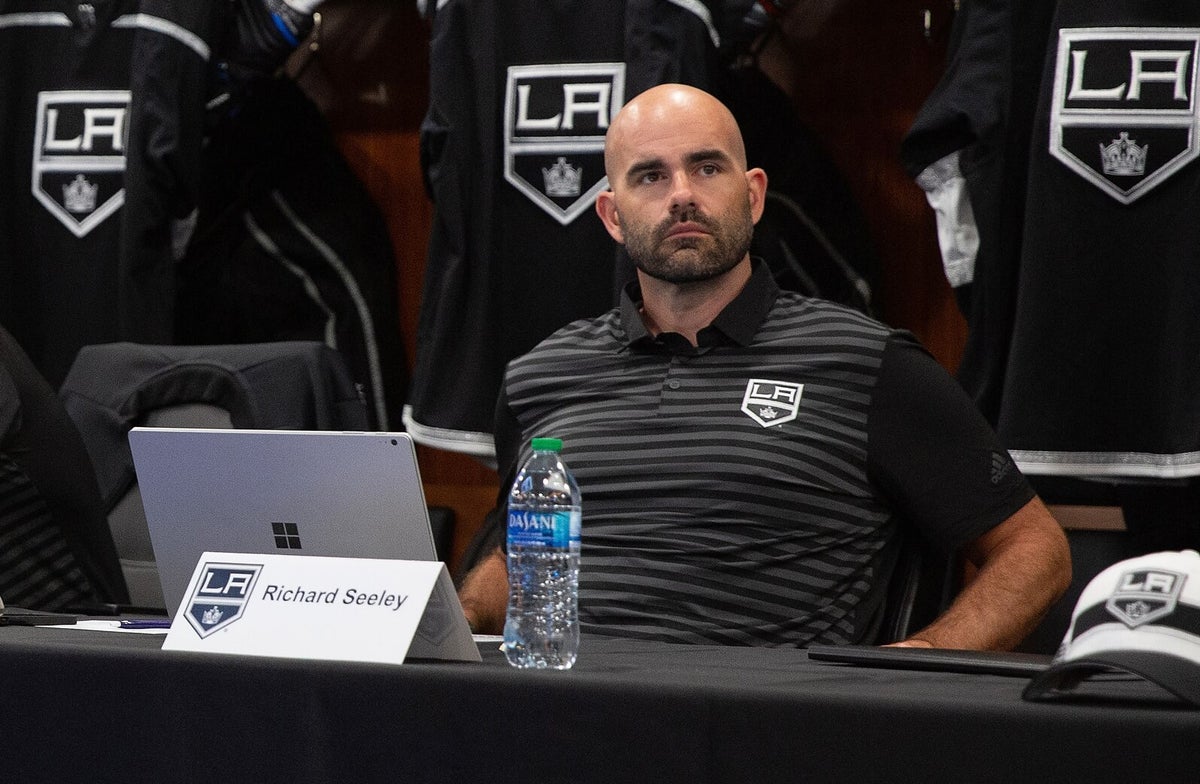
New Vancouver Canucks assistant general manager and Abbotsford Canucks general manager Richard Seeley is a local product.
Hailing from Powell River, B.C., Seeley’s joining the Canucks is a homecoming.
“Growing up in British Columbia and being in Powell River, you really get the sense of how important this team is to Vancouver and to the province as a whole,” Seeley told The Athletic on Wednesday afternoon. “You understand the kind of impact this team can have on and off the ice.
“Having some of that understanding of the local nuances in my background, it’s good, and it’s exciting.”
Seeley returns home to B.C. following over a decade working with the Los Angeles Kings, first as a head coach and general manager of the ECHL Manchester Monarchs, and then as the general manager of the AHL Ontario Reign for the past eight seasons.
A Powell River Paper Kings player during his BCHL days, Seeley had a 15-year pro career as a defenceman. While he never worked his way up to the NHL as a player, Seeley spent 15 years playing in the AHL and Europe.
Is Viggo Bjorck the best center in the NHL Draft?
Corey Pronman, Scott Wheeler and more
Now he’s been tasked with helping to launch a rebuild in his home province, and understandably, he’s thrilled for the challenge.
“I have family in the area, and I have a very supportive wife, and we all grew up watching the Canucks, and it doesn’t work without having that family buy in. So there’s a lot of excitement there. For sure, it means a little bit more …
“I’m excited to come in and help support Ryan and his staff here. What we all want now is to have a long run and go about winning Stanley Cups here in Vancouver.”
On Wednesday, Seeley took a moment to chat about implementing analytics in decision-making in the AHL, the central importance of player development and the lessons he took from having a front-row seat to the Kings’ rebuild in the earlier part of this decade.
Note: The following conversation has been edited for length and readability.
Richard, over the course of your American League management career, when did you first cross paths with Ryan Johnson and how would you characterize your relationship prior to the past week when you came to work for the Vancouver Canucks?
Ryan and I probably connected about five or six years ago. Obviously, our teams competed against one another, and we’d see each other at the rink or at AHL league meetings. Ryan and I have a mutual friend, a former teammate of mine, and when I introduced myself to Ryan, I led with that.
After that, we’d chat here and there, the odd time if we were looking at player transactions, or looking at potential fits for younger players. So we kept talking along the way.
More than that, I always really respected the teams that Ryan put together down in Abbotsford.
In those dealings, did you have a sense that there was some overlap in symmetry in how you and Johnson thought about the game?
In a sense, yeah. We always competed against each other, and I’d often lose a player or two to Ryan. And probably vice versa, too.
I came to really respect his eye for players, and the way his teams looked, competed, prioritizing leadership and had similar recruiting models. So there were some similarities for sure, and I admired some of the work he did from a distance.
You mentioned your supportive wife, and there are certain things you can tell from a guy’s hockey card statistics. And one thing I can tell from your hockey career is that you definitely have a supportive wife.
You had a long career in the American League and wore the “C” for multiple franchises. When you reflect on how your playing career has informed how you manage a team, and how you coached a team previously, how have you been able to apply what you learned as a player in how you manage today?
Yeah, I’ve got a couple stops.
I had a lot of great teammates. Spend the last little bit in Europe. Primarily with Los Angeles, the first five years I spent in their organization in the American League after getting drafted. It was fun, and I picked up some great life experiences, that’s for sure.
I think it just gives you a lens. It makes it a little bit easier to relate to some of the challenges that players have, since you’ve often experienced similar things in the past.
It goes to the human element, you’re just able to talk through it and have an understanding of what they’re going through and be supportive. You want to give players confidence, but you also have to have firm conversations with them at times. In that part, especially, I think my time as a player has been invaluable.
This is true for everybody, no matter what their background is. Everyone has a different lens to help them understand where they are now. For me, having been a player and been part of a team and having an understanding of how some of the successful teams I was part of operated, it’s been valuable to me. Then, going through, playing a lot of games in the American League level, too, I think it’s helped me relate to the players.
The other thing that leaps off your resume — a head coach and manager in the ECHL, a long career as a general manager in the American League — is that I think we can safely assume you’re a guy that’s worn a lot of hats. That fair?
Yes. And that’s part of learning, and I think a lot of successful leaders are constant leaders. Going back to my start in the ECHL, it was awesome. I learned so much about time management, how to prioritize things, especially because you are wearing too many hats in those types of roles. Now I look back and realize how much personal growth I went through during that time frame, learning how to recruit, learning how to handle challenges and all sorts of different things.
For me, learning along the way has been a big portion of it. That’s helped me to get to where I’m at today. I’m comfortable rolling up my sleeves, and I enjoyed learning in the ECHL and building those relationships. It was the same thing in the AHL, transitioning from coaching to being a full-time manager, and I was always surrounded by a lot of great people. I’ve been very, very fortunate.
There’s been a fair bit of talk since you’ve been hired about how you’ve been open-minded about utilizing data, and are seen generally as progressive by your colleagues within the industry. How did you utilize data in informing decision-making at the American League level?
We used data quite a bit, actually. Data and analytics has been a growing part of our game, and I use it, 100 percent. Being a leader, you want to learn. I wanted to understand how different parts of the game would be evaluated by an analytics department and take all of that in as part of the decision-making process. To not lean on that information would be foolish.
Now, that said, analytics isn’t going to be 100 percent of the decision-making pie. But you lean on and learn from what data tells you; it gives your human eye a different vantage point. It might draw your eye to a different type of player, one you might not have noticed right away.
I think the progressive part of it, it’s more about being open-minded, wanting to learn and trying to incorporate different perspectives to inform my own opinion.
I often wonder with the reams of data we have now — including player tracking data — and eventually, with the further implementation of AI, that across the board, the industry is getting more efficient at player evaluation. I wonder if you agree with that, and if so, what do you think that means in terms of shifting even more importance toward player development over the next 10 years in terms of how the best organizations in hockey should be functioning?
To me, honestly, player development has always been really important. I see it as the engine that drives success.
Ultimately, there’s a lot of young talent that comes over from the CHL or from Europe or from college, and the first time they enter professional hockey, for 99 percent of players, that’s going to be the first time that playing the sport has been really, really hard. Suddenly they face a little bit of adversity and need to figure out how to translate their game at the professional level, and then mature as people and players.
So, I think when you look at data points along the way, that’s helpful. I think the industry has a better understanding now, too, of the process or development curves. That said, we also know that it’s not always linear. In my experience, it can be frustrating at times, but different players take different amounts of time to develop, whether that’s physical or mental development. So as much as we want it to be linear, it just isn’t.
Utilizing data can be helpful for informing assessments of where various players are at as they move forward in their career, but I’ve always been a big believer in player development. I think if you’re able to help guys get better every day, that’s the engine that can drive your organization.
You had a front row seat in Ontario to observe a Los Angeles Kings rebuilding effort that began early on in your tenure. Is the experience you had working through that applicable to the new role you find yourself in today?
I believe so. When I arrived, after the organization won the Stanley Cup in 2012 and 2014, the organization was at a point where hard decisions had to be made. I’m not sure if it was a full rebuild or a retool, but guys like Tyler Toffoli and Jake Muzzin were moved out, and in came players like Quinton Byfield and Brandt Clarke and Mikey Anderson and Sean Walker. So I think it’s applicable to have gone through that, and it’ll be helpful here as we start that process.
Are there any do’s and don’ts from having seen that process up close in California that you’ll draw from in your new role?
Looking at it, I think the key is drafting, developing and patience.
You need to have the picks. You need to draft. You’re not going to get the engines and drivers that you need at the NHL if you’re not drafting them. The top players in the NHL, they’re just not making it to free agency. And they’re not often getting traded.
So you have to have enough draft capital to land the players you need. Then you need to have patience because development isn’t always linear.
You’re just trying to make smart decisions along the way, making draft picks and augmenting the players you draft that are — hopefully — future stars by fitting the pieces in around them. That’s where the data can help.
I guess the one thing I’ve learned and would think about too is that, as much as we might focus on data or development concepts, we’re also developing human beings. And that means finding the right fit matters. Just because one player or person isn’t the right fit in one organization doesn’t necessarily mean he’s not the right fit in another organization.
You’ve been the general manager in Abbotsford for a week, but you’ve already been busy. How would you describe the next two weeks from your perspective, given that within three weeks your lineup will be basically set and you’ll have a new coaching staff, too?
There’s a lot of great people here that are already in place. So you’re looking to just form some relationships, share a few principal ideas and learning about the organization. Talking to coaches, management and scouts, too, about their views of the players that we have, then gathering up some of the data and reading through the scouting reports, too.
So far, it’s been a lot of listening, a lot of questions, and it’s going to go quick. I’m buckling down, I’m ready to go, and I’m going to lean on some of the great people we have here, because this is going to move quickly here.
What will you look for in replacing Manny Malhotra as the next head coach in Abbotsford?
Historically, I don’t think the message that management and coaches are delivering has changed drastically across my 20 years in hockey, but I do believe the delivery of that message needs to reflect that the audience is inherently different. I’m very different from the young players that will be coming into the Abbotsford locker room this fall. So I think the delivery of that message is really important in a head coach.
We want to have a coach that has the ability to hold players accountable and teach, but also to strive to communicate that their foremost goal is to make their players better. You have to be able to give your players confidence, so a coach that cares is very important. And I don’t know that you’ll get your message across to players, unless the players know that their coach has their best interests at heart. That takes a certain type of person.
So that’s going to be the key to me. Someone who has that inner passion and drive to make players better, and the byproduct of that is that we’ll be OK in the wins and losses column if we’re focused on making players better.
This will be your 12th year on the management side, but the first time where you’ll officially have input on and shape an NHL team’s operation. How excited are you for this new challenge and this purview that you’ll have in this role?
One of the draws in this job was the people involved in this organization. In hockey, it’s all about who you’re going to battle with and who you’re tackling the next challenge with. Right now, it’s just about getting the right people involved in the organization and getting them in the right seat on the bus.
I was very drawn to the people that are on this bus, and I’m excited to play a role and support Ryan and this group going forward.
My background and in my title, is that Ryan has given me the confidence to run Abbotsford. So we’ll be having a lot of conversations about development, the timing of players, and how to best support our players to help them best realize their dream of putting on a Vancouver Canucks jersey.
For me, having gone through this with Los Angeles and a pretty robust player development program down there, I think I’ll be bringing in a unique perspective from another organization and how they worked. I think I’ll be able to take some good things from there, while also having the local knowledge because of my background, of what this team means to the city and the province.
I’m really looking forward to the challenge.
