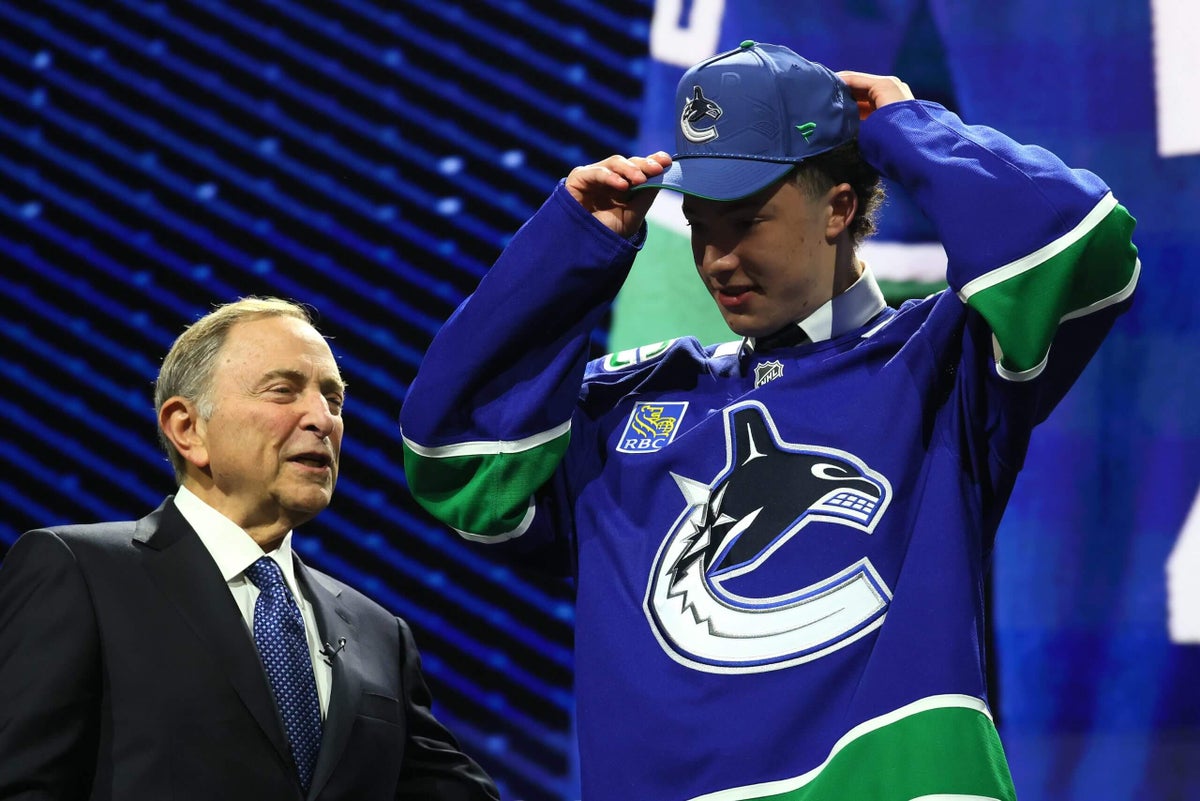
The 2026 NHL Entry Draft marks the first real rebuilding draft class this century for the Vancouver Canucks.
Among the picks Vancouver put to good use on Sunday were the ones they received for franchise defenseman Quinn Hughes, hard-working fan favourite Kiefer Sherwood, long-tenured veteran defenseman Tyler Myers and middle-six sparkplug Conor Garland.
In all, the Canucks entered the 2026 draft with 10 total picks, and emerged from draft weekend with nine new prospects and some additional capital in 2027.
There is still a ton of work to be done by the Canucks moving forward. Even beyond the development side of the equation, the goal for new Canucks brass is to build an almost entirely new young core that can lead the next great Canucks team out of the cellar and back to meaningful contention over the next five years or so.
The sheer amount of talent required to summit that particular mountain is enormous. This weekend, however, the club began the process of building up a base level of forward talent through the draft and demonstrated very clearly what Vancouver’s new decision-makers want this next generation of Canucks players to look like.
Let’s open the notebook and unpack what the Canucks did at the draft, what’s still needed to tie this offseason together and what comes next as development camp and the free-agent frenzy get underway next week.
Winners and losers from the 2026 NHL Draft
Scott Wheeler
Size, size everywhere
Clearly, new general manager Ryan Johnson and Canucks director of amateur scouting Todd Harvey have a type.
Vancouver was after one thing and apparently one thing only: athletic players, preferably with big bodies.
After the Canucks selected a 6-foot-2 centre with the third overall pick and added a heavy 6-1 power winger with the No. 24 selection on Day 1, the club doubled down on size by selecting massive 6-7 centre Brooks Rogowski with No. 33 on Saturday.
By the end of the draft, the Canucks had selected four forwards measuring 6-2 or taller: Malhotra, Rogowski, 6-4 winger Yaroslav Byzgalov and 6-4 Slovakian winger Lucian Bernat. Then, for good measure, with their final pick Vancouver selected a 6-5, 215-pound behemoth defensive defender in Samuel Eriksson. None of Vancouver’s nine draft picks across two days measured in at under 6 feet.
“You know what, we talked about this, and we had some direction from obviously (Johnson) and the staff,” Harvey told the media on Saturday after the draft had concluded. “We wanted to get bigger, we wanted to get faster, we wanted to get harder. Obviously we can say ‘Well, we didn’t take any skill,’ but don’t underrate the skill on these guys. Like, these guys have skill. And I think they’re still developing, but definitely we won’t get pushed around.”
By and large, the Canucks weren’t reaching for size. In fact, their most off-the-board selection — 19-year-old USHL forward Connor Davis, the fifth-round selection — was the shortest player the Canucks selected.
Rogowski, for example, didn’t exactly light the OHL on fire offensively during his draft year, but he has some reasonably productive NHL comps in his scoring profile, including players like Lawson Crouse and Pavel Zacha at the higher end of his statistical comparables.
While some of the NHL amateur scouts we polled expressed some concern about his ability to leverage his size in the hard areas of the ice and his overall consistency, Rogowski was widely viewed as an early-to-mid second-round pick. And he definitely had his supporters in the industry, who note that he’s a plus skater and believe he’s very likely to break out offensively with Oshawa this upcoming season.
Likewise with Bryzgalov. While there are more concerns about his overall skating ability and the deception in his hands, he’s widely viewed as a high-hockey-IQ bruiser and a potential plus playmaker from down low. Bryzgalov is a re-entry prospect and his production doesn’t jump off of the page for a 19-year-old in the WHL, but it’s worth noting he’s relatively young for a draft-plus-one player. Some of the sharpest western scouts I know thought the profile was interesting enough to warrant rolling the dice as early as Vancouver decided to do so.
Effectively, after landing a signature face-of-the-rebuild, two-way centre on Day 1, Vancouver largely found value from a variety of familiar fishing holes — the OHL, the Swedish junior ranks — in which the team has generally had success identifying talent, including in the late rounds.
This 2026 Canucks draft class might not be as chock-full of upside or value as it probably could’ve been, but it’s a strong class of talented, big-bodied athletes. Vancouver mostly found value where it belonged, and a variety of the players have the potential to provide some level of offensive value down the road if the Canucks can help their new prospects unlock their heavy skill game in the development process.
More than anything, incoming Canucks management has shown us clearly what they want the next generation to look and play like. Speed, size and character is clearly the order of the day for the Johnson-era Canucks at the draft table.
The leaper
Among the tree-like bets the Canucks placed throughout the 2026 draft, Norwegian forward Niklas Aaram-Olsen stands out.
Standing 6-1 and weighing in south of 190 pounds, Aaram-Olsen was one of the only welterweight forward types of Vancouver’s 2026 draft class. He is a skilled finisher who was solidly productive at the Swedish junior level and appeared in 16 SHL games, a good sign that his development track is accelerating quickly, even if he didn’t manage to record a point in the top Swedish professional league as a 17-year-old.
More than anything, though, Aaram-Olsen is a proper freak-level athlete.
At the NHL draft combine, Aaram-Olsen absolutely crushed the various jump-related athletic tests. These are typically the tests that NHL talent evaluators pay the most attention to, largely because they’re seen as correlated with explosive skating ability. In the standing long jump test, in particular, Aaram-Olsen recorded the best result in this draft class. The only players within two inches of Aaram-Olsen’s result were also two inches taller than the new Canucks winger.
“He’s a machine in the gym,” Harvey noted. “I mean, he’s a guy that’s pretty low-maintenance, a direct player when he’s on the ice. He’s direct and he skates quick. That kind of explosive skating, and he’s got a really good shot so he can beat goalies.”
Aaram-Olsen is likely to spend this upcoming season in the SHL, but is a Boston University commit and may join Caleb Malhotra at Agganis Arena for the 2026-27 season. In the event that Malhotra doesn’t sign an entry-level contract and turn pro before then, there’s even a chance two of Vancouver’s top picks may get the opportunity to play together at the NCAA level.
“We better call (BU coach) Jay (Pandolfo) and tell him they better play together,” Harvey joked. “That’d be great for our development.”
“When he gets excited, I get excited”
With their third-round pick on Saturday, the Canucks dipped into the pool of available goaltending talent to select Russian netminder Dmitri Ivchenko out of the Avangard Omsk pipeline.
Ivchenko stands 6-3 and is viewed as a technically proficient goaltender. He’s certainly put up sparkling results at every level he’s played at and appears to have spent some time in the KHL as a 17-year-old — though he never saw any game action — which is generally a bullish signal that he’s thought of very highly by Omsk coaches and development folks.
One wrinkle to be aware of: because of Russia’s invasion of Ukraine, which has directly led to Russia’s exclusion from IIHF competition, it’s very difficult for NHL scouts to enter the country to evaluate Russian-based prospects. Harvey told the media on Saturday that the Canucks were never able to get a live viewing of Ivchenko during the draft process.
This is an interesting dynamic. Vancouver’s process differs from that of some other NHL teams in that it strongly favours in-person viewings in the evaluation process. Goaltending, however, functions a bit differently due to the involvement of longtime Canucks goaltending coach, former director of goaltending and current goaltending scout Ian Clark.
“Ian Clark’s a big part of our process,” Harvey told the media on Saturday. “And he does such a great job. You know we all know how hard he works, and he’s on top of things. I think that he was he was excited, and when he gets excited I kind of get excited too.”
There’s a lot worth unpacking here, but first and foremost, this is a clear signal Clark is still deeply involved in Vancouver’s evaluation process at the very least. For years Clark had shaped Vancouver’s overall strategy as it pertained to goalie evaluation. After his withdrawal from the day-to-day coaching work during the 2024 offseason, however, Clark’s influence internally had dwindled precipitously. And with it, to be honest, so did the quality of Vancouver’s decision-making in the blue paint.
From the club’s decision to only sign Kevin Lankinen to a one-year deal, to the Artūrs Šilovs trade, to the long-term Lankinen extension, to the risky Demko extension, the Canucks have been on a very difficult cold streak in making transactional decisions in net.
If selecting Ivchenko is a signal that Clark may be getting more involved once again in Vancouver’s goaltending evaluation process, that would likely be a very good thing indeed.
Johnson’s first trade
Even as the NHL trade market has popped off with fans being treated to a veritable buffet of NHL trade news since just about the moment the Stanley Cup was awarded to the Carolina Hurricanes, it has been relatively quiet for the Canucks.
In fact, since the offseason kicked into full gear following the Stanley Cup Final, 28 of the NHL’s 32 teams had executed a trade before Johnson got in on the act on Saturday, executing a minor trade with the Toronto Maple Leafs during the sixth round of the draft.
The deal itself, in which Vancouver swapped out No. 161 (an early sixth-rounder) in exchange for Toronto’s 2027 fifth-round pick, was a straightforward value add. From Vancouver’s perspective, Johnson and company got a head start on accumulating additional draft capital for next season and fixed a slight win out of Vancouver’s trio of sixth-round draft picks.
The deal was tidy work for the Canucks, but obviously, it was a swap more likely to be remembered as a career milestone for Johnson as opposed to an especially consequential trade in the context of Vancouver’s rebuild.
For what it’s worth, the lack of trade activity out of Vancouver over the past 10 days doesn’t appear to be the result of a lack of effort.
Multiple league sources have suggested to The Athletic this weekend that Vancouver is eager to sell a variety of their veteran players. The club is open to discussing just about every established veteran on the roster, and one source even characterized the club as “desperate” to move off of struggling, highly-compensated centre Elias Pettersson. We know too that Jake DeBrusk has been in play, and there are various teams doing their homework — including the Ottawa Senators — on the possibility of adding the net-front specialist to their lineup.
On Friday, Vancouver explored various scenarios to move around the draft board. I’d wondered if perhaps Vancouver had been among those teams attempting to move up and acquire the Philadelphia Flyers’ pick for the purpose of selecting Ryan Lin, but have been told that it was the Calgary Flames, Anaheim Ducks and of course the Sharks that had bid up for that particular trade return.
In any event, now that the seal is broken and Johnson is in the book as having executed an NHL trade, hopefully the dam will begin to break here.
The situation he has inherited, after all, is a dire one. Emergency measures to shed inefficient commitments attached to depreciating assets and clear the decks for the purpose of efficiently accumulating future value over the next 24 months will be required to turn this particular franchise around.
In that context, Johnson’s first career trade felt like something of a microcosm of the dynamic that we saw unfold for the Canucks throughout the weekend. The deal with Toronto was solid work, competent. It was a win in normal circumstances, much like Vancouver’s unsexy but valuable haul of high-character, highly athletic, high-floor prospects at the draft.
The question, even if it doesn’t rise to the level of a concern or a criticism just yet, is whether the good work that the Canucks are pulling off is sufficient given the circumstances — or whether more aggression on the trade market, and a greater level of risk tolerance at the draft table, may be required to catch up to the pack in a reasonable enough time frame to pull this rebuilding project off.
