Welcome to Sliders, a weekly in-season MLB column that focuses on both the timely and timeless elements of the game.
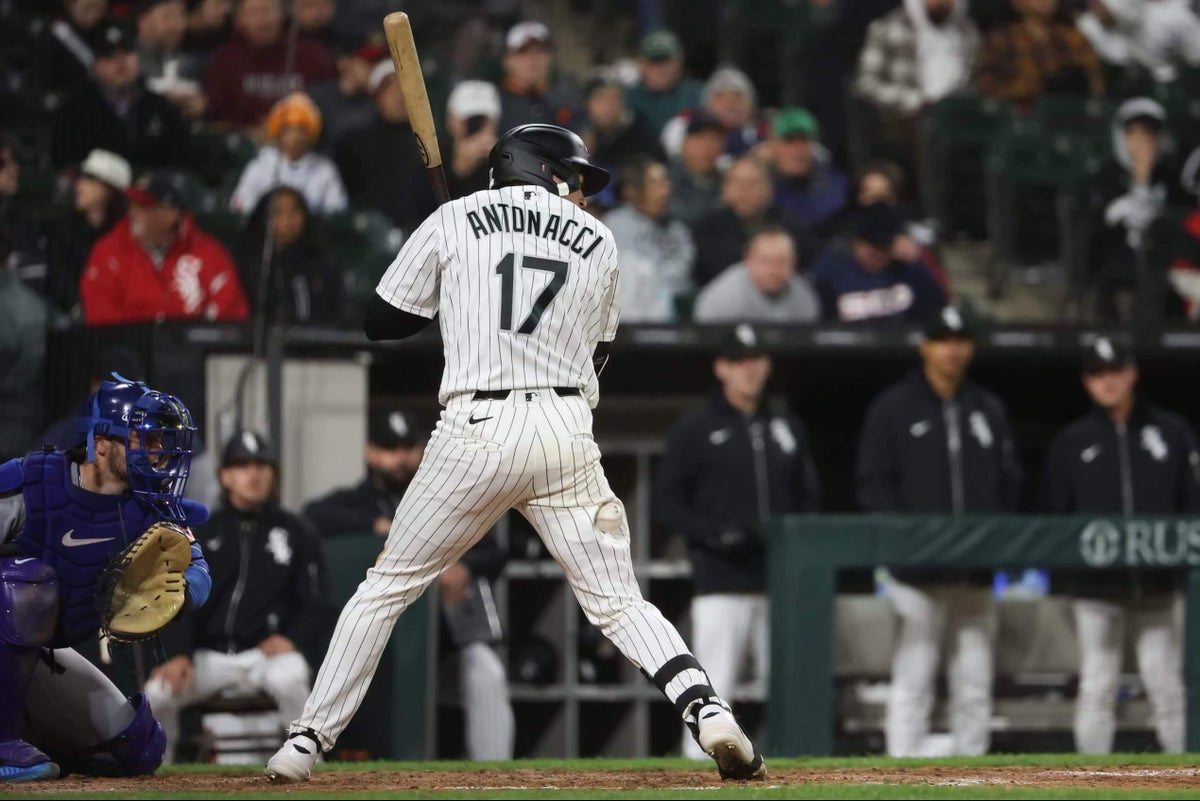
NEW YORK – Ask Sam Antonacci if it hurts to be hit by a pitch, and he looks at you as if the question makes no sense.
“No,” he said, impassively. “Not really.”
Fear of the baseball — the very rational anxiety that drives away so many hopefuls when the pitching gets tough — does not compute for Antonacci, a rookie pest for the upstart Chicago White Sox. The franchise dates to 1901, and in all that time, no player in the major leagues has been hit by a pitch so often in so few games.
It took Antonacci only 48 games to be plunked 15 times. He flinched just once, on June 7 in Philadelphia, when the Phillies’ José Alvarado drilled him on the elbow guard with a 100-mph fastball. Antonacci needed a minute to collect himself and assure the manager and trainer he was fine.
Otherwise, he has been an expert in “Tubthumping”: he gets knocked down, but he gets up again. Off the shoulder at 97 mph, off the calf at 93, a cutter to the hip, a sweeper to the kneecap, no problem. Antonacci was recently drilled in four consecutive games, and achieved a franchise first by getting hit twice in the same inning on May 22.
Sam Antonacci was hit by a pitch TWICE tonight in the fourth inning 😳#WhiteSox pic.twitter.com/UxdRQyPXNv
— Milb Central (@milb_central) May 23, 2026
“It’s just knowing that I don’t have that luxury of being able to hit 30 or 40 home runs in a season,” he said at Yankee Stadium on Wednesday. “I have to find different ways to produce, and that just happens to be one of them. I guess just being unselfish, trying to get on any way I can. I’m not going up there trying to be hit by a pitch, but if he happens to throw one at me, I’m not going to move out of the way.”
Antonacci has twice been challenged by opponents — unsuccessfully — on balls that merely grazed his jersey. It’s an occupational hazard he gladly accepts. Since the start of the 2024 season, when Chicago drafted him in the fifth round, Antonacci has been hit by pitches 91 times.
That covers games with Coastal Carolina University, the White Sox and their affiliates, Glendale of the Arizona Fall League and Team Italy in the World Baseball Classic. And it is not normal.
Josh Barfield, the assistant general manager for the White Sox since September 2023, had 1,075 career plate appearances and was hit by a pitch five times. Antonacci needed a mere 70 to match Barfield’s total, and now he’s blown past it.
“It’s who he is, it’s the way he plays the game,” said Barfield, whose father, Jesse, a 1980s star for the Toronto Blue Jays before joining the Yankees, was hit by 34 pitches in 12 seasons.
“When he’s on your team, you love him. When he’s on the other team, you hate him. He’s just a grinder. He’s going to stick his nose in there, he’s an agitator on the field, and he just makes things happen. He brings so much energy to this team every day. You love him for it.”
Sacrificing his body has helped Antonacci to a .380 on-base percentage through Thursday for the White Sox, who are 39-34 after winning one of three against the Yankees this week. The White Sox have three sluggers in the middle of the order — Colson Montgomery, Miguel Vargas and the injured Munetaka Murakami — and Antonacci bats in front of them, hitting leadoff against righties or ninth against lefties.
“He’s done a great job of setting the tone every day,” second baseman Chase Meidroth said. “Being a rookie, he plays well above his age and he’s a big part of what we do.”
Antonacci, a left-handed hitter, belted a 422-foot homer during the Yankees series, but his spirit is better defined by his first career homer: an inside-the-parker in Arizona on April 21. Antonacci slashed a ball down the left field line, and Diamondbacks outfielder Lourdes Gurriel Jr. gave up on it, believing a ballboy had interfered. Antonacci never stopped running and slid headfirst into home.
INSIDE-THE-PARK HOME RUN FOR SAM ANTONACCI 😮💨 pic.twitter.com/cjgADPis9X
— Chicago White Sox (@whitesox) April 22, 2026
His enthusiasm also shows up in the field. Antonacci — who has made no errors — usually plays left, but he has started three games at second base and also played third, first and shortstop in the minors. He used to pitch, he said, and still catches bullpens in the offseason.
“As a kid, you just want to play every position you can,” said Antonacci, who is 23 and grew up rooting for the St. Louis Cardinals in Springfield, Ill. “That’s something I took pride in. I always wanted to catch when I was younger, shag in the outfield, throw in the bullpen. It helps make the game fun, too, just never knowing where you’re going to be the next day.”
The White Sox never knew they would be here, at or near the top of the American League Central, after three 100-loss seasons in a row. But their young core is improving together, and their haul from the Boston Red Sox in the Garrett Crochet trade — Meidroth, outfielder Braden Montgomery, reliever Wikelman González and catcher Kyle Teel, who will soon return after hamstring and knee injuries — is looking better and better.
The team won four of five last week against the Atlanta Braves and Los Angeles Dodgers, and even the loss was a moral victory: Tristan Peters, a Tampa Bay castoff who has thrived in Chicago, foiled a no-hit bid by Yoshinobu Yamamoto with a homer in the ninth.
General manager Chris Getz may need to bolster the rotation before the trading deadline to keep the White Sox in contention. But so far they are enjoying life as the AL’s breakout team — leaning into it, you might say, like Antonacci at the inner edge of the batter’s box.
“This is the best talent we’ve had since we’ve been here, but it’s also just the way they play the game,” Barfield said. “We have guys that are more versatile, guys that can play defense, they can beat you on the bases, beat you with a homer or beat you by bunting a guy over.
“I think the team has embraced that identity. There’s no egos. It sounds cliche, but it’s a bunch of good guys in that clubhouse and everybody’s pulling for each other. Once you start to believe a little bit, special things can happen.”
Trotting in Memphis
For Cardinals prospect Joshua Báez, a powerful way to honor his father
Whatever happens on the field every June 16, the day is never normal for Joshua Báez, a top outfield prospect for the Cardinals. That was the day, three years ago, that Báez lost his father, Jose Manuel Báez, to a heart attack in his mid-50s.
“You show up to the ballpark and try to get distracted and just have a good time with the guys and perform, try to get something positive out of it,” Báez said by phone on Thursday, after batting practice with the Triple-A Memphis Redbirds.
“He played baseball his whole life and he was always really, really proud of me having the chance to play professionally and the chance that he didn’t get.”
This year, June 16 fell on the first day of a series against the Nashville Sounds in Memphis — and Báez had the game of his life. He homered four times and drove in seven runs in a 12-5 victory, a stirring start to the week leading up to Father’s Day.
A FOUR-HOMER GAME FOR JOSHUA BÁEZ! 🤯
The @Cardinals‘ No. 3 prospect becomes just the third Minor Leaguer this decade to deliver a quartet of roundtrippers: pic.twitter.com/3cRsqt88Is
— MLB Pipeline (@MLBPipeline) June 17, 2026
“My mom was here on top of the dugout, and every time I would get back, she would be bawling her eyes out, just from how special and how different the vibes felt that night,” said Báez, who had never hit more than two homers in a game.
“He meant so much to me and it was really emotional during the game. For me, I kind of just took trips to the bathroom (between innings), soaked it up and just went back out so I could do the job.”
The homers — three to left field and one to right-center — traveled a combined 1,510 feet and gave Báez 23 for the season, leading all Triple A hitters through Wednesday. He became the first player ever with a four-homer game for the Redbirds, who were founded in 1998.
Báez, 22, was a second-round draft pick by the Cardinals in 2021 out of Dexter Southfield School in Brookline, Mass. He was born in Boston but spent much of his early childhood in Bani, D.R., where his father grew up playing baseball with Miguel Tejada, among others.
“He was that guy, he’d get walked with the bases loaded to not get four runs,” Báez said of his father. “Every time I go back home to Bani, I always get recognized and people come up to me randomly and talk about him, just how much we’re similar and how much raw power we both have.”
Báez moved back to Boston with his mother and siblings at age 11 but remained very close to his dad, who stayed in the D.R. for work while playing baseball part-time. His son should soon achieve the ultimate goal of any aspiring ballplayer: a spot in the major leagues.
“Don’t change anything,” Báez said, when asked what he still needed to do to earn the call. “Be myself, be present, keep a calm mind and continue to have fun.”
Five questions with…
Marty Lurie, star of “Baseball Mensch” on Amazon Prime
Marty Lurie has been a Bay Area radio institution for 30 years, always ready with a smile and an anecdote, always hustling for interviews that tie baseball’s rich past to its fascinating present.
Lurie himself has a compelling life story, now featured in a documentary by Randy Field called “Baseball Mensch: The Marty Lurie Story,” available on Amazon Prime. Lurie was supposed to travel to Cooperstown, N.Y., this weekend for a screening at the Hall of Fame, but a back injury canceled the plans.
Still, he’d like to have a presence at the Hall when the time is right, with plans to someday donate all of his interview archives to the library. It’s a destination he never could have expected during his first career as a criminal defense attorney, a life he left behind to become a rookie broadcaster with nearly a half-century of life experience.
Lurie’s unusual perspective has served him well. A big-league clubhouse might seem tricky to navigate, but it sure ain’t life or death.
“I was 49 years old walking in,” Lurie says in the film. “And I’d been through, as I tell people, ‘Look, I’ve been in the holding cell with someone who cuts people’s heads off. It doesn’t worry me to talk to you. Let’s talk about baseball.’”
You’re renowned for your knowledge of baseball history. How has that served you professionally? I’m 80 and as I tell people, it’s good to be old in baseball because you know this stuff and you can share it. It’s almost like your religious experience. It’s generational and that’s what baseball is anyway. When I watch somebody play right field today, for me, in my mind, I’m watching Carl Furillo play right field. And that’s what baseball’s all about, is how it connects people together. It’s one of those sports, if you showed up from out of space, and you came in 100 years later, 1908 to 2008, it’s still the same game. The people and the names have changed, but it’s the same feeling. And that’s why people love going. So the film gives us a chance to kind of celebrate that, the good part of baseball.
How were you able to fit so smoothly into a new career after getting into it so late? Over those 49 years, baseball never left me. It was like someone who studied playing the piano. I read the Sporting News every week, had baseball cards, read the box scores every morning. I loved listening to baseball on the radio. I remember having a short wave radio and staying home from school in 1958 and I heard Stan Musial’s 3,000th hit on Armed Forces Network. In ’82, I remember laying on the floor trying to get the station so I could hear the Brewers/Orioles (Game 162), which was a fabulous game where (Jim) Palmer got lit up. So it’s always been part of my life. It’s always made me feel good. In those moments of criminal law and those tough days and working so hard, I always had that safety net of coming back to being a kid again and thinking about baseball. So when I walked in at 49, I was ready to talk about what happened in 1956.
You had a close connection with Willie Mays. How did that come about? Willie and I had so much fun together because I was a lawyer and he loved to tease me and he’d say, “Can’t you ask better questions than that?” This is in front of 500 people. And I’d say, ‘Wait a minute, you’ve been milking that catch for 60 years, everybody in the park knew you had it.’ But the one thing, when I first got with Willie that I think changed our relationship, he said, “Name the 1956 Cincinnati Reds, go ahead!” And he used to sit at his table in the clubhouse at spring training and I would sit with him and I’d say, “All right — Ted Kluszewski, Johnny Temple, Roy McMillan, Frank Robinson, Gus Bell, Wally Post, Ed Bailey.” And he said, “Yeah, who was at third, though?” And I went, “Ray Jablonski!” And at that point I knew that he knew that I knew, and we had a different relationship. So the movie brings that out. It brings out my love for the game and how it impacted my life and how I’ve tried to impact other lives with what I do.
How did being a lawyer help as an interviewer? Number one, it taught me how to ask open-ended questions to ballplayers. My job is to not tell you what I think, but I want to hear about what you think. Picking juries and doing the death penalty cases, you wanted to know what was on the mind of your jury. “Will you be fair? Yes? Well, why will you be fair?” So, that (helped) me interview baseball players. I’d say to Ken Griffey Jr., “Why did you like baseball as a kid? I know you played in the clubhouse and all that, but what was it?” And he’d give an answer. I interviewed a fellow, he was a Tiger fan and he owned Fitzpatrick Chevrolet, which was one of our sponsors. And he was an old man, let’s say this is 2000, and he went to a game in the World Series in ’34 against the Cardinals. And I said, “What do you remember about it?” And he said it was going by bus with his family, and his anticipation of getting there. I like to hear those stories, because everybody has a baseball story. Everyone does.
I love that “holding cell” quote from the movie. It must help when you’re just never afraid, right? When I was at Candlestick, I remember Bobby Bonilla. He was always a little bit cocky, and he was with the Mets and we had to get sound after the game and send it out. And he was just dawdling around after the game, just standing there talking to people. And finally I said, “You know, we have work to do here.” And Bobby Bonilla said, ‘Oh really? We’re gonna stop what we’re doing just to help you?” And everyone looked at me and I said, “Hey, I felt it was time to say something to him.” I wasn’t intimidated, I guess that’s the point. That’s the being-a-lawyer part.
Off the Grid
Bob Johnson, 40+ WAR, outfielder
When Nick Kurtz ripped two home runs for the Athletics on Monday, it gave him 54 in his young career. That prompted this fun list from the great Sarah Langs:
Most home runs in first two seasons of career, A’s history:
Bob Johnson: 55
Nick Kurtz: 54
Mark McGwire: 52 https://t.co/lC9BtWwHS8— Sarah Langs (@SlangsOnSports) June 16, 2026
You probably know about Mark McGwire, but Johnson’s very plain name is mostly forgotten. He starred for the Philadelphia A’s from 1933-1942, a quarter of the franchise’s 40-year stretch without a pennant.
Johnson was remarkably steady; in each of his first nine seasons, he hit between 21 and 34 homers while driving in 92 to 121 runs. It beat working at the fire station in Glendale, Calif., where Johnson was a pump engineer before his older brother, Roy, signed with the Detroit Tigers.
Bob considered himself a better player than Roy and pursued his own pro career. While the brothers would both hit .296, Bob’s personal scouting report was right. He outhomered Roy, 288 to 58, and Baseball Reference credits him with 55.5 career WAR to Roy’s 17.3.
Johnson was born in Oklahoma and grew up in Tacoma, Wash., and because he was a quarter Cherokee, he was widely known as “Indian Bob.” His SABR biography cites a 1934 story from the Chicago Tribune in which Johnson summed up his background more succinctly.
“If you ask him his nationality,” the story says, “he’ll say, ‘American.’”

Classic clip
Final pitch of the College World Series, 2005-2025
The best-of-three College World Series Finals begin on Saturday in Omaha, Neb., with the University of North Carolina seeking its first title against the University of Oklahoma.
In that spirit, here’s a compilation of the final pitch of all but one of the College World Series going back to 2005, courtesy of GhostOfNeylandFilms. (Arizona’s 2012 clinching moment can be found here, with a view from the dugout and on-field interviews.)
I see only a few future MLB players from these moments of victory: pitchers Louis Coleman (LSU, 2009), Jackson Kowar (Florida, 2017) and Jake Eder (Vanderbilt, 2019); a pair of future All-Stars from South Carolina: Whit Merrifield, who lashes the winning hit in 2010, and Jackie Bradley Jr., who squeezes the final out — and hurls it skyward — in 2011; and Oregon State outfielder Tyler Graham, who makes the final catch in 2006.
If you spot any others, drop ’em in the comments — and enjoy the action this weekend in Omaha.
