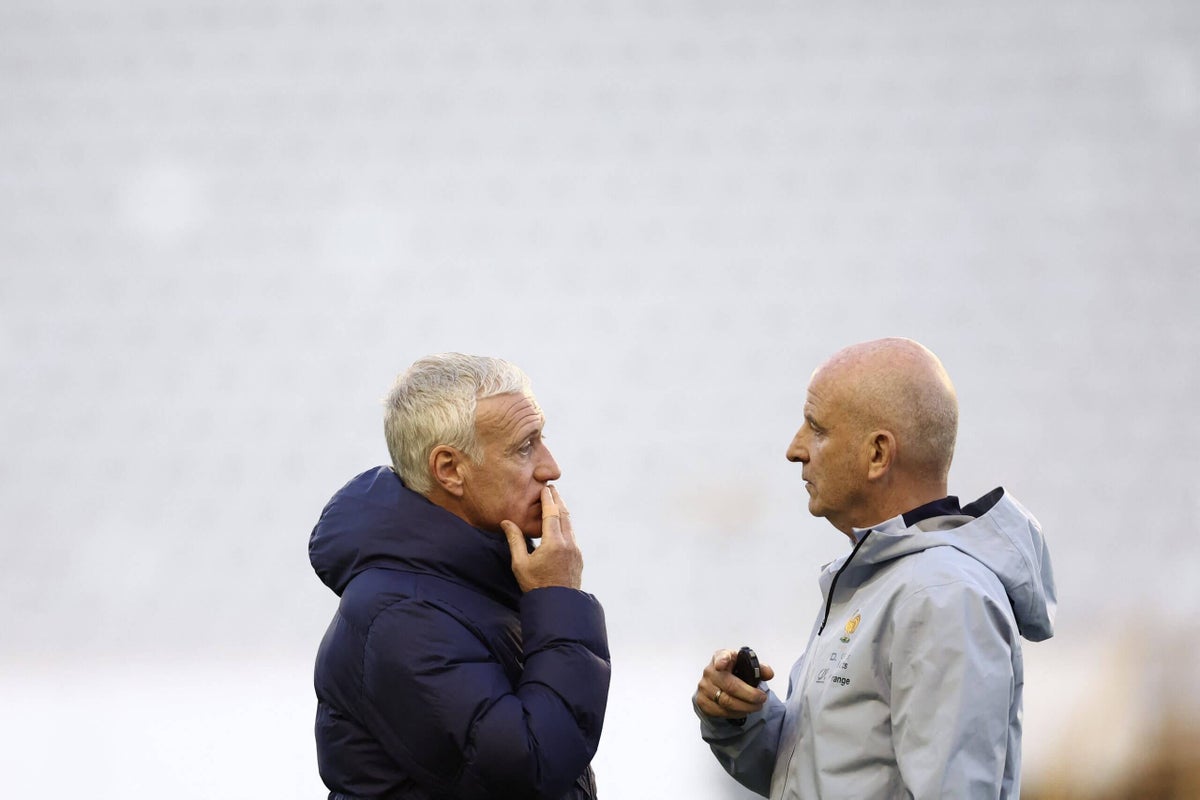
This piece was first published during Euro 2024, but it has been updated to reflect further conversations with Guy Stephan during a second interview with The Athletic in Washington D.C. in March 2026.
On a usual France match-day, Didier Deschamps will go into Guy Stephan’s bedroom, pick up an electric razor and shave his assistant’s head with light, gentle strokes.
Nobody else will be present but the ritual is an essential part of a matchday routine that dates back to 2014. There are other superstitions: at every meal — breakfast, lunch and dinner — Stephan sits to Deschamps’ left. On every bus ride and plane flight, he sits to his right.
“It’s all about balance, there’s nothing political about it!” Stephan laughs.
The proud Breton has been Deschamps’ number two for the last 17 years: the first three at Marseille and the last 14 with France. They endured tough times together at Marseille, a “volcanic” club, in Stephan’s words. But their relationship goes back even further than that, to 2000, when Deschamps, then the French captain, and Stephan, assistant to then-manager Roger Lemerre, won the European Championship.
It has been a phenomenally successful alliance, yielding league titles at Marseille and three finals at major tournaments with France, including winning the 2018 World Cup in Russia. Major disappointments, such as a shock last-16 defeat to Switzerland at Euro 2020, have been rare.

Guy Stephan talking to the media ahead of the Norway game (FRANCK FIFE / AFP via Getty Images)
“It hasn’t always been linear,” Stephan tells The Athletic. “But despite those few defeats, we’ve managed to hold on.”
The bond between Stephan and Deschamps — who will step down after the World Cup — is now so strong that they often do not even require words to communicate.
“We understand each other,” Stephan says. “We don’t even need to speak anymore. A glance is enough when we’re out on the pitch or at a training session; if something needs changing or tweaking, we just look at each other and —boom— it’s as if we’d actually spoken. That’s the strength of the time we’ve spent together — 17 years. We don’t always agree — not always… We talk things through, but once a decision is made, it’s made.”
On Friday afternoon at Gillette Stadium near Boston, Stephan will emerge from a career in the shadows to take centre stage in the France dugout. That telepathy, between head coach and assistant, should put Deschamps’ sporting mind at rest even from afar.
Due to the passing of Deschamps’ mother this week, he has returned to his native country to mourn with his family. Stephan will assume temporary reins for the third group game against Norway. He has done so once before, coaching the team in a defeat against Denmark following the passing of Deschamps’ father in June 2022, but aged 69, this will be his first time doing so for France at a major tournament.
Stephan is, almost certainly, the coach at this World Cup with the most international tournaments to his name. Stephan is now at his fourth World Cup alongside Deschamps. Yet he had prior history, too, having served as the assistant to Lemerre when France won Euro 2000, before leaving the job after the World Cup in 2002. Stephan also had a couple of years coaching Senegal, bringing his total major tournament haul up to 10.
Stephan and Deschamps had what the assistant describes as a “normal” coach-player relationship at Euro 2000, but they crossed paths again when both men worked as analysts in a television studio in 2007. Deschamps asked Stephan to work with him. “I said ‘OK!’ There was a brief flirtation — something with Liverpool — back in 2008. A little something, but it didn’t work out. Then came Marseille in June 2009.”
As for France, this, he insists, will definitely be their final tournament, with Zinedine Zidane expected to take over. “People will miss Didier later on,” Stephan says. “That’s not a criticism of the new manager at all. They’ll just realize everything that was achieved over fourteen years. But people want change; they like a change of pace. Journalists like having new stories to write, too—it’s normal. That’s life!”
Stephan did not tread the traditional route into football management. His father, a mechanic, thought being a footballer was not a profession and, while Stephan’s secondary school PE teacher, Claude Perrard, was an encouraging presence, he enrolled in a teacher training course at the behest of his parents.
He does not regret it. “My career path would probably have been different, not better or worse, had I turned professional before studying,” he says. Stephan was, in his own words, “a good player, not a very good player” but he still represented France’s youth team.
Between the ages of 19 and 23, Stephan spent his weekdays training to be a teacher in Dinard, Brittany, and then on Saturdays driving 90 minutes to play for second division side Guingamp. He had a close relationship with the club president, Noel Le Graet, who went onto become FFF president for 12 years, from 2011 to 2023.
Stephan qualified as a sports teacher but did not return to the classroom. Instead, in 1980, aged 23, he became a professional footballer, joining Rennes — his eldest son Julien, who was born there, is their current manager. It was the start of a professional playing career that also took in spells at Le Havre, Orleans and Caen.
Then, on July 24, 1986, everything changed. Stephan was travelling home after training at Caen when he was involved in a serious car accident. He fractured his jaw, leg and elbow and sustained such a serious head injury that he was put into a coma.
“I learnt you have to get up again,” he says. “It’s obviously difficult at the time, for you and even more difficult for those around you. You tell yourself that you’ll get back up again.”
After several months of rehabilitation and physiotherapy, Stephan returned to training but soon realised “it wouldn’t be like before”. He struggled to return to the same level and, at the age of 29, decided to retire.
But Stephan’s football story was not over. His calling was always to teach in some form — his knowledge of psychology, physiology and pedagogy acquired from his teacher training helped him gain his coaching qualifications — and so he became Caen’s first-team assistant alongside Pierre Mankowski.
The coaching profession has evolved over the years. When Stephan started out in the 1980s, coaches tended to be, in his words, “authoritarian” and “ruled with an iron fist”. But times have changed and coaches have had to adapt too.
Deschamps has faced criticism for being too functional but Stephan disagrees he is “old school”. Despite winning the World Cup and Euros, plus three Champions League titles, Deschamps hardly ever harks back to his playing days and instead stays reactive to the present moment.

Stephan and Deschamps prepare for a Marseille game in 2009 (GERARD JULIEN/AFP via Getty Images)
“He’s got something extra,” Stephan says. “The main thing is to always be aware of what’s going on out there. You’ve got all the generations, you have to talk a lot with the players. It’s important for them to express themselves.
“In that respect, Didier is very, very strong. He’s very good at talking one-on-one with a player — he spends a lot of time and energy on that. Today’s coaching job is all about human relationships and getting the best out of the player. He has evolved. He’s closer to the players than he used to be.”
But if Deschamps is close to the players, he is even closer to Stephan. During an interview with The Athletic in Washington D.C., Deschamps briefly gatecrashed — received by Stephan with a traditional French kiss on both cheeks — and he called Stephan, who turns 70 in October, “un gamin” (the youngster).
“We spend much more time together than we do with our wives when we’re in camp,” Stephan laughs. “We think about football in the same way, even if there are some differences. We mustn’t leave room for the slightest leak. Sometimes they cause problems and conflict in a group. We have to try to resolve it as quickly as possible. But there are always some. The media, you’re too strong,” he chuckles.
Stephan is energised by the turnover of players in the France squad for this tournament. He describes this as “oxygenation.” The generation of Hugo Lloris, Raphael Varane, Paul Pogba and Olivier Giroud has passed on, and the team is now from a largely younger generation, powered by Kylian Mbappe, Michael Olise, Ousmane Dembele, Desire Doue, Bradley Barcola and Rayan Cherki.
Could Mbappe break the men’s World Cup goal record?
James Horncastle
“But you need both things: individual quality and collective quality,” Stephan warns. “For a coach, it’s collective quality that ensures longevity. But it’s the individual talent that wins you games.
“One of our main tasks is observing players and being able to recognise — at a certain point — that a player is at the elite level because of their technique, their intelligence, and their power. Sometimes— and I don’t mean this in a derogatory way —we hear people in the media say, ‘Hey, that player ought to be playing.’ I don’t want to name names, but they have no idea. People, generally speaking, have no idea of the power, technique, and intelligence required to play at the elite level.”
The players are just one team but there is a whole backroom staff to align as well. When Stephan started out coaching, he, like many in that era, did almost everything, including training the goalkeepers and preparing players physically. Now, he is responsible for devising the daily training programme and writing it on the flipchart, but an army of around 20 other staff members also have an input, from the team chef to data and performance analysts.

Didier Deschmaps flanked by Guy Stephan and goalkeeper coach Franck Raviot (Franck FIFE / AFP via Getty Images)
Even so, Deschamps has a tight inner circle of technical coaches — Stephan, goalkeeping coach Franck Raviot and physical trainer Cyril Moine — which is far smaller compared to other national teams. He can rely on them to be, in Deschamps’ words, “fuel to his thinking”. His style is quality over quantity, with loyal, competent staff covering every base from medical to media.
One of the difficulties managers face is keeping players who do not feature in matches on board. That has become even trickier with the increase in squad sizes from 23 to 26, a rule initially introduced at Euro 2020 because of the global pandemic. A little like England with Jordan Henderson, there are players selected for what they bring to France off-the-field, in the example they set. N’Golo Kante, now 35, remains in the France squad.
“It’s difficult for a player — someone who played in 2018, for example — to stay with the squad and become a substitute,” says Stephan. “There are always exceptions, though. Kante: Fantastic man. Fantastic mentality. When he plays, he performs at the right level, and when he’s on the bench, everything is fine. There are very few players like that.”
Beyond training and match preparation, Stephan’s role is to “oil the cogs”, as he puts it, including from a psychological aspect.
“I know the manager’s plans for the next match. I can anticipate. Who is going to be affected? When I’m walking down a corridor or going for lunch and cross paths with a player, I ask how he is, how his family are. I try to find a topic of conversation that will lead to an exchange.
“I can see whether that player seems down or not, whether he’s smiling. I don’t have to report all the information because there’s a certain trust with the player which is also very important. Then, in training sessions, I can engage him as much as possible.”

Stephan and Deschamps running a France training session (FRANCK FIFE / AFP via Getty Images)
In turn, that creates a more sustainable environment throughout the tournament, which is needed if a team is to go far.
Ask Stephan what makes a World Cup-winning manager, and he could not be clearer. “You need to detect everyone’s qualities, bring people together, be a good psychologist, strategist and someone who obviously takes responsibility for results, whether good or bad,” he says.
What strikes him, however, is Deschamps’ calm persona in big pressure moments.
“He transmits serenity to the group,” says Stephan. “He’s focused but he’s not uptight in his language. Matches are often won in the second half and substitutions. We talk a lot during and after games. Sometimes there are questions on the bench. He asks my opinion and there’s a certain pressure to get results. That’s true for everyone. But he’s not a stressed person. That’s one of the reasons for his success, too.”
“I’ve watched Didier grow. I’m older than him (by 12 years) so he owes me respect, I say that with a smile. He was already very good and I’ve seen him get better.”
