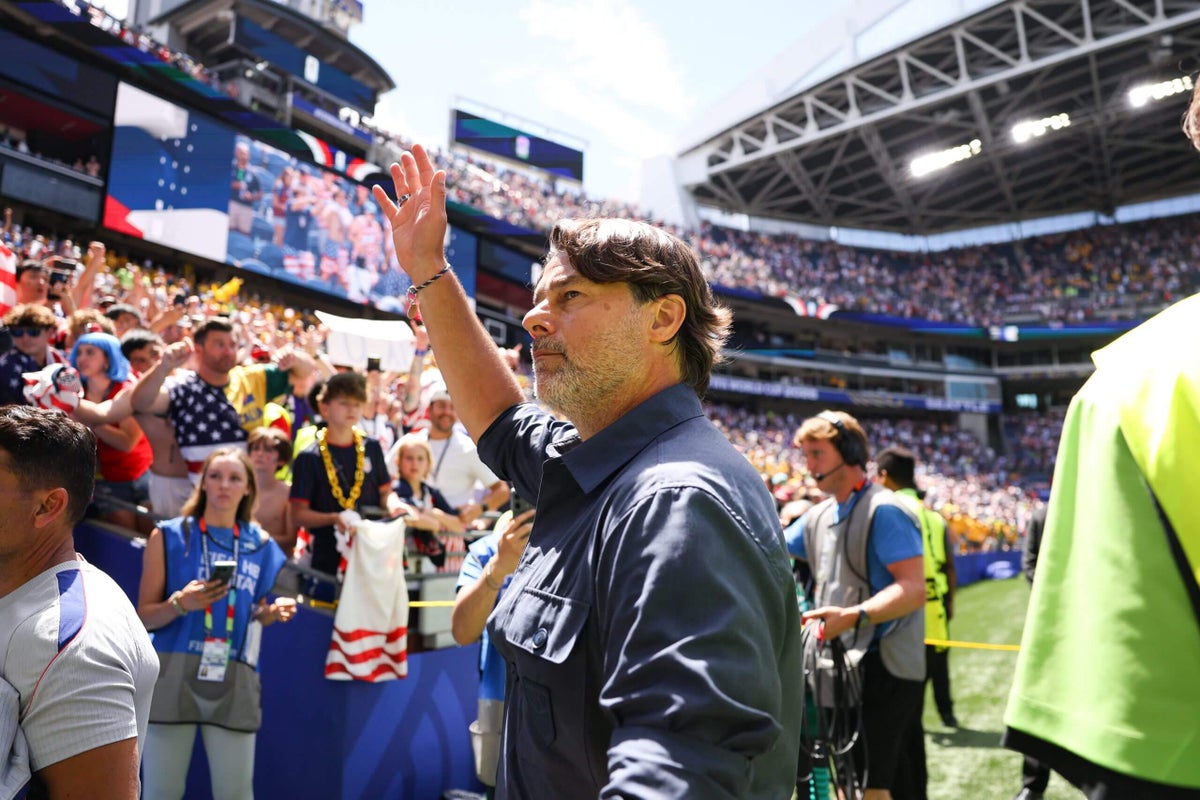
No country has ever won the World Cup under a manager or head coach born outside its borders, yet this tournament features more teams with non-native bosses than in any previous edition.
Of the 48 nations competing in North America, 28 managers who are classed as foreign — including the two employed by Tunisia — have sat in the dugout.
Unlike with players, there are no requirements for managers to have any family ties with the country they represent, which is why it’s acceptable, if not totally normal, for England to be led this summer by a German, the United States by an Argentinian and Canada by an American.
Get free access to the most comprehensive World Cup coverage in The Athletic app
The list, as you can see below, is extensive and features five Frenchmen, five Argentinians, three Spaniards, three Italians (awkward, as Italy didn’t qualify) and two Englishmen, plus 10 coaches of other nationalities.
Some of the more striking appointments are Thomas Tuchel taking charge of England, Mauricio Pochettino coaching the United States and Jesse Marsch at the helm of Canada, but perhaps the biggest of the lot is Carlo Ancelotti, who is hoping to guide Brazil to a sixth World Cup as the first foreigner in charge of their team.
If Ancelotti’s huge success at club level was not enough for Brazilians to get excited about, then the sight of the 67-year-old performing keepy-uppies with his coaching team might have done the trick.
So what is it like to manage the national team of another country?
Foreign World Cup managers
| TEAM | MANAGER | MANAGER NATIONALITY |
|---|---|---|
|
Algeria |
Vladimir Petkovic |
Bosnia and Herzegovina |
|
Austria |
Ralf Rangnick |
Germany |
|
Belgium |
Rudi Garcia |
France |
|
Brazil |
Carlo Ancelotti |
Italy |
|
Canada |
Jesse Marsch |
United States |
|
Colombia |
Néstor Lorenzo |
Argentina |
|
Congo DR |
Sébastien Desabre |
France |
|
Curaçao |
Dick Advocaat |
Netherlands |
|
Ecuador |
Sebastián Beccacece |
Argentina |
|
England |
Thomas Tuchel |
Germany |
|
Ghana |
Carlos Queiroz |
Portugal |
|
Haiti |
Sébastien Migné |
France |
|
Iraq |
Graham Arnold |
Australia |
|
Jordan |
Jamal Sellami |
Morocco |
|
New Zealand |
Darren Bazeley |
England |
|
Panama |
Thomas Christiansen |
Spain |
|
Paraguay |
Gustavo Alfaro |
Argentina |
|
Portugal |
Roberto Martínez |
Spain |
|
Qatar |
Julen Lopetegui |
Spain |
|
Saudi Arabia |
Georgios Donis |
Greece |
|
South Africa |
Hugo Broos |
Belgium |
|
Sweden |
Graham Potter |
England |
|
Tunisia |
Sabri Lamouchi |
France |
|
Tunisia |
Herve Renard |
France |
|
Turkey |
Vincenzo Montella |
Italy |
|
Uruguay |
Marcelo Bielsa |
Argentina |
|
USA |
Mauricio Pochettino |
Argentina |
|
Uzbekistan |
Fabio Cannavaro |
Italy |
Fitting into the culture is key. Tuchel, a former Chelsea head coach, lives in London and spends as much time as possible at St George’s Park, England’s training centre in the middle of the country, for work. He is not yet necking pints or eating fish and chips by the sea, but he says he will consider singing the national anthem if England go all the way at this tournament.
“I feel a connection to the country and sporting culture in England,” Tuchel said to reporters when told about the wait for a foreign coach to win the World Cup.
“What makes me the most happy is making the people proud, and nobody wants it more than me.”

England’s German coach Thomas Tuchel (Alex Pantling – FIFA/FIFA via Getty Images)
Pochettino is also encouraging a nation to raise its ambitions with his insistence that the USMNT should target World Cup glory on home soil. The 54-year-old worked to shift the power away from the players when he joined, and aimed to remake the culture within U.S Soccer.
Seeing the Argentinian, formerly of clubs including Tottenham Hotspur, Paris Saint-Germain and Chelsea, run down the touchline to celebrate the final goal in the 4-1 win over Paraguay that kicked off the United States’ campaign at this tournament highlighted the spirit and togetherness within the camp.
Marsch, meanwhile, has never been afraid to pump up those around him and says he’s enjoying the responsibility of leading a co-host nation.
“When I first came, I had to learn a lot about what it meant to be Canadian,” the American told reporters last week. “I’ve always tried to create an environment where our differences make us stronger, not weaker. From the moment I stepped into the environment with this team, I was incredibly impressed by how much they loved each other.”
So the barriers have been fully broken down, with 56 per cent of nations managed by a foreigner at this World Cup — a considerable increase on the 28 per cent from the previous edition in 2022.

But is this now seen as the route to success? Of those competing this summer — and not making their World Cup debuts — the only countries never to have been managed by a foreigner at this tournament are Germany, Scotland, Croatia, Norway and the Czech Republic. So-called bigger nations tend to stick with their own, but not exclusively, as Ancelotti’s hiring in Brazil shows.
Argentina were managed in 1934 by Felipe Pascucci, an Italian who had previously been in charge of Buenos Aires club River Plate. Helenio Herrera, the great Argentinian/French coach, was Spain’s coach in 1962. And England have dabbled in the foreign market before with Sweden’s Sven-Goran Eriksson at the 2002 and 2006 World Cups, and Italy’s Fabio Capello in the 2010 edition.
Yet the trend of appointing foreign coaches in modern times had been mainly confined to lower-ranked nations until this tournament.
While the top three teams in the FIFA world rankings — Argentina, France and Spain — all have homegrown managers, five of the next seven teams in the top 10 are now led by someone born abroad; England (Tuchel), Brazil (Ancelotti), Morocco (Mohamed Ouahbi was born in Belgium, but he is classed as Moroccan by FIFA, which is why we did not include him in the table above), Portugal (Spaniard Roberto Martinez) and Belgium (Rudi Garcia, a Frenchman).
Martinez knows this challenge well, having previously been in charge of Belgium, where he could not speak French or Flemish, but communicated effectively in English. He has now learned Portuguese after moving to Lisbon and immersed himself in local history and football lore to gain a better understanding of the culture.
How fast can you guess the World Cup flag from the drawing?
Reuben Pinder and Joe Crisalli
Portugal have won the UEFA Nations League under Martinez but struggled to progress deep into a World Cup since 1966, when they finished third. This could be the former Wigan Athletic and Everton manager’s final crack at improving that record, with his contract coming towards an end.
For a nation with Cristiano Ronaldo at the centre of everything, only victory will suffice. But success is measured differently elsewhere.
For countries outside football’s traditional elite, the appointment of a foreign manager can often bring its own rewards.
Before this World Cup, 38 different teams (including 12 who have only ever been to one previous edition) achieved their best-ever finishes in the tournament with a foreigner in charge.
Among those was the Frenchman Philippe Troussier, who managed co-hosts Japan in 2002, helping them to the round of 16.
“I was fortunate to have four years to build a team and develop a strong identity,” Troussier tells The Athletic, reflecting on his time in charge. “The Japanese people have a remarkable tradition of welcoming visitors with great respect and courtesy, and from the very beginning I was given trust, which was extremely important.”

Philippe Troussier managed World Cup co-hosts Japan in 2002 (Matthew Ashton/EMPICS via Getty Images)
Troussier had previously managed South Africa at the 1998 World Cup after helping Nigeria qualify for that tournament in his homeland, so he was already well-travelled. The Japanese FA provided an apartment for him in the centre of Tokyo and family members were given special treatment each time they came to visit.
Although there were challenges, he transformed Japanese football by breaking down formal modes of address among players and encouraged youngsters to thrive.
In the years leading up to 2002, he organised trips to Africa to toughen up his players and promoted individual development, including training sessions focused on showing the opponents less respect.
Not everyone was initially convinced.
“You only had to see the number of journalists waiting outside my home to understand that I had become a major subject of discussion,” he recalls, adding that he “mostly remembers the criticism” at the start.
“I was introducing somewhat revolutionary methods, particularly in terms of management, leadership, and my direct approach. This naturally required behaviour that differed from those traditionally found in Japanese society. I wanted the players to understand that failure and error are not weaknesses, but essential stages in the learning process that ultimately make individuals stronger.”
After four years, and an impressive run at that World Cup, Troussier left as a hero following Japan’s 1-0 elimination by a Turkey side who would make the semi-finals, before narrowly missing out on becoming France manager soon after.
Dutchman Guus Hiddink managed the other co-hosts, South Korea, at that same World Cup and earned legendary status by guiding them to the semi-finals. As a result, he became the first person to be granted honorary Korean citizenship and was urged to run for president. He received a villa as a gift, as well as free flights for life with Korean Air.

Guus Hiddink was the first foreigner to be made an honorary citizen of South Korea (Kim Jae-hwan/AFP via Getty Images)
Clearly, the chance to manage at a World Cup remains a huge draw even for some of the biggest names in football.
Fabio Cannavaro, Italy’s 2006 World Cup-winning captain, has taken on the Uzbekistan job after previous manager Timur Kapadze left having guided the Asian nation to a first qualification. Carlos Queiroz, the wise old head whose first senior international job was with Portugal in 1991, is also back in the spotlight with Ghana, who are strong, well-organised and capable of causing a shock — as England found out this week.
Money will still play a big part in appointments, although the workload, living arrangements and long-term plans are all factors that have to be carefully considered.
U.S. Soccer used contributions from hedge-fund billionaire Ken Griffin and donor Scott Goodwin to afford the record contract for Pochettino, and the initial hiring of Marsch in 2024 was part-funded by the ownership of Canada’s three Major League Soccer teams: Toronto FC, Vancouver Whitecaps and CF Montreal.
Some nations cannot afford such lengthy, lucrative contracts, which is why many often go for a short-term fix in preparation for a major tournament. Jamaica, for example, who hoped Englishman Steve McClaren’s experience would be enough to help secure World Cup qualification before they lost out to Dutch coach Dick Advocaat’s Curacao side.
The former England manager used to fly to the Caribbean from his home in Yorkshire a few days before camps started, but has since moved on after a long list of issues and an emotionally-charged final game last November.

Steve McClaren had a short stint in charge of Jamaica (David Buono/Icon Sportswire via Getty Images)
Problems for foreign managers tend to centre around logistics and occasionally finances.
As most national-team coaches have agents or lawyers to look over the terms of their contract, the finer details are discussed well in advance and typically consist of visa arrangements, transport, a basic salary, performance-related bonuses, living allowance, certain expenses and sometimes paid-for flights back home throughout the year.
Many other coaches have managed international teams who did not qualify for the World Cup, but perhaps Simon McMenemy’s route to the top job with the Philippines in 2009 is the most unusual.
After breaking his leg playing football, the then 32-year-old Scotsman was working in an office job that he hated when he began talking to a pair of Filipino brothers he used to coach on Facebook, who alerted him to the vacant position.
Three weeks after applying, he received a phone call offering him the job, so he quit his other part-time role as assistant manager of English seventh-tier side Worthing and flew to Manila without even discussing terms.
When he arrived, he was picked up at the airport and taken straight to training, before finally signing a contract a few days later. “I remember it had a bonus included without a figure,” he tells The Athletic. “But it was my first professional contract, and I had no experience of negotiating, so I just signed it.”
The end date was eight months later, on the final day of the ASEAN Championship (then known as the Suzuki Cup), a tournament the Philippines had little expectation of even reaching. Under McMenemy, however, they flourished, advancing to the joint-best finish in history before their run was ended by Indonesia in the semi-finals, where an estimated 90,000 spectators packed inside the stadium and a further 15,000 gathered outside.
“I don’t think at that point I was ready to deal with the emotion of such big games,” McMenemy says. “I was crying my eyes out in my hotel room going to the games. Even now I’m getting choked up talking about it, because I never expected to be in a situation like that; where, within four months, I’m standing in a national team stadium in a semi-final.
“To be in that stadium was genuinely life-changing. The noise inside was incredible. I was a total unknown, but everyone knew me after that.”
McMenemy later experienced the other side of international management as Indonesia boss in 2019, describing a difficult World Cup qualifying draw and the results that followed as a “total nightmare”.

Scotland’s Simon McMenemy managed the Philippines and Indonesia (Andrew Gal/NurPhoto via Getty Images)
“I got the Philippines job out of nothing, so perhaps the Indonesia experience levelled it out, but still I have to pinch myself because I’ve experienced moments that people can only dream of.”
Troussier, who has since led the national teams of Morocco, Qatar and Vietnam, puts the increase in foreign managers at this World Cup down to a number of factors, but believes the biggest strength is the neutrality it brings: “Ultimately, what matters is not whether the coach is local or foreign, but whether he possesses the competence, the experience, and the leadership required to help the national team achieve its ambitions.”
With more countries than ever placing their faith in foreign coaches, the weeks ahead will reveal whether that trust is rewarded.
