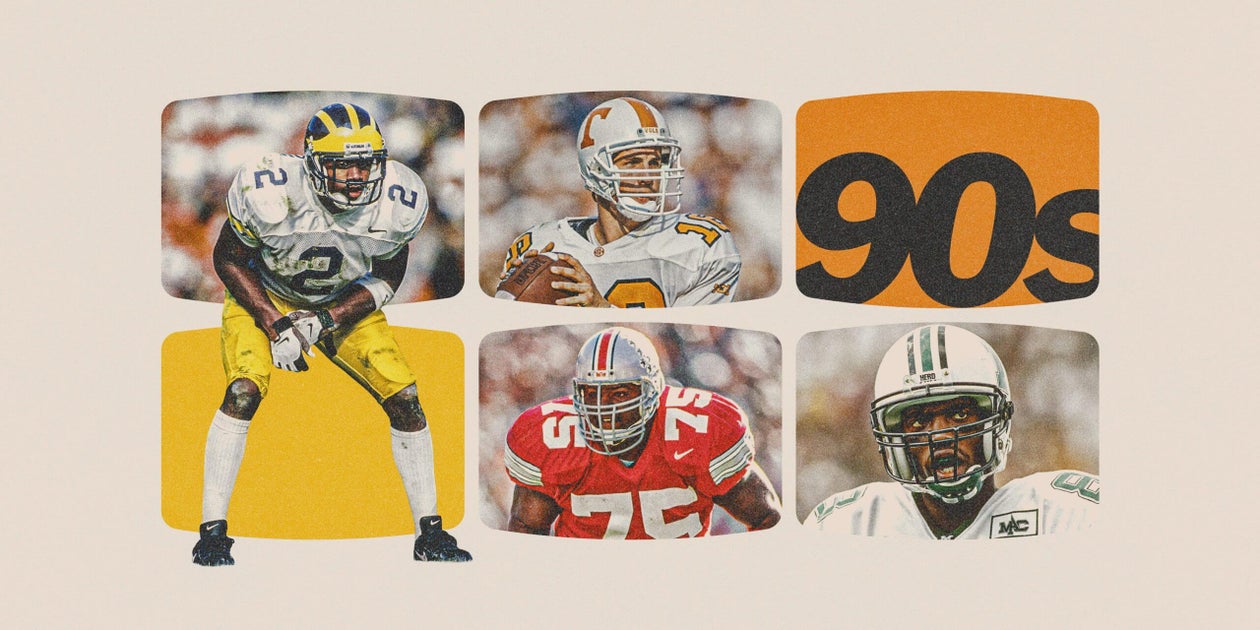
Editor’s note: As the World Cup continues in the United States for the first time since 1994, The Athletic is looking back at college sports in the 1990s and how much has changed since then. Join us for a couple of weeks of offseason football and basketball nostalgia.
Trying to pick the best 25 college football players of any decade is a daunting task. Some top teams, like Florida State in the 1990s, may have a half-dozen who merit consideration. And unlike in pro sports, the best players have short peaks.
I started covering college football in the ’90s. My first big game for ESPN was the 1997 Fiesta Bowl between Ohio State and Arizona State. The undefeated Sun Devils were led by Jake Plummer. The favored Buckeyes had a star-studded defense led by Shawn Springs. OSU rallied in the final minute to win 20-17. It’s still one of the best games I’ve watched.
It was a great decade for the sport. When my editors asked me to write about the 25 best players of the ’90s, I couldn’t wait to dig in, but I soon realized this is almost an impossible task.
I didn’t even have room for the most dazzling player I covered of this era: Michael Vick, a phenomenon for Virginia Tech. In 1999, he led the Hokies to the national title game, where they scared FSU before falling in the Sugar Bowl 46-29. He set an NCAA freshman record for passing efficiency, though his stats beyond that were hardly eye-catching. He completed 59 percent of his attempts and threw only 12 TD passes, but he had eight more rushing TDs and finished third in the Heisman vote. But that was his only season in the ’90s, and I didn’t feel I could bump another great player who starred for two or three seasons in the decade.
I found the only thing tougher than picking the 25 best was actually ranking them. Let’s get to the countdown:
25. (tie) Jonathan Ogden, UCLA, OT
A towering presence for the Bruins, Ogden started four seasons, from 1992 to ’95. The 6-foot-9, 340-pounder began his college career as a Freshman All-American and ended it by becoming UCLA’s first Outland Trophy winner. Ogden allowed just two sacks over 23 games during his last two seasons.
25. (tie) Aaron Taylor, Notre Dame, OL
The Irish produced a lot of NFL talent in the Lou Holtz era. Taylor was the best O-lineman of that period and the top player legendary offensive line coach Joe Moore had in South Bend. He was a two-time All-American and won the Lombardi Award in 1993. The Irish were ranked in the top four in the final polls in back-to-back seasons with Taylor anchoring the front, playing both guard and tackle. They averaged 275 yards a game on the ground and rolled up 71 rushing TDs in his final two seasons.
24. LaVar Arrington, Penn State, LB
Career: 173 tackles, 19 sacks, 39 TFLs, 3 INTs
Best season: 1999; 72 tackles, 20 TFLs, 9 sacks, 1 INT, 2 blocked kicks
Arrington finished the decade strong, winning the Butkus Award as the nation’s top linebacker and the Bednarik Award as the top defensive player. He also finished ninth in the Heisman voting. The year before, he became the first sophomore to be named the Big Ten Defensive Player of the Year. That was the year of his famed “LaVar Leap,” when the freakishly athletic linebacker soared over the Illinois O-line and landed on the running back in the backfield to blow up a fourth-down play.
23. Will Shields, Nebraska, OL
Shields, an Oklahoma native, wasn’t offered a scholarship by the Sooners. Instead, the 6-1, 305-pound guard ended up becoming a Hall of Famer for OU’s Big Eight rival. He won the Outland Trophy in 1992 and was a three-time all-conference selection and two-time All-American. The Huskers led the nation in rushing in three of Shields’ four seasons at Nebraska.
22. Pat Fitzgerald, Northwestern, LB
Career: 299 tackles, 20 TFLs, 3 INTs
Best season: 1995; 130 tackles in 10 games
Fitzgerald was a local kid who helped spark a profound turnaround in Evanston. The Wildcats were 5-16-1 in his first two seasons and went 19-5 in his last two, including a storybook 10-win run to the Rose Bowl in 1995 — the Wildcats’ first Big Ten title in 59 years. The 6-3, 240-pound tackling machine was a two-time consensus All-American who won back-to-back Big Ten Defensive Player of the Year awards. He also became the first two-time winner of the Nagurski and Bednarik awards, which go to the nation’s top defensive player.
21. Eddie George, Ohio State, RB
Career: 643 rushes, 3,578 yards, 43 TDs; 60 rushes, 516 yards, 1 TD
Best season: 1995 Heisman Trophy winner; 303 rushes, 1,826 yards, 23 TDs; 44 catches, 399 yards, 1 TD
The chiseled 6-3, 235-pound tailback looked like he was as big as some opposing defensive ends. In George’s first two seasons at OSU, he was part of a stacked running back room and didn’t have a major impact. But in 1994, he took over as the lead back and rushed for 1,353 yards and 12 TDs. The next season, he ran wild in the Big Ten. He also proved to be a big weapon as a receiver, and he capped his college career by beating out Nebraska’s Tommie Frazier for the Heisman Trophy.

Donovan McNabb led Syracuse to four consecutive ranked finishes. (Rick Stewart / Allsport)
20. Donovan McNabb, Syracuse, QB
Career: 8,389 yards passing, 77 TDs, 26 INTs; 465 rushes, 1,561 yards, 19 TDs
Best season: 1998; 2,134 yards passing, 22 TDs, 5 INTs; 134 rushes, 438 yards, 8 TDs
Syracuse had a terrific run of dual-threat quarterbacks that started in the late ’80s with the great Don McPherson. McNabb, who opted to play for the Orange rather than follow in Tommie Frazier’s shoes at Nebraska, was the Big East Rookie of the Year in 1995 and went on to be named Big East Offensive Player of the Year a record three times, from 1996 to ’98, when he finished fifth in the Heisman vote. He ran for 1,561 yards in his career, but he was even more dangerous as a passer. He was voted the Big East’s Offensive Player of the Decade for the 1990s.
19. Tony Boselli, USC, OT
The ’90s weren’t a great decade by USC standards, but Boselli was one of the elite offensive linemen of his era. He had an ideal blend of size, intelligence and physicality, helping him become a three-time first-team All-Pac-10 honoree and a two-time All-American.
18. Steve Emtman, Washington, DT
Career: 134 tackles, 36 TFLs, 14 sacks
Best season: 1991; 20.5 TFLs, 1 INT
A two-time state discus champ from Washington, Emtman redshirted as a freshman in 1988 before blossoming into a terror in the middle of the Huskies defense. In 1990, Emtman led Washington to its first Rose Bowl in almost a decade and won Pac-10 Defensive Player of the Year honors. The following season, he won the Outland Trophy and the Lombardi Award and finished fourth in the Heisman race. He fronted a defense that allowed just 67 rushing yards and 9.2 points per game in 1991, sparking the Huskies to a share of the national title.
17. Warren Sapp, Miami, DT
Career: 176 tackles, 19.5 sacks
Best season: 1994; 84 tackles, 10.5 sacks
Sapp arrived at Miami as a 230-pound tight end but got talked into becoming a defensive tackle and bulked up to 270 in time for his redshirt freshman season in 1992. He left Miami as the school’s first Lombardi Award winner. Sapp flashed some of his Hall of Fame talent in 1993 when he recorded 52 tackles and six sacks en route to second-team All-America honors. He was even more dominant the next season. Against No. 3 Florida State, Sapp terrorized Noles quarterback Danny Kanell, who threw three interceptions, while FSU managed just 47 rushing yards. Sapp had seven tackles, two sacks, three more QB pressures and two deflected passes in a signature performance in the 34-20 Miami win.
16. Dre Bly, North Carolina, CB
Career: 20 INTs, 2 TDs, 27 PBUs, 102 tackles
Best season: 1996; 11 INTs, 1 TD
Bly didn’t have the height or length that Charles Woodson or Champ Bailey had, but he made a ton of big plays for the Tar Heels. North Carolina went 28-8 in his three years in Chapel Hill, including rare top-10 finishes in 1997 and ’98. Bly became the first freshman in ACC history to earn consensus first-team All-America honors after he led the nation and set an ACC single-season interceptions record with 11. As a sophomore, he had five interceptions, including a pick six. As a junior, even with offenses trying to steer clear of him, he still had four picks to finish with 20 for his career.
15. Desmond Howard, Michigan, WR/KR
Career: 127 catches, 1,944 yards, 30 TDs; 21 rushes, 215 yards, 2 TDs; 41 kick returns, 373 yards, 1 TD; 15 punt returns, 261 yards, 1 TD
Best season: 1991 Heisman Trophy winner; 61 catches, 950 yards, 19 TDs; 12 rushes, 165 yards, 2 TDs; 12 kick returns, 373 yards, 1 TD; 15 punt returns, 261 yards, 1 TD
Only two of Howard’s three seasons at UM were technically in the ’90s, but those were by far his best years. A converted running back, the shifty 5-9, 176-pound Cleveland native had a breakout season in 1990, catching 57 passes for 858 yards and nine TDs at a time when teams weren’t throwing the ball all over the place in the Big Ten. He also averaged 30 yards per kickoff return.
As a junior, he led Michigan to a Big Ten title and became the first receiver to lead the conference in scoring (138 points) — notching 11 more receiving touchdowns than anyone else in the league. His Heisman campaign was punctuated by his iconic 93-yard TD punt return against Ohio State, capped by his memorable Heisman pose.
14. Danny Wuerffel, Florida, QB
Career: 10,875 yards passing, 114 TDs, 42 INTs; 8 rushing TDs
Best season: 1996 Heisman Trophy winner; 3,625 passing yards, 39 TDs, 13 INTs; 2 rushing TDs
The 6-2, 209-pound Wuerffel didn’t have a rocket arm or blazing speed, but he operated Steve Spurrier’s offense better than anyone, leading the Gators to four SEC titles. He also went 4-0 against Tennessee and 45-6-1 overall as a starter, developing from the SEC’s Freshman of the Year in 1993 to third in the Heisman race in 1995 to a Heisman win in 1996, when he led the Gators to their first national championship.
13. Marvin Jones, Florida State, LB
Career: 369 tackles, 27 TFLs, 5.5 sacks, 3 INTs
Best season: 1991; 125 tackles, 13 TFLs, 2 sacks, 2 INTs
You could make a strong case that another Noles linebacker should be here, as Derrick Brooks was a great college player, too. Brooks had the better pro career, but Jones was a bit better at FSU. A bigger backer at 6-2, 230, “Shade Tree” was a punishing hitter. He broke out as a freshman with 133 tackles and had huge games against Virginia Tech, Miami and Florida. Jones went on to become a two-time first-team All-American. He finished No. 4 in the Heisman vote in 1991 and won the Butkus and Lombardi awards for a team that finished ranked No. 2 in 1992.
12. Tedy Bruschi, Arizona, DL
Career: 74 TFLs, 52 sacks, 6 forced fumbles
Best season: 1993; 19 sacks, 27.5 TFLs
An unheralded recruit from Northern California, Bruschi became one of the driving forces behind Arizona’s “Desert Swarm” defense. The Wildcats led the nation in rushing defense in 1993 and recorded their first 10-win season by defeating Miami in the Fiesta Bowl. Bruschi went on to earn All-America honors in three consecutive seasons and was named the Pac-10 Defensive Player of the Year in 1995.
11. Ray Lewis, Miami, LB
Career: 388 tackles, 4 INTs, 1 TD
Best season: 1995; 160 tackles, 2 INTs, 1 TD
A state wrestling champ in high school, Lewis grew up as an FSU fan, but he got Miami’s last available scholarship in its 1993 signing class — and it paid off spectacularly for the Canes. In his first career start, against Colorado, Lewis harassed speedy QB Kordell Stewart all day, notching 17 tackles in a Miami win. He became a first-team All-American in 1995 and left school with the highest and second-highest single-season tackle totals in program history.
10. Champ Bailey, Georgia, CB/WR/KR
Career: 8 INTs; 59 catches for 978 yards; 6 total TDs
Best season: 1998; 3 INTs; 47 catches, 744 yards, 5 TDs; 16 rushes, 84 yards
The 6-1, 190-pound Bailey had excellent size and length to go along with great wheels and competitiveness. He emerged as a lockdown corner in his debut season of 1996, making 47 tackles to go with seven passes broken up and two interceptions. The next season, Georgia began to use Bailey as a two-way threat, and he averaged 19.5 yards per catch, had five carries and returned 11 kickoffs in addition to his standout play on defense.
In 1998, Bailey became a featured weapon for the Dawgs’ offense, and he was on the field for 100-plus snaps in seven of the team’s 11 games en route to first-team All-America honors and the Nagurski Trophy.

Champ Bailey starred for Georgia on defense, offense and special teams. (Vincent Laforet / Allsport)
9. Peyton Manning, Tennessee, QB
Career: 11,201 yards passing, 89 TDs, 33 INTs; 12 rushing TDs
Best season: 1997 Heisman Trophy runner-up; 3,819 yards passing, 36 TDs, 11 INTs; 3 rushing TDs
The son of Archie Manning lived up to the lofty hype. He went 7-1 as a starter in 1994 and was named the SEC’s Freshman of the Year. A year later, he set UT records for completions, completion percentage and yards. In ’97, he capped off his career by leading the Vols to the SEC title. Manning passed for an SEC-record 11,201 yards, went 39-6 as a starter and holds the league record for lowest single-season interception percentage (1.05).
8. Ron Dayne, Wisconsin, RB
Career: 1,115 rushes, 6,397 yards, 63 TDs; 31 catches, 304 yards
Best season: 1999 Heisman Trophy winner; 303 carries, 1,834 yards, 19 TDs
No player better fit the Badgers’ mauler identity than the 5-11, 252-pound power back. Dayne ran through the Big Ten for four years, starting in 1996 when he won conference freshman of the year honors with 1,863 yards — 2,109 with the bowl included. In all, including bowl games, Dayne ran for 7,125 yards and 71 touchdowns, much of it coming after contact. He passed Ricky Williams for the FBS career rushing record and would still hold the record if the NCAA counted bowl statistics before 2002 (San Diego State’s Donnel Pumphrey holds the official mark).
7. Charlie Ward, Florida State, QB
Career: 5,747 passing yards, 49 TDs, 22 INTs; 172 rushes, 889 yards, 10 TDs
Best season: 1993 Heisman Trophy winner; 3,032 passing yards, 27 TDs, 4 INTs; 65 rushes, 339 yards, 4 TDs
Ward, who went on to play 11 seasons in the NBA, was seemingly ahead of his time in football. But his timing was perfect for Bobby Bowden and Florida State.
Ward was solid in his debut season as a starter, but he really cleaned up his play the following season, going from good to great, cutting his interception total from 17 to four and boosting his completion percentage from 56 to 70 percent, even if he didn’t run quite as much.
Ward was a lethal dual-threat QB who was masterful in leading FSU to its first national title in 1993. He won the Heisman by the fourth-widest margin in the award’s history. At the time, only USC’s O.J. Simpson had racked up more first-place votes.
6. Marshall Faulk, San Diego State, RB
Career: 766 rushes, 4,589 yards, 57 TDs; 82 catches, 973 yards, 5 TDs
Best season: 1992 Heisman Trophy runner-up; 265 rushes, 1,630 yards, 15 TDs; 18 catches, 128 yards, 0 TDs
Plenty of big programs went to Louisiana to recruit Faulk, but they all seemed to want him as a cornerback. The Aztecs were smart enough to nail this evaluation. Al Luginbill, the SDSU head coach, gave the 5-10, 180-pound Faulk the chance to play running back, and he put on quite a show.
In Faulk’s second game, he ran for 386 yards on 37 carries in a little over three quarters to break the FBS single-game record — and scored seven touchdowns, a freshman record. Faulk finished that season with 1,429 yards on just 201 carries, averaging 7.1 yards to go with 21 rushing TDs in 12 games. The next season, Faulk ran for 220 yards and three touchdowns in a 31-31 tie against a talented USC defense. He followed that up by shredding BYU, a team riding a 16-game home winning streak, with 299 rushing yards and three TDs in a 45-38 upset. On the season, he ran for 1,630 yards and 15 TDs in 11 games, finishing a close second to Miami QB Gino Torretta in the Heisman race.
In 1993, Faulk produced 2,147 more yards from scrimmage, going for 1,530 on the ground along with 44 receptions for 644 yards and 24 total TDs.
5. Randy Moss, Marshall, WR
Career: 174 catches, 3,529 yards, 54 TDs
Best season: 1997; 90 catches, 1,647 yards, 25 TDs
Moss began his college career at Florida State due to off-field issues, as the Noles took him under the condition that the gifted wideout would redshirt the 1995 season. While sitting out that season, the 6-4, 200-pound freak athlete blew the minds of coaches and teammates during FSU practices. Moss ended up having to leave FSU, and the West Virginia native transferred home to Marshall, a Division I-AA program at the time. He was unstoppable, leading the Thundering Herd to a 15-0 record and the national title, making 78 catches for 1,709 yards and 28 touchdowns.
The next season, Marshall moved up to I-A (now FBS) and Moss kept dominating for a 10-3 team. He finished fourth in the Heisman Trophy voting behind Charles Woodson, Peyton Manning and Ryan Leaf. The Thundering Herd faced Ole Miss in the Motor City Bowl, and Moss torched the Rebels’ fastest corner on the first offensive play for an 80-yard touchdown. He finished with six catches for 173 yards in a 34-31 loss.
Neither college football nor the NFL had ever seen anyone quite like Moss.
“You watched his tape and he’s playing these MAC schools and they’re doubling him,” former NFL assistant John Garrett said. “There’s a corner right in his face trying to jam the heck out of him, and there’s a safety over the top. There’re a lot of plays where he leaps over the guy and makes these Herculean catches.
“The other thing Randy could really do, he could take his eyes off the ball, like Willie Mays, where he would see the ball, turn and run to the spot. Randy could run a go route and put his head down, take off and really book and knew exactly where it was gonna be to go get it. It’s remarkable if you really study it. Generational talent.”
If there was any skepticism due to the level of competition Moss faced in college, don’t kid yourself. He toyed with NFL defenses with the Vikings. He would’ve done that in any college football conference he played in.
4. Ricky Williams, Texas, RB
Career: 1,011 rushes, 6,279 yards, 72 TDs; 85 catches, 927 yards, 3 TDs
Best season: 1998 Heisman Trophy winner; 361 rushes, 2,124 yards, 27 TDs; 24 catches, 262 yards, 1 TD
The San Diego native wasted little time making an impact, breaking Earl Campbell’s Texas record for rushing yards by a freshman. As a sophomore, Williams ran for 1,272 yards, helping Texas win the Big 12 in the league’s first year of existence. In 1997, he went for 1,893 yards and 25 rushing TDs, winning the Doak Walker Award, earning unanimous All-American honors and finishing fifth in the Heisman vote.
Williams’ senior season featured all sorts of remarkable performances. He ran for six TDs in the opener against New Mexico State. He became the only player in FBS history to rush for over 300 yards in back-to-back games, against Rice and Iowa State. He ran for 166 yards in a win over rival Oklahoma. He ran for 259 against Baylor. Against Texas A&M, he ran for 259 yards on 44 carries and broke Tony Dorsett’s FBS career rushing record (only to be passed by Ron Dayne a year later). He became the seventh player to rush for 2,000 yards in a season (in just 11 games) and won the Heisman in a lopsided vote over Kansas State QB Michael Bishop.
3. Tommie Frazier, Nebraska, QB
Career: 3,521 passing yards, 43 TDs, 11 INTs; 342 rushes, 1,955 yards, 36 TDs rushing
Best season: 1995 Heisman Trophy runner-up; 56.4 percent completion rate, 1,362 passing yards, 17 TDs, 4 INTs; 97 rushes, 602 yards, 14 TDs
Frazier was perhaps the toughest player to slot. He sparked the Huskers to back-to-back national titles and was the MVP in both the 1995 Orange and 1996 Fiesta bowls en route to championships. He pulled off one of the most memorable plays of the decade when he followed the Huskers right guard and fullback toward the right sideline late in the first half of the Fiesta Bowl. Frazier dodged the first Florida tackler, and then the second and then a third. It appeared that a trio of UF defenders would wrestle him to the ground about 10 yards downfield, but Frazier powered through and then barreled through more Gators. Nine Gators got their mitts on him, and none of them could bring him down on a 75-yard touchdown. Nebraska won 62-24 as Frazier ran for 199 yards on 16 carries. His passing numbers, as they often were in an option attack, were modest: 6-of-14 for 105 yards and one TD pass.
“He was awesome,” former UF defensive coordinator Bobby Pruett said. “He was speedy, he made the right decisions, and they had that tailback, Lawrence Phillips. They did great play-action, would run a screen the other way. We had a really good defense. Sometimes, the supporting cast and the flow of the game makes such a big difference. Frazier dominated the ball game.”
A year earlier, Frazier had been sidelined for the final seven regular-season games due to a blood clot, but he returned to help Nebraska beat Miami 24-17 in the title game after he led two late touchdown drives.
His passing stats weren’t gaudy, and he never played in the NFL. But as the face of Nebraska’s option offense, perhaps no player is more strongly identified with 1990s college football.
2. Orlando Pace, Ohio State, OT
At almost 6-7, 335 pounds with over 36-inch arms and nimble feet, the mammoth Buckeye was a prototype offensive tackle. He became only the second true freshman to start an opener for the Buckeyes and went on to win Big Ten Freshman of the Year in 1994. Over the next two seasons, Ohio State’s left tackle didn’t allow a sack as he became the first player to win the Outland Trophy twice. In 1995, he helped pave the way for Eddie George’s Heisman win. The next season, Pace finished No. 4 in the Heisman voting — the best finish by an O-lineman in 23 seasons dating back to OSU’s John Hicks finishing No. 2 in 1973.
Pace recorded a staggering 80 “pancake blocks” in his junior year, his last before he left to become the first pick in the 1997 NFL Draft.
1. Charles Woodson, Michigan, CB/WR/KR
Career: 16 interceptions, 370 receiving yards, 167 rushing yards, six total touchdowns
Best season: 1997 Heisman Trophy winner; seven INTs, 11 catches for 231 yards and two TDs, one rushing TD and one punt return TD
He went to Ann Arbor as Ohio’s “Mr. Football.” Most schools recruited him as a running back, but Michigan recruited him as a cornerback. Smart move. He’s arguably the greatest DB in the history of football. Woodson thrived every step of the way, winning Big Ten Freshman of the Year in 1995. The next year, Woodson set a UM record with 15 passes broken up and made first-team All-American, also getting about 10 plays a game on offense. In 1997, Woodson led UM to the national title, its first in almost a half-century, as he picked off seven passes, averaged over 20 yards a catch and was a dangerous return man.
Woodson’s spectacular one-handed INT in a 23-7 win over No. 15 Michigan State gave oxygen to his Heisman campaign. Then, Woodson led UM to a big road win at No. 2 Penn State, scoring on a 37-yard reception while also holding Nittany Lions star Joe Jurevicius to 20 yards. Woodson was dominant against Ohio State, making a 37-yard reception on a third-and-long to set up the game’s first touchdown. Then, he forced a three-and-out and broke a 78-yard touchdown on a punt return. In the second half, he snuffed out OSU’s first drive by picking off a pass in the end zone. A month later, Woodson helped slow down Ryan Leaf and Washington State, picking off his eighth pass of the season and breaking up four in a 21-16 Rose Bowl win that lifted the Wolverines to a share of the national championship.
Woodson won every award a DB can win — the Nagurski, the Jim Thorpe, the Bednarik — and even two awards defensive backs could never win: the Heisman and the Walter Camp, where he beat out Peyton Manning.
“He was the best player I’ve ever been around, hands down,” said Brady Hoke, who was the Wolverines defensive line coach at the time. “Charles would not let you beat him in practice. He worked harder than any guy on the team. I don’t care if it was a one-on-one or a 40-yard dash, he just would not let you beat him, and he played like that. He also always seemed to play his best against the Buckeyes. And he was so talented. He was almost 6-2. He was long. He could change directions. He was something else.”
