Southern California is an interesting recruiting territory these days.
In recent years, out-of-state programs like Alabama, Oregon, Texas, Texas A&M, Notre Dame and Washington have scored significant recruiting victories in the region. But over the past two offseasons, USC has hired a new general manager, Chad Bowden, who has placed a major emphasis on local recruiting, which led to the No. 1 class in the 2026 cycle. And UCLA (Bob Chesney) and Cal (Tosh Lupoi) hired new coaches who have been much more engaged on the recruiting trail than their predecessors.
Those hires and the programs they oversee are operating with more urgency in the region, which is home to 31 of California’s 35 blue-chip prospects in the Class of 2027 and is one of the more fertile recruiting areas in the country.
To gain more insight into how things are unfolding across the SoCal landscape, which stretches from Los Angeles to San Diego, The Athletic spoke to 10 high school coaches about the recruiting climate. They were granted anonymity in exchange for their candor to protect relationships.
- Coach 1: A high school head coach
- Coach 2: A high school head coach
- Coach 3: A high school director of football operations
- Coach 4: A high school head coach
- Coach 5: A high school head coach
- Coach 6: A high school head coach
- Coach 7: A high school head coach
- Coach 8: A high school head coach
- Coach 9: A high school assistant coach
- Coach 10: A high school head coach
Which school is recruiting the region the best right now?
Coach 1: Right now, there’s a lot of buzz at UCLA with what coach Chesney has done there. There’s a buzz within Southern California football about what these guys are bringing. I think they’ve changed the culture in the beginning part (of their tenure).
Coach 2: USC, just on the name recognition of the recruits coming in. But if you take a look at the delta between what was done last year compared to this (year), I think UCLA is blowing it out of the water.
Coach 3: I’d have to say USC from the standpoint (that) they have the most Southern California kids committed. Cal is second. I think they’re doing a good job, and UCLA is coming along.
Coach 4: Obviously, USC and UCLA are doing a good job. Arizona State and Arizona have both been here and consistently with it. … Oregon, Texas has a strong presence here. Boise State for sure. Cal has been doing a really good job. Stanford as well.
Coach 5: I’d probably say Texas A&M and Oklahoma. So is Alabama. (Crimson Tide general manager) Courtney Morgan is from Los Angeles and understands the landscape and what it has been historically. Oregon dominates Southern California.
Coach 6: I feel like Washington does a really good job. I feel like UCLA, since (Chesney) has done a really good job. Miami has been out quite a bit, too.
Coach 7: UCLA. They are by far the most aggressive out here. USC is more old-school. “Yeah, we are SC. They’ll come to us.” … UCLA is looking under the hood more as far as when it comes to getting to know a player and know the system he’s coming from, talking to the staff and the coaches and understanding how the kid is trending, rather than just seeing if they fit the height-weight-speed combination.
Coach 8: It feels like UCLA. They’ve come on late. Although Oregon always does a good job of recruiting Southern California.
Coach 9: The two local schools are kicking ass.
Coach 10: In the last 4-5 years, I think it’s probably Oregon, but USC and UCLA have really picked it up of late.

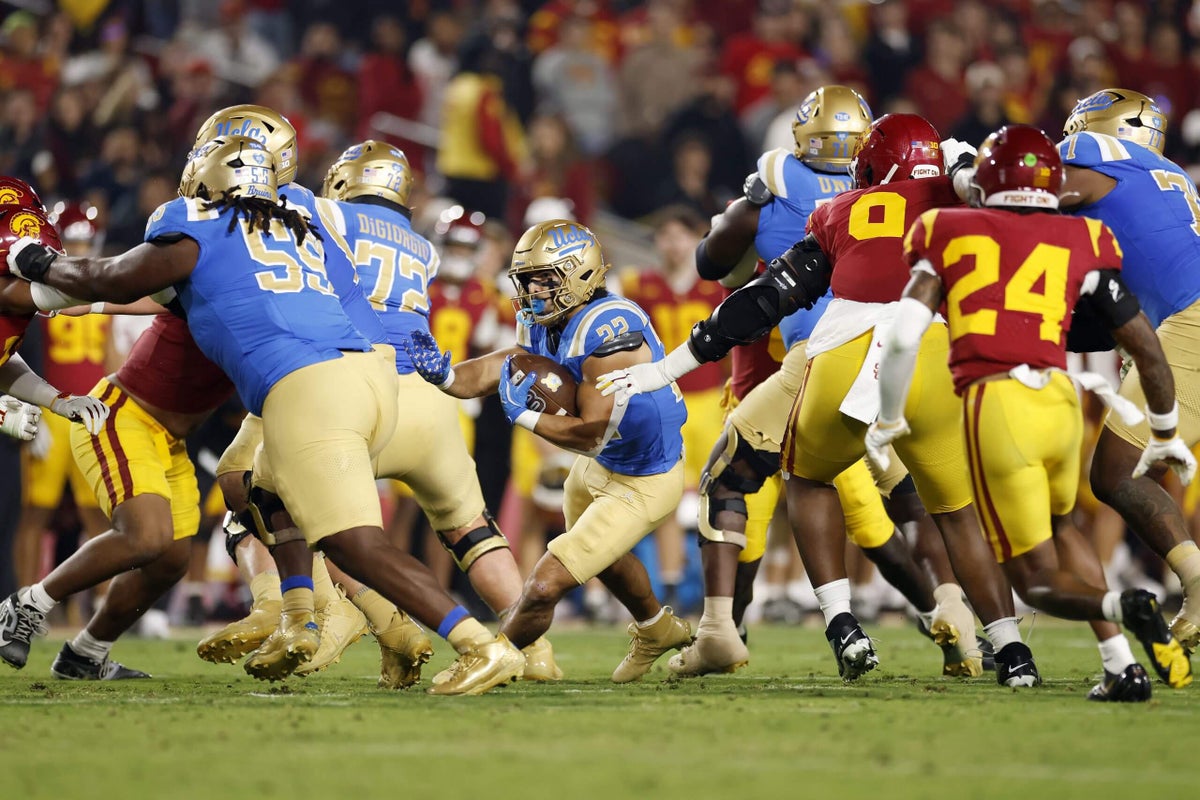
UCLA’s recruiting is on the uptick under new coach Bob Chesney. (Kirby Lee / Imagn Images)
What’s surprised you most about UCLA’s recruiting surge?
Coach 2: To me, they’re putting a lot of stock and belief into what Bob Chesney’s selling. I don’t necessarily think it’s a sales job; I think he’s really compelling in what he has to say, and he’s incredibly dynamic. He’s just one of these guys you just don’t see any reason why you wouldn’t believe what he’s saying.
Coach 3: What’s surprised me the most is they’re getting some out-of-state kids to come to UCLA — some high-level out-of-state kids.
Coach 4: In the past, we’ve heard a bunch of why they can’t do stuff and why they’re different than other schools. But we’re not hearing any of that. We’re not hearing any of those excuses. They’re excited to be there. They’re very active in getting kids on campus.
Coach 5: I think coach Chesney has been doing a really good job of being exciting. … His staff has been personal and able to relate to student-athletes. Not to say previous staffs did not, but UCLA has the stigma of being little brother and (a school that) doesn’t really care about football and they’re usually late to the party. … They’re doing better.
Coach 6: They come out in full force on our guys and ready to go. They seem very energetic and interested. They develop a really good rapport with the players.
Coach 7: They don’t have a lot of Cali guys on staff, so as quickly as they got integrated with California is impressive. That was a surprise. When they came out here, they got right into the community. You’d see their whole staff going to a bunch of different schools when they could. It might be five, six, seven, eight of their staff at one school and that was pretty impressive.
Coach 9: That coaching staff, top to bottom, is awesome. I think Chesney has done an amazing job of bringing in the energy. I went to a couple of their practices and the energy is through the roof, and the kids are feeding off it.
Coach 10: They have a really good coaching staff. I think they probably have more resources than the last couple of regimes there did. And they have a nice combination of things going there with a good, energetic, positive staff.
How has USC changed its recruiting approach since Chad Bowden got there?
Coach 2: The emphasis obviously is on the West Coast. They definitely want to lock down the best players on the West Coast. That’s the No. 1 thing he has done and made a commitment to — “We’re not going to let any of our elite players get out of the area regardless of position.”
Coach 3: They’re up front and they talk about NIL and what that looks like, when before it was vague to say the least. Now it’s straight to the point. You know where it is, you know what your value is and what they want to do.
Coach 4: We’ve been very involved with USC over the years. … They’ve done a great job and are continuing to do a great job.
Coach 5: The focus on out-of-state national kids is more targeted. Whereas before it was kind of whoever they wanted, they’d pursue nationally, mainly in the South, and it was kind of reflective in the culture. I heard the cries about, “Hey, SC isn’t recruiting our kid or coming to recruit our kids.” They’ve changed that.
Coach 7: I really don’t think it has actually. It’s still USC, and they still lean too much on the past. … I still think they’re too old school. I just don’t think it’s what 2026 is. Things are different now. The whole landscape is different. The No. 1 ranking in the commitment class doesn’t really mean anything. It just doesn’t. “Oh, they got 20 four- and five-star guys.” Half of those kids ain’t gonna be there in two years, and a bunch of the other half of those guys ain’t gonna pan out.
Coach 9: He came in guns blazing, man. He’s done a great job with recruiting the local guys and getting them to stay home. It’d been a while where both SC and UCLA weren’t really recruiting locally for whatever reasons, but when Bowden came in, he made a huge emphasis on recruiting the top-tier guys and keeping them here.

Lincoln Riley and the Trojans signed the No. 1 recruiting class in the 2026 cycle. (Sean M. Haffey / Getty Images)
Have you noticed more of a Big Ten presence since expansion?
Coach 1: A little bit more. I think teams are reaching out to Southern California a little more because they’re competing against USC and UCLA, so I think everybody is picking up the pace with regard to Southern California talent.
Coach 2: I have not. Not at all. I thought we would, but not at all.
Coach 3: They’ve always been around, but almost every Big Ten school has been out to see us.
Coach 4: Yeah, because there’s no excuse not to (come) here now.
Coach 6: For sure. You have a longer reach now.
Coach 7: Yes. Absolutely. Northwestern and Purdue weren’t here like this years ago. I’ve seen a lot bigger presence from the Big Ten out here.
Coach 8: Not necessarily.
Coach 9: I have, and they’re getting good players, not just the Michigans and Ohio States.
Coach 10: Not really. I think those that were in the Pac-12 and moved to the Big Ten still have the same amount of presence, but we don’t see a lot of those other programs.
Which school is the most aggressive with money?
Coach 1: From my experience, USC. I’m sure there are others out there as well, but for us, them.
Coach 2: USC, in my opinion.
Coach 3: Texas. Hands down. At one time, it was Oregon, but I think people are actually catching up to them. And USC right now, they’re spending some money.
Coach 4: I don’t get involved with that much at all, but without question in my mind, Miami is No. 1.
Coach 5: Oregon and USC. … They’re definitely someone throwing their weight around. And the Texas schools.
Coach 6: I try not to get involved with that because I don’t want to get blamed on the back end, but it seems like the Texas schools seem to be a little more aggressive with that.
Coach 7: They’re all the same, I think. It just depends on the kid. They’ll find the money for him if they think he can change the program.
Coach 9: I know it’s the new norm, but I try not to get involved with that. I leave that to the players and the families and whatever representatives they have. … It’s a sensitive subject.
Do you deal with programs less now that agents have become prevalent?
Coach 1: A little more, to be honest with you. When kids go into the portal, in the past, it would work through the high school coach or family, but it seems like, especially with the portal, once they leave our campus, it’s more agent-driven.
Coach 2: I still am very much in contact with the coaches. Where it’s changed is I have much stronger relationships with the general managers now than I’ve ever had.
Coach 3: Actually, it’s more. I get more phone calls now because agents are involved and colleges come to me for help.
Coach 4: No. In the past, you kind of went through the handler to get the kids. I think colleges are still doing that, but they’re vetting the player more. So-called handlers are going to sell the car no matter what shape it’s in, but if they want the real truth, they’re going to the high school coaches. I’m also getting calls about transfers — “Hey, this kid played for you four years ago. Can you tell me about him?”
Coach 5: For me, it’s still the same.
Coach 6: We get a lot of coaches still. GMs will usually call, but coaches will still come out and check things out.
Coach 7: It’s probably even more now. But I do think it’s my fiduciary responsibility to know both sides of it. I need to educate my players and their families.
Coach 10: No. I think when things are real, and schools are really recruiting somebody, they still reach out to the coaches.
Which assistant coaches have been the most impressive in recruiting?
Coach 1: The staff that always does a great job is Boise State. They ignore the stars and they ignore the rankings and they go after the guys who fit within the culture of their program.
Coach 2: (Receivers coach) Colin Lockett is one that’s at UCLA. I think (inside receivers coach) Chad Savage does a really good job at USC. I still think Tosh Lupoi, even though he’s a head coach, he’s still a dynamic recruiter. That’s why Cal is starting to become more of a player in this game as well.
Coach 3: (Receivers coach) Dennis Simmons at USC. If he wants a kid, he’s getting him.
Coach 4: (Texas offensive line coach) Kyle Flood was outstanding when he was here. (Michigan tight ends coach) Freddie Whittingham and I have always had a great relationship. … (Special teams coordinator) Sean Saturnio from Army. I love it when he’s down here.
Coach 5: (Georgia defensive backs coach) Donte Williams is always one that sticks out. Wherever he is, he always finds a way to get the best players. … (Receivers coach) Del Alexander at UNLV. He’s a guy that’s been in the game for a very long time. Really, really develops relationships first, and then you’ve got the youngbloods like (receivers coach) James Finley at Oregon State, who really develops relationships with these players and is a hell of a coach himself, and Chad Savage. Chad is a beast.
Coach 6: Shannon Dawson, the OC at Miami.
Coach 7: I’m always impressed with how Ohio State moves and operates when they come in, but I wouldn’t say any one assistant is above the other.
Coach 8: I think the Ohio State and Oregon and BYU coaches are really professional.
Coach 9: Chad Savage from SC. Love Chad. I’ve known him for many years. Everywhere he’s gone, he’s brought talent. … He’s relentless. (Cornerbacks coach Trovon) Reed at SC, he’s done a huge job for them, too. (Arizona defensive line coach) Joe Salave’a is one of the real OGs in the game and he’s a really good recruiter. My boy over at Oklahoma, (director of player personnel) Stacey Ford. He’s relentless. All of Oregon’s coaches are real impressive
How strong do you think the 2027 class is in the region?
Coach 1: I think it’s OK. I think the 2028 class has more talent overall.
Coach 2: I don’t think it’s tremendously strong. I think some of the reclassification kids make the 2027 class better, but I think the 2028, 2029 classes are loaded, though.
Coach 3: I don’t think it’s as strong. There’s not an elite quarterback around. It’s kind of lineman-driven. It’s different. I wouldn’t say it’s not very good; it’s just a different type of class.
Coach 5: I think it’s probably one of the better classes the past couple of years at certain positions, but the totality of the class, it’s kind of waiting to be seen. … It could be one of the best if everyone pans out.
Coach 6: I think it’s a strong class.
Coach 8: In a word, it’s ridiculous. The sheer number of guys who can play high-level football really stands out.
Coach 9: I think it’s pretty strong. It’s not to the level of last year, where it felt like there were superstars all over the board. It was ridiculous, but the talent level here is still really high, top to bottom.
Do schools recruit differently since the portal has become a factor?
Coach 1: If you’re a smaller school, you may want to meet that kid who is not in reach for you because you never know when a kid may fall to you. … You never know when a kid is going to leave a USC and go to UC Davis or Colorado State.
Coach 2: I haven’t noticed that much of a difference. The only thing is that the borderline kid is the one that’s really been affected. Where in the past, if he was a borderline kid they would offer. But now they’re more hesitant because they don’t need to offer that guy.
Coach 3: A thousand percent. Less guys are getting scholarships now. That’s just the truth. When you have offers on the table, you don’t have very long either unless you’re a top guy. … If you’ve got something, you’ve got to jump on it.
Coach 4: I heard one recruiter tell me, “We have offers out to high school kids; if they don’t commit by June we go to the portal.” So I think that’s something colleges are going toward unless he’s a crazy national recruit.
Coach 6: I think it’s a little different for linemen. A lineman who might have been a grayshirt-type kid gets looked over a lot right now. That kid ends up somewhere else, like a smaller school or a JC.
Coach 7: Absolutely. They’re not as thirsty. If we don’t get that kid, “OK, we’re gonna go to the portal.” It used to be like 23 of 25 kids in the recruiting class were gonna be high school kids. Now, it might only be 10 or 12. You can be all-world, but if you’re only 18 or 19, how are you competing with that 22- or 23-year-old man? That’s tough.
Coach 8: I don’t think schools really project anymore. … The bigger schools, though, are specifically not projecting that because they can go to the portal and wait till he does — or doesn’t — develop.
Coach 9: 1,000 percent. Some of them still are sticking to their guns, where they want to recruit the high school guys first before they tap into the portal. The portal game has not only changed the game at the high school level, but the junior college level is really feeling the impact, too.
Coach 10: It’s limiting numbers. … I really feel for the walk-ons who have less opportunity. Everything is so different now than it used to be. It’s like you’ve gotta come in as old as you can (reclassify) and leave as early as you can, graduate in January. I’m not saying these are bad people doing it, but this is the advantage and the sacrifices they’re making.
