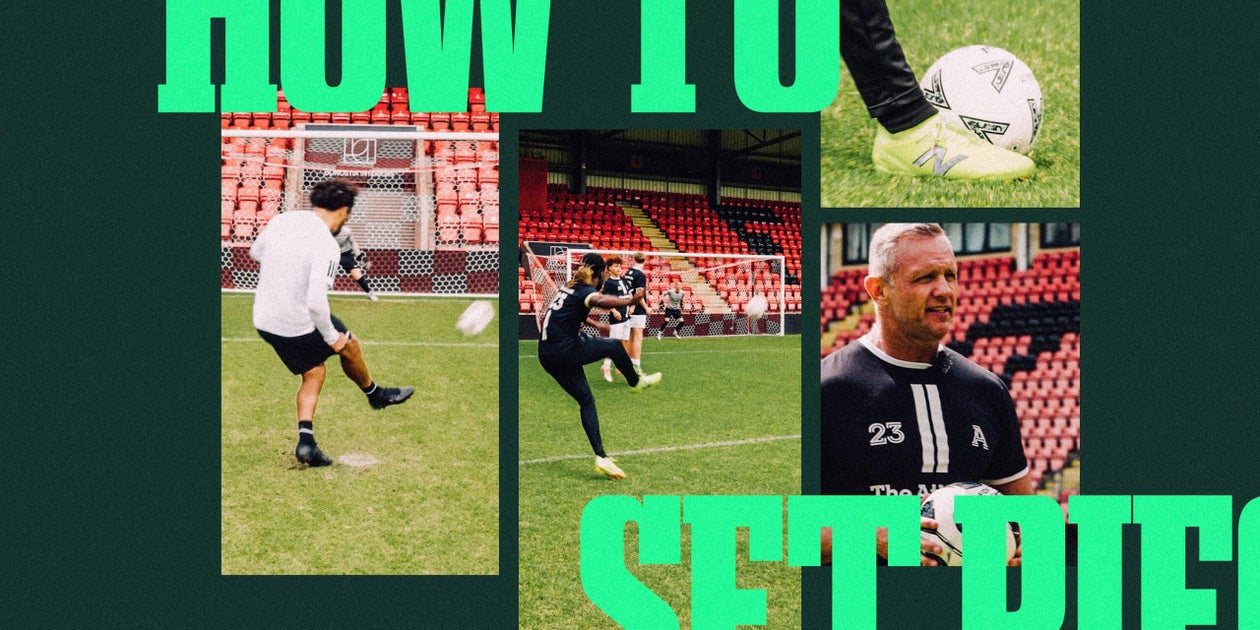
Something curious happened at the last World Cup. The number of goals scored from set-pieces fell off a cliff, down from 44 per cent in Russia in 2018 to 24 per cent in Qatar four years later.
There’s a school of thought that the heat in the United States, Mexico and Canada, allied to the rise of specialist set-piece coaches at club and international level, will lead to a significant upturn in goals scored from dead-balls at this summer’s tournament.
Either way, nobody underestimates the value of practising and perfecting those scenarios, whether that’s the free-kick that Andrea Pirlo mastered in a pair of loafers, the nerveless penalty that is fast approaching its 50th birthday, or a corner-kick routine that requires all the stars – Tom Huddlestone and Lee Trundle in our case – to align.
Alongside the former Tottenham Hotspur midfielder and the king of the showboat, we’ve got the YouTuber and content creator Eman SV2, 14-year-old Liverpool academy player Rafferty Bolshaw, and the left foot of another teenager, Jimmie Basquine, to show you how to make those set-pieces really count in the latest part of our How To Series…
Corner kick & volley
A lot of things have to come together to pull off this spectacular set-piece routine, starting with a pinpoint delivery from the corner taker.
The pass needs to pick out an unmarked team-mate on the edge of the penalty box, and arrive at the perfect height, with just the right weight and pace, to enable the ball to be struck first time but also to prevent an opponent from intercepting. Get all of that right and the player at the receiving end still has to execute the volley.
Step forward David Beckham and Paul Scholes, or David Beckham and Roberto Carlos or… look, it doesn’t have to be David Beckham taking the corner every time but it helps.
Start your week right… with a watch of this!#OnThisDay 19 years ago, Scholesy stunned Bradford ☄️ pic.twitter.com/tmYJMt7fGO
— Manchester United (@ManUtd) March 25, 2019
There’s also a bit of bluffing required here in the sense that the corner taker, together with the attacking players in the penalty area, need to give the opposition the impression that it’s going to be a standard delivery into the box, in order to free up space for a teammate on the edge.
Prior to taking the corner that Arjen Robben beautifully converted for Bayern Munich against Manchester United in a Champions League semi-final in 2010, Franck Ribery gestured for his teammates to move closer to the goal. By the time the United players realised what was happening, Ribery had delivered a deeper ball and Robben was shaping up to expertly steer a left-footed volley into the corner.
The purest of volleys from Robben 😎#UCL pic.twitter.com/gWPc69ZPyQ
— UEFA Champions League (@ChampionsLeague) December 12, 2023
Realistically, it’s going to take a lot of practice for anyone to pull that off. Well, unless Huddlestone is taking the corner in east London on a Tuesday afternoon in May and Trundle is striking the volley.
Take one, ladies and gentlemen.
How to volley from a corner like a pro
Stuart James
Olimpico
It’s the one goal that has eluded Lionel Messi, who has taken an awful lot of corners in his career but, somewhat surprisingly, never managed to score directly from one.
Hang on, does anyone ever mean to score from a corner anyway? After all, we’re talking about a dead-ball that’s taken from a position that’s level with the goal-line.
Turkey’s Hakan Calhanoglu has his hand up at the back. “I went for the goal,” the Inter Milan midfielder said after scoring directly from a corner against Roma in 2021.
Actually, it turns out that Calhanoglu is far from alone. After scoring directly from a corner for the New York Red Bulls in 2012, Thierry Henry said that he decided to go for goal after spotting the Columbus Crew goalkeeper Matt Lampson way off his line.
#OTD in 2012: Thierry Henry gave us an olimpico for the ages. ☄️ pic.twitter.com/8woL5z0kWu
— Major League Soccer (@MLS) September 15, 2022
The U.S. women’s national team icon Megan Rapinoe said something similar to Henry after sailing a corner over the head of the Australian goalkeeper Teagan Micah at the 2021 Olympics.
In the Premier League, the Brazilians Matheus Cunha and Bruno Guimaraes have both scored Olimpicos in the last two seasons.
At this point you probably want to know why it’s called an Olimpico. It should really be called an ‘Onzari’, given that the Argentinian Cesareo Onzari is credited with being the first player to score directly from a corner, way back in 1924, against Uruguay. Instead, the term Olimpico was coined because Uruguay were the reigning Olympic champions when Onzari’s curling corner drifted inside the near post.
#BibliotecaAFA El 2 de octubre de 1924 se convirtió el primer gol marcado desde un córner en la historia del fútbol (“gol olímpico”). Fue en cancha de Sportivo Barracas, y lo marcó Cesáreo Onzari, para la @Argentina, en un amistoso ante Uruguay. pic.twitter.com/OiTLyAtghe
— AFA (@afa) April 13, 2022
Although ‘gol olimpico’ is widely used today in Spanish and Portuguese-speaking countries, it’s not a term that’s well known in England, where goals scored directly from corners tend to be attributed to a combination of luck, poor goalkeeping and a gust of wind.
Maybe all of that overlooks the quality of the corner-taker’s delivery – a ball that needs to be curling and hit with pace and accuracy to have any chance of going in, whether it was intended or not.
In 99.9 per cent of cases an Olimpico will be scored via an inswinging corner. Leandro Carvalho, who played for the Brazilian side Ceara, is in the 0.01 percent category. After spotting the Corinthians goalkeeper Cassio slightly out of position in a game in 2019, Ceara adjusted his run-up and speared a swerving ball with the outside of his right boot – it’s that trivela again – inside the near post.
Lembra dessa pintura de Leandro Carvalho no Brasileirão de 2019? 🤔
O gol olímpico completou um ano, e o jogador do Ceará foi presenteado com um quadro de Mario Alberto, que eternizou o lance.
Confira ➡ https://t.co/wI0KCStjsJ pic.twitter.com/o01tfjog1N
— ge (@geglobo) September 12, 2020
It’s probably best to try the inswinger first. Or, in the case of the FIFA president Gianni Infantino, don’t try to take a corner full stop.
FIFA president Gianni Infantino grabs the captain’s armband and steps up to take the corner…
(via @sntvstory) pic.twitter.com/C39dmkX3jW
— ESPN FC (@ESPNFC) June 8, 2019
Eman is primed.
How to score an olimpico
Stuart James
Knuckleball free-kick
Cristiano Ronaldo has a lot to answer for here.
In 2008, in a Premier League game for Manchester United at Old Trafford, Ronaldo hit a remarkable dipping free-kick that nestled in the top corner and left the Portsmouth goalkeeper David James totally bewildered. Cue the rise of the knuckleball free-kick.
Precision. Perfection. @Cristiano at his elite best 🚀#PLMoment pic.twitter.com/1g8cGXVzh7
— Premier League (@premierleague) September 17, 2017
At least that’s the popular perception, that Ronaldo is the architect. In reality, the former Brazil midfielder Juninho Pernambucano has claims to own the copyright on this one, after scoring 44 free-kicks for the French club Lyon and mastering the art of striking a ball that explodes off the boot, wobbles in the air and dips violently.
🇧🇷 Juninho Pernambucano, the free-kick master 👑#UCL | #FlashbackFriday pic.twitter.com/N0mmVvKQee
— UEFA Champions League (@ChampionsLeague) July 17, 2020
Pirlo, one of the most distinguished Italian footballers of his generation, became so fascinated by Juninho’s technique that he wrote in his autobiography about how it became an obsession of his to discover the secret behind it, right down to experimenting in his best shoes.
“The magic formula was all about how the ball was struck, not where,” Pirlo explained in his book I Think Therefore I Play. “In essence the ball needs to be struck from underneath using your first three toes. You have to keep your foot as straight as possible and then relax it in one fell swoop. That way, the ball doesn’t spin in the air, but does drop rapidly towards the goal.”
Gareth Bale admitted that his decision to gravitate away from taking curling free-kicks to preferring the knuckleball technique was more about style than success because it looks so spectacular when it comes off. The downside is that the margin for error feels greater because of the unpredictability of the strike.
Gareth Bale perfect free-kick 🎯🏴 pic.twitter.com/Qsd90yl0o8
— UEFA EURO (@UEFAEURO) July 16, 2025
One variation to the technique that players such as Ronaldo, Bale, Pirlo and Marcus Rashford prefer (the latter’s knuckleball free-kick for Manchester United against Chelsea in 2019 is well worth watching), is to use the side of the foot.
David Luiz was a big fan of that method and scored with an extraordinary free-kick for Brazil against Colombia in the 2014 World Cup.
It was almost as good as Eman’s effort below.
How to hit a knuckleball
Stuart James
Curling free-kick
Bend it like Beckham was the name of a movie released in England in the early 2000s, and for good reason. Goldenballs, as his wife Victoria nicknamed him, was a specialist at bending free-kicks around the wall by using the inside of his foot to whip the ball with pace.
Typically, a player taking a curling free-kick will address the ball at an angle somewhere between 30 to 45 degrees – France and Bayern Munich’s Michael Olise, for example, tends to use that sort of run-up.
But Beckham and James Ward-Prowse, who has been one of the best free-kick takers in the Premier League across the last decade, would at times approach the ball at something closer to 90 degrees – there’s a lot of hip movement going on with that stance and that helps to generate spin through the way that the foot connects with the ball.
Crucially, the ball is struck with the inside of the foot, not the instep, and in the case of a right-footer, contact is made with the bottom-right side of the ball, almost brushing around and over it, a bit like a tennis forehand.
🔙 Cuando David Beckham hizo un golazo ante Colombia en la #CopaMundialFIFA 1998 y luego corrió a pedirle la camiseta al @PibeValderramaP. 🏴👕🇨🇴 pic.twitter.com/U1Lv8Gs1Zf
— Copa Mundial FIFA 🏆 (@fifaworldcup_es) May 2, 2024
Everyone will have their own technique when it comes to taking a curling free-kick. Messi moves his hips to the right as he prepares to strike the ball with his left foot, and shifts all the weight onto the outside of his ankle on the non-kicking foot.

“We call it ‘inversion sprain’ when it twists inwards,” Dr Rajpal Brar explained on a Squawka podcast in 2020. “It’s that same force (as spraining an ankle). But in Messi’s case, he’s trained himself and his body to control that motion.”
As well as Messi and Olise, Brazil’s Raphinha, Rashford, Ronaldo, Belgium’s Kevin De Bruyne, the Australian Nestory Irankunda, and Mexico’s Luis Chavez, who scored an exceptional free-kick against Saudi Arabia at the last World Cup, are worth keeping on eye on over the next six weeks.
As for Eman, “sometimes you just know”.
How to curl a free kick like a pro
Stuart James
Free-kick under the wall
“It was one of the smartest free kicks in football history,” Jurgen Klopp, the Liverpool manager at the time, said.
Klopp was talking about the way in which Philippe Coutinho deliberately struck a low free-kick towards the bottom of the wall against West Ham in 2016, knowing there was every chance that the players in the wall would jump, and that’s exactly what happened. With the West Ham keeper Darren Randolph covering the other side of the goal, Coutinho’s shot didn’t need to be powerful to score.
The Brazilian was by no means the first player to do that – Ronaldo scored for Real Madrid with a similar free-kick against Bayern Munich in 2014, Ronaldinho did likewise for Barcelona many years earlier, and Lucio Flavio, another Brazilian, made it a speciality of his while playing for his club side Parana.
Under the wall 👀#UCL pic.twitter.com/t6KtoquJRj
— UEFA Champions League (@ChampionsLeague) January 9, 2024
In fact, this kind of free-kick became so common that it led to football’s equivalent of the draught excluder – a player lying prone behind the wall. When Marcelo Brozovic did that for Inter Milan against Barcelona in 2018, it prompted laughter from Messi.
Lionel Messi’s reaction 😂
That’s how to defend the under-the-wall free-kick ✅
Marcelo Brozovic had done his homework this week… pic.twitter.com/7U8AKKQs5k
— Football on TNT Sports (@footballontnt) October 24, 2018
Anyway, over to Rafferty to show us how to do it.
How to go under the wall from a free kick
Stuart James
Natural-side penalty
To take a natural-side penalty means striking the ball across your body, either a right-footer sweeping it towards the left corner, or a left-footer towards the right.
For some context, in the shootout in the 2022 World Cup final, five of the eight penalties were taken to the natural side, including the two that France didn’t score. In Argentina’s quarter-final against the Netherlands, which was also decided by a penalty shootout, eight of the 10 were taken to the natural side, including all three missed penalties.
So, why do it?
As well as the comfort of that kicking action, one of the key benefits of a natural-side penalty is that the ball is always moving away from the goalkeeper, so much so that you can strike the inside of the side-netting.
Picture Harry Kane in the 2024 European Championship semi-final against the Netherlands, rapping a hard and low kick emphatically into the bottom left-hand corner. When hit with pace and precision, it’s a penalty that’s nigh on impossible to stop, even if the goalkeeper goes the right way, as was the case with the Netherlands’ Bart Verbruggen against Kane.
PENALTY TO ENGLAND! ⚽️
🇳🇱 1 – 1 🏴#Euro2024 | #NEDENG pic.twitter.com/PNyM2gMai9
— ITV Football (@itvfootball) July 10, 2024
Getting the placement and the trajectory of that penalty right is easier said than done, though. Players can end up either dragging the ball, which is what happened to France’s Aurelien Tchouameni in the 2022 World Cup final shootout against Argentina, when his penalty went wide of the left-hand post (Enzo Fernandez did exactly the same against the Netherlands), or being so worried about missing the target that they take a kick that’s too safe and not close enough to the corner (France’s Kingsley Coman in the 2022 World Cup final).
How to score a natural-side penalty
Stuart James
Non-natural side penalty
Only one Argentina player took two non-natural side penalties in both of their shootouts at the last World Cup: Messi. Neither penalty was close to the corner, and neither penalty had any power. Coolly, calmly, Messi rolled the ball into the back of the net, far enough away from where the goalkeeper had already started to move. Nerves of steel, you might say.
In the penalty shootout, Messi takes kick #1 for his team, using the same technique.
Keeping one’s head clear enough to accurately detect the goalkeeper’s movements and execute this technique well under the pressure in a World Cup final penalty shootout is almost surreal.
9/12 pic.twitter.com/2LVFaUDsib— Geir Jordet (@GeirJordet) April 19, 2023
With the exception of the occasional thunderbolt with the laces – Harry Maguire for England comes to mind (below) – a non-natural side penalty will typically be taken with the side foot and placed.
Harry Maguire’s perfect penalty 🏴💥 pic.twitter.com/ixNVDme1rD
— UEFA EURO (@UEFAEURO) October 20, 2025
By using that surface of the boot and locking the ankle on contact, the ball can be punched with power but also directed accurately – that, of course, may still not be enough, as Jordan Henderson discovered against Colombia in the 2018 World Cup (a shootout that England went on to win).
When West Ham knocked Brentford out of the FA Cup in a shootout last season, unusually three of their five penalties were taken to the non-natural side and all of them found the top corner. It was the perfect demonstration of that technique, which requires you to open your hips prior to contact.
How to score a non-natural-side penalty
Stuart James
Panenka penalty
Named after Antonin Panenka, the Czech midfielder who spent two years practising the audacious penalty that he converted to win the 1976 European Championship final against Germany.
🇨🇿 Happy birthday, Antonín Panenka 🎉
Best recreation of this penalty? 🤔#HBD | @ceskarepre_eng pic.twitter.com/8zxnVcZvxD
— UEFA EURO (@UEFAEURO) December 2, 2021
In Ben Lyttleton’s book Twelve Yards, Panenka tells the story of how he missed two penalties in the same game, prompting him to come up with an entirely different method of taking a spot kick. He was so invested in finding a solution that he lay in bed thinking about it at night, wondering how he could win more money, beer or chocolate from the goalkeeper he practised with after training every day, when the two men would bet on the outcome of Panenka’s penalties.
As goalkeepers generally choose one side and commit to diving that way, Panenka decided to disguise his intentions by running up as normal before delicately chipping the ball down the middle of the goal. The disguise is key but there’s a lot of technique required with the Panenka penalty too, not to mention confidence.
🇳🇱🆚🇮🇹 EURO 2000
🙋♂️ Step up, @Totti
⚽️ Panenka chip🎉 Happy Birthday, Francesco Totti 🎂#TBT #ThrowbackThursday @azzurri pic.twitter.com/pzysTUN0NJ
— UEFA EURO (@UEFAEURO) September 27, 2018
“It’s important to get the goalkeeper to the position where you want him to be,” Panenka told Lyttleton. “You have to persuade him with your eyes, with your run-up, with your angle, with your body, that you are aiming for a corner.”
Panenka executed all of that perfectly in 1976, winning the European Championships for his country in style – albeit a style that was frowned upon at home. After the game, politicians told Panenka that if he had missed, he would have been punished as his penalty could have been interpreted as disrespecting the communist system.
Opponents on the pitch often find the Panenka disrespectful too, but that hasn’t stopped plenty of people from trying it, including Messi, Zinedine Zidane, Pirlo and Sebastian Abreu, who should have had the weight of the world on his shoulders, or at least the whole of Uruguay, when he stepped up in 2010.
🤔 Who can say they’ve successfully converted a Panenka penalty in a #WorldCup knockout stage match to send their country to the semi-finals for the first time in 40 years?
🇺🇾 @loco13com can!
🎂Happy birthday!pic.twitter.com/MtnnKPnnSv
— FIFA World Cup (@FIFAWorldCup) October 17, 2020
A word of caution: although the Panenka looks great when the ball goes in, it’s calamitous when it doesn’t – ask Morocco’s Brahim Diaz, whose attempted chip in the Africa Cup of Nations final earlier this year was catching practice for the Senegal goalkeeper Edouard Mendy.
How to execute the perfect panenka
Stuart James
Tie-up laces penalty
“The first player I saw do it was Paul Gascoigne. It was on a video that I had called: Gazza, the real me’. But Gazza never took a penalty (doing it). He’d do it as a joke by pretending to pick the ball up, knocking it and carrying on walking. So I added my own bit on and thought I’d take a penalty that way.”
Trundle is explaining how Gascoigne, one of England’s most naturally gifted footballers, inspired him to take a penalty kick that was watched by only a few hundred people at the time but millions on social media in the days and weeks that followed.
“It was a Swansea Legends game at Briton Ferry and more or less the last kick of the game. We were winning 9-2 and I’d already scored six, so if I missed the penalty, it didn’t really matter. A mate was playing in the game and we were going to do the Arsenal penalty, where (Robert) Pires touched it to the side for Henry. But another mate said: ‘Do the bend down one.’”
Trundle laughs. “Luckily, someone was filming it.”
As Trundle feigned to do up his lace during his run-up, he toe-poked the ball into the back of the net in the same motion.
@LeeTrundle10 that was naughty mate 😍 pic.twitter.com/OnG4G6AeX1
— Jordan (@JordanWebber96) December 4, 2016
“The next day people were saying it was a camera trick,” Trundle adds. “They said: ‘How can you get that much power in it?’ But that all comes from your toe and your movement as you bend down.”
One to add to your repertoire, Lionel.
How to score a ‘tie-up laces’ penalty
Stuart James
