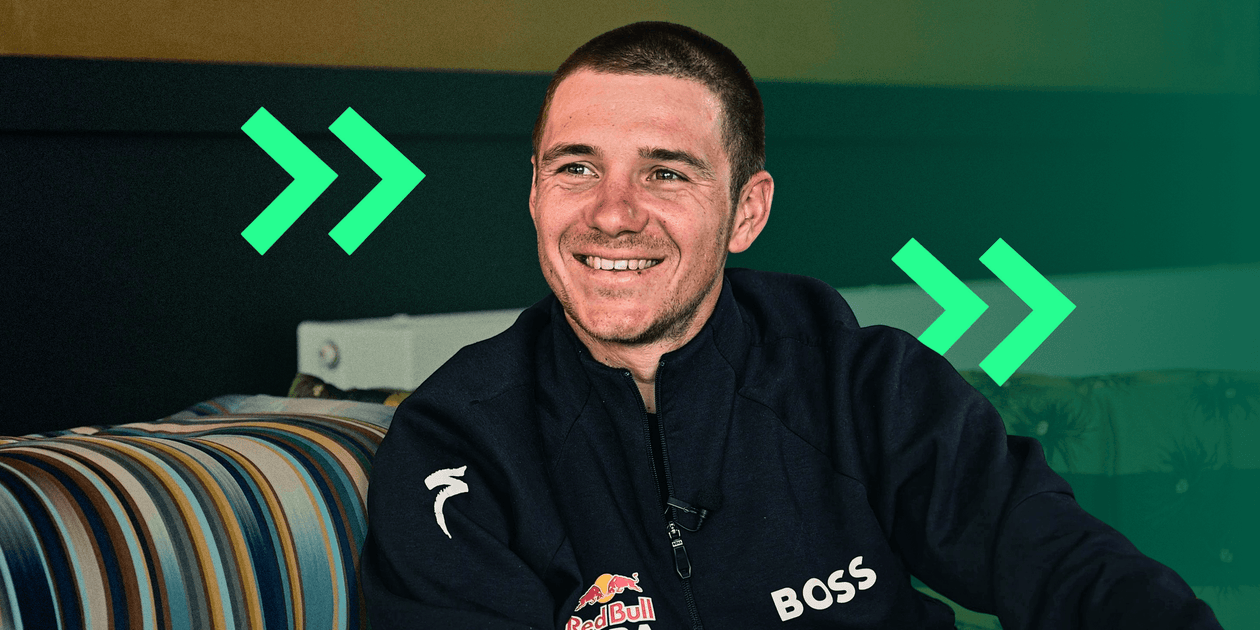
“We used to play our football games on Saturday,” explains Remco Evenepoel. “On Sunday, I would go to a forest and do my running training, somewhere between 10 and 20 kilometres, mostly for endurance, but with some (sprint) efforts.
“And because my passion for football was just falling away, it started to take more and more energy for me to do that training on Sunday than it used to. At one point, I remember just standing in the forest, and I told myself: ‘Either you go now and do your running training, or you take your mountain bike and begin to ride.’
“I think I was standing there for about 20 minutes thinking: ‘What am I going to do now?’ And then I took the bike, went off, and that was the moment where I chose to stop.”
Now a double Olympic champion, Evenepoel was once just a child who was obsessed with the ball. An academy star for both Anderlecht and PSV, he captained Belgium’s Under-16s from left-back.
Remco Evenepoel on captaining Belgium and playing with Gakpo
Jacob Whitehead and Madison Eades
Yet he lost his love for the game after being released from Anderlecht’s academy as a 17-year-old, turning his back on a professional career to pursue newer cycling dreams. The decision paid off.
Aside from his Olympic golds, Evenepoel is a Vuelta a Espana winner, a two-time Tour de France stage winner, has won prestigious one-day race Liege-Bastogne-Liege twice, and is possibly the best time trialist that the sport has ever seen.
And now, as he begins his quest for a Tour de France podium next week, the World Cup in the background, the 26-year-old Belgian has managed to fall back in love with the beautiful game…
Growing up on the outskirts of Brussels, Evenepoel was part of a sporting family. His father Patrick had a brief career as a professional cyclist, but his son was obsessed with football — a fan of the city’s largest club, Anderlecht.
“If there was ever an hour with nothing to do, I would grab my ball and do some stuff in the garage, breaking a lot of lamps,” Evenepoel remembers. “It could also be enjoying playing tennis against the wall, doing a few laps on the bike around the house, but most of the time, it was football.
“When I was about four years old, I went on one of those holiday camps. There were scouts of Anderlecht and Molenbeek there, but because my family had always been Anderlecht fans, the choice was easy.”
It set the all-rounder on his academy journey. As a child, it allowed him to be in the stands at the Constant Vanden Stock Stadium for a goal that he describes as the best he has ever seen live — Mbark Boussoufa’s last-minute winner against Club Brugge to steal the league for Anderlecht.
“He was completely on the outside, in the cold, but made this crazy action, shot from a crazy angle,” he remembers. “I was a young kid, he was my favorite player, and watching it live was pretty amazing.”
By the time he was 11, Evenepoel’s ability had seized the attention of clubs outside Belgium. He chose to move to PSV, in the Dutch city of Eindhoven, living in digs as an international scholar.
“And then, actually after two years, I had requests from Premier League clubs — Arsenal, Manchester City, Chelsea, Manchester United as well,” Evenepoel continues. “But I think back then I just felt the step was too big or it would change my life too much, too early. I was only a 13-year-old. In the end, I had the chance to go back to Anderlecht, so I did that at 15.”
Part of the reason that Evenepoel stood out was his energy. “I played everywhere,” he says. “The younger I was, the more I was like an attacking midfielder, the famous No. 10. But of course, I’m not the tallest guy, and my running endurance was probably better than my technique.
“So they moved me to be a box-to-box midfielder, as a defensive midfielder when I stopped growing, and then totally to the left side, as a winger or a full-back. So I played everywhere, and it was good to play multiple positions.”
Evenepoel says he used to model his game on Lucas Biglia, the 58 cap Argentina midfielder who played for Anderlecht for seven years between 2006 and 2013.
“He wasn’t the quickest, but was always running and was quite calm on the ball,” Evenepoel says. “I had the same in me. Then, when I was left-back, I would just run the whole game because of my endurance, (and) be really attacking as well.”

Evenepoel’s role model Lucas Biglia celebrates a goal for Anderlecht. (FAHY-LEFOUR-THYS/AFP via Getty Images)
His fitness levels are still legendary in the Anderlecht academy. As a 15-year-old, he beat every member of the senior squad in the bleep test — a conditioning exercise where participants have to run shuttles between cones placed 25m apart, finishing each repetition faster than triggers which sound at an increasing rate.
“At one point, the CD playing the sounds actually finished,” Evenepoel remembers. “Apparently my record is still standing, so they knew then I had something unique. I’m still pretty proud of it.”
On another occasion, he entered the Brussels half marathon as a 16-year-old, one day after competing in a football match — finishing 13th in 76 minutes. “I ended up running with the Kenyan guys for some of it,” he laughs. “Then I blew up.”
His ability began to earn higher honors. Bob Browaeys, coach of Belgium Under-16, made Evenepoel captain of his side.
“He was at the highest level,” Browaeys told The Athletic back in 2024. “I never had a player with such a high-performance mindset. That was unbelievable.”
It meant that Evenepoel played alongside several truly elite footballers during his academy journey.
“I played a lot with (Juventus and Belgium striker) Lois Openda,” Evenepoel remembers. “Also Cyril Ngonge, who plays for Napoli. Lots of guys that are now in the Belgian league. They were all in my age group.
“But then there were a lot of guys who were just above me and just under me who I would play with. (AC Milan and Belgium winger) Alexis Saelemaekers was one. I also played with Cody Gakpo at PSV. And then Jeremy Doku was two years younger, but he used to train with us (at Anderlecht).”

Cody Gakpo during his time at PSV, before joining Premier League side Liverpool. (Dean Mouhtaropoulos/Getty Images)
Evenepoel also notes that another former teammate Albert Sambi Lokonga, lived out his dream by regularly appearing for Arsenal in the 2021-22 season, the Premier League side he supports alongside Anderlecht.
“Gakpo really stood out in his junior years,” Evenepoel remembers. “You could just see those flashes which he shows now when he had the ball, he was really special. But there were plenty more who were really good when we were younger, but who got a little stuck at the under-23 level. But Gakpo was one of the most impressive.”
Initially, Evenepoel picks himself in midfield of a dream five-a-side squad of former teammates. “But ah, I can’t pick myself over Saelemaekers,” he laughs.
Evenepoel ends up going for six, picking Roma’s Mile Svilar in goal, Leeds United’s Sebastiaan Bornauw at the back, before loading his attack with Ngonge, Saelemaekers, Gakpo and Doku. His dream coach?
“Vincent Kompany,” he replies instantly. “He’s more of a working coach than a tactical one, and I think it would be a good fit. We’re both from close to each other in Brussels. It would be a good match.”

Until the age of 16, Evenepoel’s football career had progressed smoothly — playing for his favorite club, captain of the national team at age-group level. Suddenly, however, he began to find himself out of the team.
“It was pretty difficult because I was used to playing every game, for almost the entire game,” Evenepoel says. “When we played tournaments, I would be playing from the first game until the last and almost never be subbed.
“So it was a new situation; I felt as if I was still giving my maximum and being at the level I needed to be. But then they put me on the bench, and then, from the bench, I was out of the squad. I went from the top to the bottom quite quickly, and it was difficult to handle. I started to lose my passion for football.”
Looking unlikely to make it at Anderlecht, he moved to nearby KV Mechelen.
“I went there to try to rediscover my love for the game,” he says. “If I had been more patient, I would probably have had the chance to go professional there. When I told Mechelen I was going to stop, that I was going to pursue cycling, they told me they were going to offer me a contract in the summer. I was going to be with the under-23 team until I turned 18, and then with the first team.
“Did I make a mistake there in terms of my football career? Maybe, yes. But I think at that time I was feeling really sad playing football. I just wanted something new.”
Why Remco Evenepoel quit football to chase Olympic golds
Jacob Whitehead and Madison Eades
It helped that Evenepoel’s prodigal engine quickly manifested itself in cycling. After just a few training rides, his father took a closer look at his son’s data, through a former professional’s eye. The level was extraordinary — and Evenepoel’s obsessive nature supercharged his development.
“Starting playing football early, aged four, I always felt that though you would step onto the pitch and do the exercises, you were always in the same environment, just a football field. I wanted to discover new places, not just be in the same 100m area.
“There were some horrible days in the rain where I regretted my choice, but I think, in the end, you have to make risky choices. That was one of the riskiest.”
In cycling, the power was always there, despite early crashes which came from the novelty of riding in the peloton. As an 18-year-old, he won the time trial and road races at the junior versions of both the European and World Championships.

Evenepoel wins gold in the junior time trial at the world championships in 2018. (Photo: Justin Setterfield/Getty Images)
Did football help his cycling development?
“My time in Holland at PSV really did, because the Dutch mentality is totally different to the Belgian one,” he says. “I really had to fight for my spot, because I’d gone from being captain at Anderlecht to arriving in a new team not knowing anybody. And I ended up in the same situation — being captain of the team and playing all the games.
“So that was the period when I learned to take care of myself and focus on my own performance, which is still helping me now in cycling.”
In 2019, he secured his first professional victory and became the youngest ever rider to win a top-level WorldTour race. He had gone stratospheric.
At 26, Evenepoel’s palmares include two Olympic gold medals, the 2022 Vuelta a Espana, two wins at the sport’s oldest Monument, Liege-Bastogne-Liege, and two stage wins at the Tour de France. Nicknamed the “aero bullet” for his positioning on the bike, allied with his small stature, he is the world’s most dominant time trialist against the clock.

Evenepoel with his two Olympic golds at Paris 2024. (Tim de Waele/Getty Images)
It means he is at peace with how the end of his football career unfolded.
Now, he has rediscovered his joy for the sport to the extent that he is desperate to follow Arsenal’s results during races. He initially fell in love with the north London club during the 2005-06 season, their final year at Highbury wearing burgundy kits, pretending to be Thierry Henry, Dennis Bergkamp, and Robert Pires.
This spring, the most prestigious race in the Netherlands, Amstel Gold, was on the same day as Arsenal’s key Premier League game against Manchester City. Evenepoel won the race, but as he passed through the mixed zone, was desperate to find out the final score.
“I think it was half-time, so I just tried to find my phone and started to watch the game,” he says. “It wasn’t the best result, obviously.”
That day, Arsenal’s lead was cut to two points by City — but Evenepoel was delighted as his side recovered to win the league. He regularly texts with fellow Belgian Leandro Trossard, attending the Emirates for a win over Chelsea in 2024 as he recovered from a major crash at the Tour of the Basque Country. “It was an amazing memory, such a beautiful game,” he says.
The World Cup knockout stages will overlap with July’s Tour de France, threatening to throw his sleep schedule into disarray. Evenepoel talks down Belgium’s chances — “We have a strong attacking line, but I have my doubts about the defence” — while he is disappointed that Anderlecht academy starlet Nathan De Cat, 17, did not make the squad after injury.
“He’s a crazy talent,” Evenepoel says. “He’s been incredibly good, like an Axel Witsel type of player, but maybe a bit more technical and with more skill on the ball. He has a big future ahead — I think he’ll be playing for one of Bayern Munich, Real Madrid, Barcelona, one of these teams.”
Having joined German squad Red Bull-BORA-hansgrohe in a blockbuster transfer last winter, Evenepoel now works alongside sports scientists in Red Bull’s football division.
“It’s mainly in terms of recovery, they share a lot of their methods in terms of physiotherapy and stuff like that,” he says. “There’s a lot of communication between both teams. It’s interesting, because nowadays in cycling, we’re not just riders and more, we’re more developing to be athletes.
“It’s the same in football too. I remember when I went to watch Anderlecht games, the players weren’t that muscular, they were thin and technical. Now, the average weight is probably 10 kilograms higher than it used to be 20 years ago. The body mass is completely different.”
Does the closeness of that work mean that Evenepoel still misses football? Last year, his Red Bull teammate Primoz Roglic, a former elite ski-jumper, told The Athletic that he still dreams of flying.
“Of course,” Evenepoel replies. “When I go to watch games, like Arsenal vs Chelsea, I mean it was my dream to play at that stadium. When I was sitting in the stands, looking at my favorite team, there was this fire in me, like, maybe I should have pushed through.
“But on the other hand, I quickly remind myself that if I had been playing for a football team, I would not have become Olympic champion twice, I would not have won a Grand Tour. And then I started to accept the fact I’m not playing football anymore.”
