If you would like to follow The Athletic’s Wimbledon coverage, click here and follow our tennis page.
What will Serena Williams’ return to tennis do to Wimbledon, four years after her last appearance? Are two dominant world No. 1s in a strange position? Will a player protest continuing from the French Open have the desired effect? And what will Novak Djokovic’s tournament say about his future?
Wimbledon 2026 promises to be a cracker. Here, The Athletic’s tennis writers Ava Wallace, Matt Futterman and Charlie Eccleshare chart some of the key storylines to follow over the next two weeks.
How will Wimbledon experience the Serena Williams effect?
What does Serena Williams’ comeback mean to fans?
This question is important mostly because it is blatantly apparent that Williams has come back for reasons that have little to do with the outside world. She wants her children to watch her play; she wants to test herself; she still really, really loves tennis. She has done all the winning already.
But Williams, at 44 years old, accepted a wild card into the singles event at Wimbledon, so suddenly it feels fair to ask, even if it might not be the right question: how far can she take this?
Martina Navratilova is the oldest woman to win a singles match at a Grand Slam in the Open Era. She was 47 years, 8 months old when she returned from a 10-year absence to beat Catalina Castaño at Wimbledon in 2004. Navratilova had a longer runway than Williams, who has played just two doubles matches since announcing her return, and the quality in the women’s game is deeper today than it was then. Grass, unlike hard court or clay, is slick, as well, and tends to cause even the most in-form players to slip.
But winning matches isn’t out of the realm of possibility, especially for someone who has Williams’ talent and, crucially, her aura. Prepare for pandemonium on Centre Court — surely? — when she emerges to play Maya Joint, the 20-year-old Australian, in the first round. Joint, as much as she will focus on playing the ball and not the 23-time Grand Slam singles champion, will nevertheless be across the net from a legend returning to the scene of seven of her greatest triumphs.
Serena’s team-up with big sister Venus in the doubles draw will only add to this, given that the pair won six of their 14 Grand Slam doubles titles together at the All England Club.
That’s really what Williams’ return to tennis means to fans. They get another chance to watch one of the greatest athletes of all time compete again, own the stage again, inspire others anew and maybe, just maybe, win a match or two.
— Ava Wallace
Serena and Venus Williams are reuniting at Wimbledon
Ava Wallace
A tale of two world No. 1s?
The two world No. 1s come into Wimbledon with a lot less certainty than they arrived at the French Open with last month.
Back then, Jannik Sinner was the men’s game’s all-conquering champion, and with an injured Carlos Alcaraz absent, he was expected to cruise to a first Roland Garros title. Aryna Sabalenka, although always prone to not quite getting over the line at a major, was still considered a big favorite.
Instead both crashed out in spectacular fashion, blowing huge leads to lose to Juan Manuel Cerúndolo in the second round and Diana Shnaider in the quarterfinals respectively. Sinner lost his last two sets 6-1; Sabalenka lost her decider 6-0.
Despite the similarity of their Paris exits, they are in quite different positions. Sabalenka’s form feels like genuine cause for concern, with the Shnaider loss followed by another 6-0 final-set defeat in her next tournament. That was to world No. 4 Jessica Pegula at the Berlin Open last week. Pegula is a strong opponent but it was still alarming to see Sabalenka so comprehensively outplayed in the closing stages of that match.
She has never won a grass-court title or reached a Wimbledon final, and is yet to win a non-hard-court Slam.

Aryna Sabalenka is again attempting to master the Wimbledon grass. (Cameron Spencer / Getty Images)
Sinner melting in the French heat can be largely compartmentalized as another case of his struggles in such conditions. With cooler temperatures expected in London over the next couple of weeks, this shouldn’t be such an issue. And that one Cerúndolo defeat shouldn’t detract too much from the fact he went into the French Open on a 29-match winning streak and has been far and away the world’s best male player this year.
The only rejoinder to that is Sinner has had a strangely fraught time of it at the Slams — relatively speaking — since winning Wimbledon a year ago. He was so outclassed in the U.S. Open final by Carlos Alcaraz a couple of months later that he vowed to rework his game to try to match his great rival. At the Australian Open in January, he was unusually profligate on break points during a semifinal defeat to Novak Djokovic, and was angry with himself afterward. And then there was Paris.
Should Sinner fail to retain his Wimbledon crown, he will not hold any of the four major titles — a barely believable possibility, given how good he’s been everywhere else in the past 12 months, during which time he’s won six ATP Masters 1000 events (the rung below the Slams) and the ATP Tour Finals.
For both Sabalenka and Sinner, the next two weeks offer a chance for them to remind everyone why they should be considered the world’s best with little rejoinder.
— Charlie Eccleshare
Will this year’s tournament be chalk or chaos?
Wimbledon 2025 was pretty much a bloodbath for high-seeded players. Thirteen men’s seeds went out in the first round, setting a Grand Slam record, and 10 went out at the same stage on the women’s side. By the third round, four of the top five women’s seeds were done.
There are fewer tennis stars these days who are true grass experts; being a true grass expert counts for less than it used to anyway, and the depth of both tours means that “upsets” according to the number next to a player’s name can become 50-50 results — or even expected — with a deeper look into the data.
Come the end of last year’s tournament, Amanda Anisimova made the women’s final as the No. 13 seed. Iga Świątek won it as the No. 8.
The men were more true to form, with Alcaraz and Sinner meeting in the final after the semifinals featured four of the top six seeds, but several notables lost their opening match — Daniil Medvedev, Alexander Zverev, Lorenzo Musetti, Holger Rune.
So what beckons in 2026?
The grass season is short. The top players’ form is patchy or simply undefined. Bottom line? There could be more blood.
— Matt Futterman
Where will this edition leave the top of the WTA Tour?
Mirra Andreeva winning the French Open was a tidy outcome within the bigger picture of the women’s tour.
Tennis has enjoyed a dominant stretch from Aryna Sabalenka, Elena Rybakina, Coco Gauff and Iga Świątek for the past few years, but absent those top players in the waning days of Roland Garros, it at least made sense that Andreeva took the title. The 19-year-old Russian’s victory felt like a natural expansion of power at the top of the game, far from a surprise, as delightful as it would have been for qualifier Maja Chwalińska to win.
Now Wimbledon is shaping up to be a fascinating stress test.
One Grand Slam won by a player from outside of that group of four isn’t so monumental, especially since it was Andreeva. Two would be a major statement about the shifting locus of power in the women’s game. And as Wimbledon begins, the conditions are there for another new champion — and Wimbledon already has nine different winners in the past nine editions, right back to Serena Williams in 2016, who retained her 2015 title.
The dominant four players of the past few years remain in varying degrees of flux: Sabalenka has imploded in each of her past two tournaments, losing a deciding set 6-0 at both the French Open and the Berlin Tennis Open. Rybakina has been struggling to produce good results in part because her forehand seems amiss. Świątek, the defending champion, sometimes finds it difficult to keep a consistent level, largely due to her serve. Gauff has had trouble playing assertively enough to close out matches, and arrives at Wimbledon with baggage about a lackluster history on grass.
As for Andreeva, she made the quarterfinals of Wimbledon last year and is certainly capable of winning the Wimbledon crown. But it wouldn’t be a surprise if there was an emotional or physical drop-off after the high off winning her first Grand Slam title.
A Wimbledon title run from a player outside of that group of five — say, Jessica Pegula, or last year’s finalist Amanda Anisimova, or perennial contender Elina Svitolina —might feel like a page turn in the wider tour, even if at the All England Club, it would be something like business as usual.
— Ava Wallace
How will the fight between the players and the majors over prize money and representation evolve?
Since last March, a group of top-10 ATP and WTA stars, led by former ATP Tour player and ex-WTA chief executive Larry Scott, has been lobbying the four majors in three main areas: Increasing prize money to represent a greater share of tournament revenue; making contributions to a player welfare fund; and the creation of a formal player council.
Prize money at the four majors represents around 15 percent of revenues; the players want that figure to be 22 percent by 2030, in line with ATP and WTA Tour norms. At the French Open, the players limited their pre-tournament media commitments to 15 minutes; at Wimbledon, they will be doing the same for the first week of the tournament, having initially welcomed the All England Club Lawn Tennis Club’s increasing its prize money from $72.7 million in 2025 to $85.8 million this year. The main impact will be on news conferences and on media rightsholders, including the BBC in the U.K. and ESPN in the U.S.
The AELTC has said that it does not believe revenue is an appropriate figure from which to calculate prize money, and French Open tournament director Amélie Mauresmo expressed similar reservations at Roland Garros.
“Revenue does not take into account the investment that we give. And as I’ve spoken about, we’re not for profit, we’re very different to a 1,000 (the ATP and WTA tournaments a rung below the Grand Slams) event. Everything goes back in the sport. I am frustrated that that message hasn’t got across,” Deborah Jevans, chair of the All England Club, said at a pre-tournament briefing earlier this month.
Wimbledon has a profit-share agreement with the Lawn Tennis Association (LTA), which oversees British tennis, in which it distributes 90 percent of annual tournament profits to the association. Last year’s profit was £52.7m ($70.4m). Like the other three majors, Wimbledon also invests in tournament infrastructure and grassroots tennis as well as player prize money.
Representatives from the All England Club and the player group met during the French Open, a source briefed on the player group’s plans and the discussions, speaking anonymously because they weren’t authorized to speak publicly, said they had been direct and productive. Ahead of that tournament, the French Tennis Federation (FFT) offered concrete proposals regarding the players’ three pillars, the deadline for which, the source said, is next week.
In the immediate term, the most significant talks over the next couple of weeks will be between representatives from the player group and the United States Tennis Association (USTA). These will centre on prize money for this year’s U.S. Open, which takes place in August and September, and the person briefed on the group’s plans said further escalations are possible from the players if the talks don’t go well. They said that these could include withdrawals from the mixed doubles event and curtailing contracted media obligations with ESPN.
Representatives for the USTA did not respond to a request for comment. The talks are scheduled for next week, with Wimbledon getting under way on Monday.
— Charlie Eccleshare
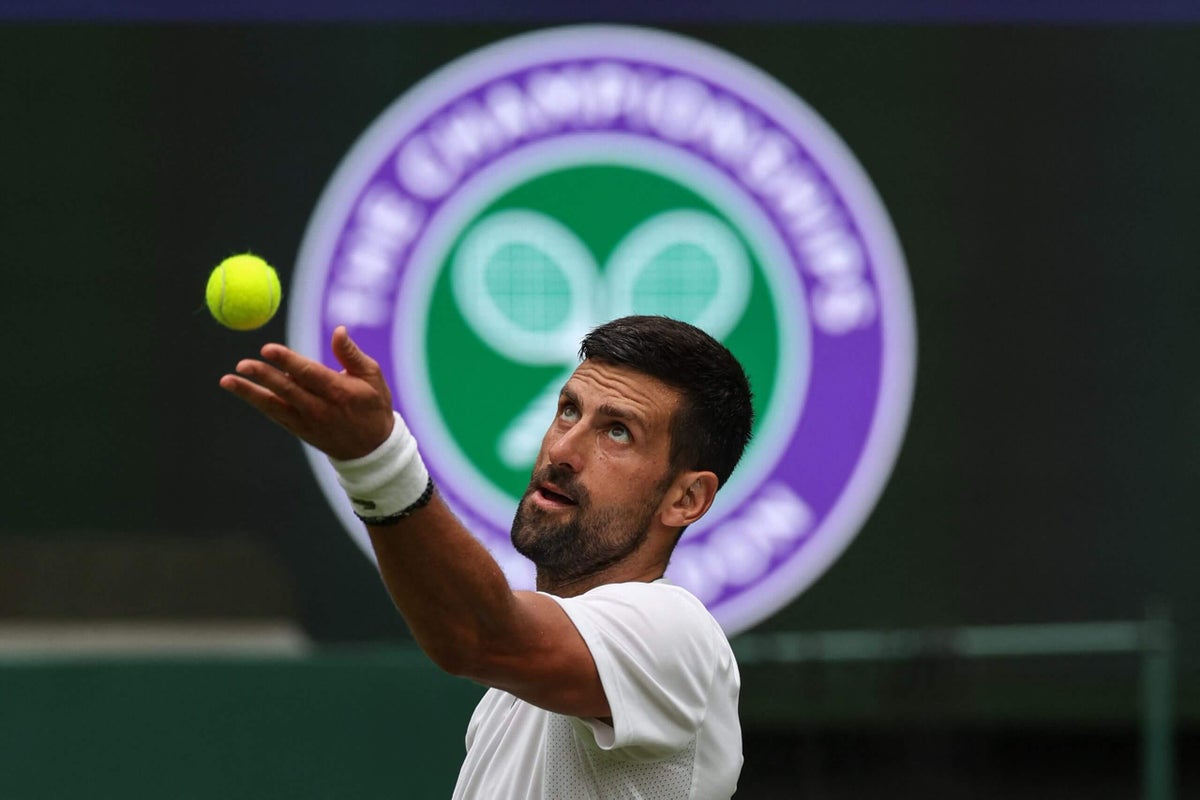
And what will this Wimbledon say about Novak Djokovic’s future?
With Alcaraz’s wrist looking like it’s on the mend and Djokovic in the final year of his 30s, Wimbledon 2026 figures to be the 24-time Grand Slam champion’s last best chance to get to 25.
If he does that, he would also tie Roger Federer with eight singles titles at Wimbledon.
Djokovic’s GOAT status is already secure. He doesn’t need another title at the All England Club to establish his grass-court credentials. And he doesn’t need a 25th Grand Slam title to erase any doubts about his unsurpassed accomplishments.
Doesn’t matter. Djokovic wants another title in the worst way, especially at Wimbledon, and especially after he lost in the third round of the French Open.
He knows as well as anyone that getting through Alcaraz and Sinner in a single Grand Slam tournament is nigh-on impossible and should be for the rest of his career. He has said as much himself. How many more times will there only be one of them standing in his way — or none, if someone goes on a heater and takes out Sinner before Djokovic gets to him.

Novak Djokovic is a master of winning at Wimbledon. Can he do it one more time? (Clive Brunskill / Getty Images)
No one knows the geometry of a grass tennis court better than Djokovic. No one is more familiar with the nuances and mystique of Centre Court than he is. That should be evident in the first few games Djokovic plays, maybe even the first few points.
The tennis is still there in his hands. Grass offers him the chance to play shorter points, likely on cooler temperatures than he endured during that first week in Paris.
The question is whether he can stay strong and healthy for two weeks. To do that he is going to need to avoid the dips that saw him play extra sets in his first two matches at Roland Garros. He only has so much gas in his tank, and the best-of-five format requires reserves in the second week.
He needs to serve at a high level, get quick free points, and close matches when the finish line is in sight. It’s a huge ask of any 39-year-old, even Djokovic. But there’s a fair chance it will only get harder from here.
— Matt Futterman
Wimbledon 2026: Women’s singles bracket
Wimbledon 2026: Men’s singles bracket
Tell us which storylines you are looking out for in the comments.
