SAN FRANCISCO — Tony Vitello was a wildly successful NCAA head baseball coach, a tireless recruiter, a persuader who gripped every living room with a convincing sales pitch. With input from a departmental compliance officer or three, he had a sense for what rules could be bent, what rules could be broken, and what norms could be challenged, all in service of leading a rollicking bandwagon of college kids to unprecedented heights.
So let’s put the first half of Vitello’s first professional baseball season in NCAA terms that the former University of Tennessee coach can comprehend:
The San Francisco Giants, overseen by Buster Posey and managed by Vitello, have lost institutional control.
How else to describe the past three months for a 32-46 franchise that failed so spectacularly with a win-now roster that it relegated itself to raising a white sheet by Flag Day, that is learning the disastrous consequences of putting country charm ahead of cunning, and that, prior to Tuesday’s homestand opener against the Athletics, found itself in twinned crisis mode that it somehow bungled on both ends?
It’s anyone’s guess why the Giants made Posey available to meet with reporters in the home dugout when their president of baseball operations was unprepared to address one major brush fire (the insubordinate conduct of Rafael Devers, who apparently wants all the entitlements of being a franchise star without accepting the responsibilities) and was completely unwilling to answer questions about the much-more-consequential Pride Night controversy from June 12, which was back at low boil in the news cycle Tuesday after MLB Commissioner Rob Manfred blamed Giants officials for inadequately communicating uniform rules and regulations to players.
Posey attempted to defuse the Devers situation from the ninth inning Sunday in Miami, when the first baseman made a show of protest over being lifted for a pinch runner — a petulant display that optically undermined the authority of a manager whose clubhouse credibility has been an open question from the moment he was plucked off a college campus to manage pro athletes.
Curiously, Posey also acknowledged he hadn’t yet spoken to Devers about the incident.
“I think everybody has to be themselves,” Posey said. “Ultimately, and I haven’t talked to Rafi about this, I do think he understands that there’s got to be some accountability, and you know, sometimes it’s not fun to stand in front of a microphone or a camera. But that’s something that he’s going to need to work on.”
Either Posey got to Devers in the next hour, or someone else did, or the first baseman had a sudden change of heart about making a rare appearance at his locker, because he took a half-dozen questions from reporters and called the entire incident a misunderstanding. He said he apologized to Vitello on the flight back to San Francisco because it was “the right thing to do.” Devers devoted his longest response to lambasting the media for blowing the incident out of proportion.
As crisis management goes, for a major-league clubhouse, this was pretty standard stuff. The fastest way to move past unpleasantness is to minimize and to make up.
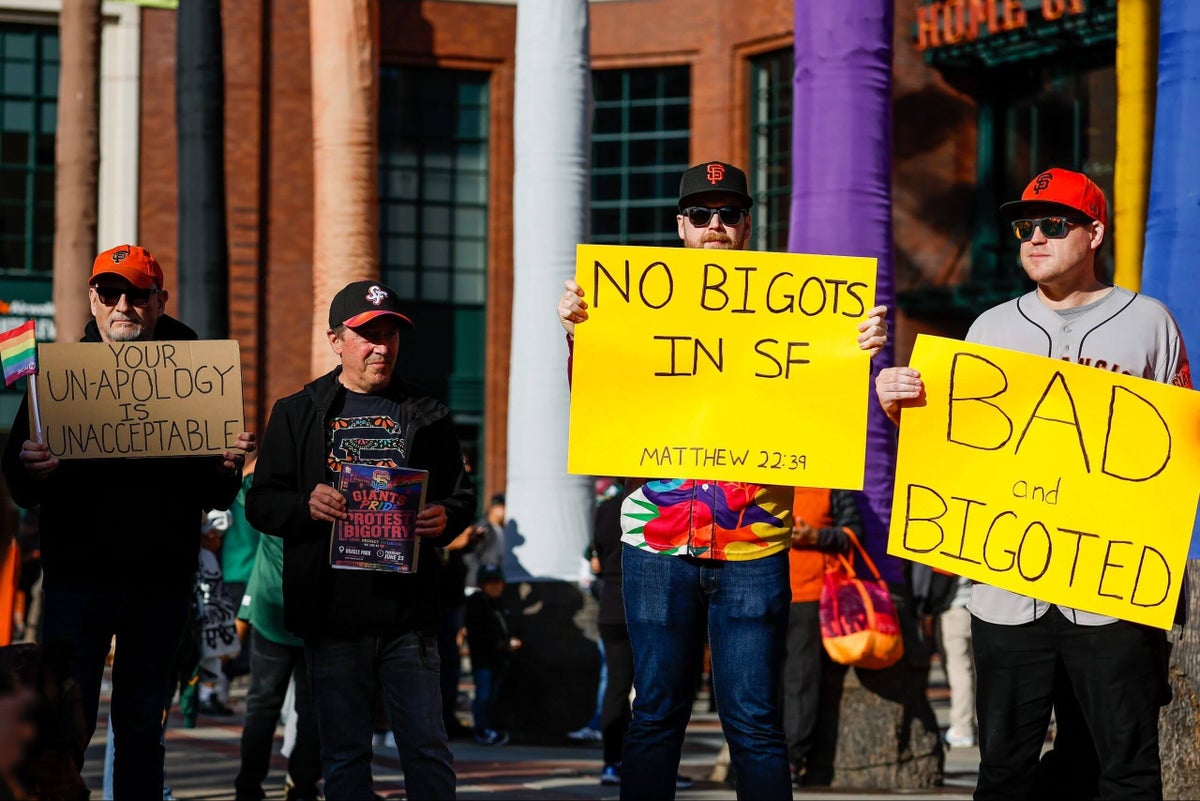
But the Devers flap isn’t part of a Department of Justice investigation. It’s not easy fodder for politicians seeking to insert themselves in the news cycle. It hasn’t touched a socially vital nerve within the community and fanbase. It hasn’t been co-opted by culture warriors. Formulating a response to the Pride Night controversy would require so much more soul and sophistication from the organization, and it was clear on Tuesday that the Giants were wholly unprepared for the moment.
It was obvious that Pride Night would be the first, second and third issues Posey would be asked about. Yet after making a brief introductory statement, saying he understood there were strong feelings on the topic and that the organization would continue to have internal conversations about the matter, Posey said, “our focus is on the team right now, the upcoming draft, the trade deadline and trying to win games. Anyone who has baseball questions, I’m happy to take baseball questions right now.”
Reporters asked a series of Pride Night-related questions anyway, none of them inappropriate or out of bounds. Posey deflected each time until the setting turned awkward. If this was how it was going to play out, if the Giants felt boxed in by pending investigations and not at liberty to challenge the critical assertions of a commissioner who appeared all too comfortable throwing them under the bus, then why not summon CEO Larry Baer to stand in front of the cameras and take the hit for the organization? Why leave the spineless stonewalling to Posey, who has limited executive training for these kinds of situations?
Very tense moment between Buster Posey and the press when questioned about the Giants pride hats and their players.
Before this, he began with a statement saying the organization had shared their response on pride night and he wasn’t going to revisit. @KPIXtv pic.twitter.com/LOvHmgxOLk
— Matt Lively (@mattblively) June 23, 2026
There’s a rule, you know, that protects catchers from getting run over by baserunners in home-plate collisions. It took a catastrophic ankle injury to Posey, a brilliant young catcher in 2011, for MLB to institute that rule more than a decade ago. Posey, now in a different role, got run over again on Tuesday. But everyone in the organization should have seen this coming.
Besides, if the issue in question is a failure in communication between a front office and coaching staff, or between a coaching staff and the players, isn’t that a fundamental baseball question, as much as a pitching change or lineup decision?
Vitello acknowledged that prior to the June 12 home game against the Chicago Cubs, he was unaware that three Giants players would violate league uniform rules and write Bible verses on their Pride Night hats with the rainbow logo, or that a fourth would opt for the hat with the team’s standard, orange logo.
“I had no idea that anyone was going to write on their hat,” Vitello said.
Doesn’t that failure to give the manager a head’s up by the players involved — Landen Roupp, JT Brubaker, Ryan Walker and Sam Hentges — connote some lack of respect for him?
“I don’t see that as a disrespect to me to be honest with you,” Vitello said. “Anything that goes on the field where guys aren’t trying to win the game for their team, where I think disrespect has come into play … I have not been disrespected in this role at all, which was a concern of people on the phone. You come into this title, they’re adults, things like that. I think that’s far from the issue. If anything I could go for revisiting some of the games we played in the early third of the year where we showed a little more attitude, a little more edge, a little more welcoming challenge.”

Tony Vitello’s first season as a major-league manager has been far from easy. (Ezra Shaw / Getty Images)
As for the Devers incident, Vitello called it a non-issue within the clubhouse and attempted to play it off as “something for you guys to run with and talk about.” Vitello said he respects Devers as a competitor who wants to win, and added that he appreciated how Devers has been friendly to his family, including his father, Greg.
“As a person, the way he treats my family, my dad, I’ll go to battle with him off the field too,” Vitello said. “If he came over to my condo and said ‘I need your help. You can’t ask about it. We’re gonna do some damage.’ All’s I’d say is, ‘Who’s car we gonna take?’”
There are two possibilities here. Either Vitello is fibbing, and clumsily so, in an attempt to save face. Or he is so naive to the inner workings of a major league clubhouse that he doesn’t know when he’s being shown up. Either way, it’s not a great reflection on the Giants’ clubhouse leadership, which will have to be much sturdier and savvier if they hope to reestablish a consistent and winning brand of baseball anytime in the near future.
Which leads us to the question that might not generate the most news-cycle sizzle and might not be the easiest to answer, but also might be the most pressing to fans: Why should the Giants expect next year to be any better?
Posey acknowledged that while he still believes in the position-player core of Devers, shortstop Willy Adames and third baseman Matt Chapman that he invested more than a half-billion to form, he would be open to all possibilities prior to the Aug. 3 trade deadline — with the exception of dealing right-hander Logan Webb, who isn’t going anywhere.
“I think where we’re at, unfortunately, we’ve got to have everything on the table and hear out different thoughts from not only internally, but from other teams, as well,” Posey said. “Try to right the ship.”
It’s not fair to call Devers a cancer in the clubhouse. He’s more of an arterial blockage, signed through 2033 on a nearly immovable contract and limited to designated hitter and first base, which happen to be the only two places where the Giants can make space for their brightest shaft of light, 21-year-old rookie Bryce Eldridge, in this darkened crypt of a season.
The Giants are probably stuck with Devers unless they take pennies on the dollar. But if it’s a fresh start they’re seeking, and heavens knows they need one, they’ll almost certainly have to explore it.
Posey earned praise last year when he traded four players to Boston for Devers, whom the Red Sox were eager to ditch just 17 months after signing him to a 10-year, $313.5 million contract. Devers was the difference-making slugger that three of Posey’s predecessors had tried and failed to acquire since the end of the Barry Bonds era. It was the executive version of taking a big swing, which is what modern hitters are supposed to do. Sometimes it won’t work out. Player misevaluations happen every year in every front office. The Devers trade remains solid in concept, even if we’re getting a better idea why the Red Sox were so eager to send him elsewhere.
It’s the decision to hire Vitello to replace Bob Melvin that makes you wonder if Posey is cut out for this.
Vitello might be a “good hang,” to use one of his stock phrases. And given the front office’s misses on the pitching end this winter, the Giants probably would be a fourth-place team right now even if Bruce Bochy or the disembodied ghost of John McGraw were managing this team.
Vitello also outshone his boss on Tuesday when it came to offering support to fans upset by the Pride Night decisions made by the four pitchers, saying, “I would hope and expect the vibe out there is how important it is for (players) to be inclusive of everybody in the fanbase or who wants to be part of the fanbase. Those are the conversations I’ve been privy to. I know Buster spoke with some people today about it.”
But those were sentiments that Vitello needed to relay to the clubhouse before June 12, not after it. Does anything about Vitello’s messy and unfocused public interactions lead you to doubt Manfred’s characterization of the team’s “inadequate and unclear” communication with players over their ability to wear their standard hat on Pride Night?
The Giants might be just a professional baseball team, but the Bay Area is a unique place. Even as institutions crumble around us, it’s a region that demands more from its institutional leaders. Posey had a “great aura” as a player, as Shohei Ohtani once described it. But to be a leader requires more work than that. And it requires some willingness to wade into political topics.
Instead, by offering silence and stonewalls, the Giants made the worst possible impression Tuesday afternoon. They left you to ponder a gnawing possibility: that if they said what was really on their minds, you might not like it one bit.
When the NCAA determines that an athletic program has lost institutional control, it’s the precursor to a death sentence. Obviously, it doesn’t work that way for a major league franchise. The Giants, after a 3-1 victory over the A’s Tuesday night, will play 84 more games this season. Barring a work stoppage, they’ll play a full, 162-game schedule next year, too.
But losing has consequences. If they have to start over, maybe they’ll leave it to the next president of baseball operations to do things like fire the manager or trade the highest paid player. It’s a lot easier to clean house when you didn’t buy the furniture.
For now, with his grace period expired and his credentials in question, it’s still Posey’s job to reestablish control.
“I’m committed to seeing it through,” Posey said. “What we all like about sports, is it’s a meritocracy. So, if you play well, you stay. Or the team plays well, and you win a bunch of games, you stay.
“If not, then there’s conversations that have to be had.”
