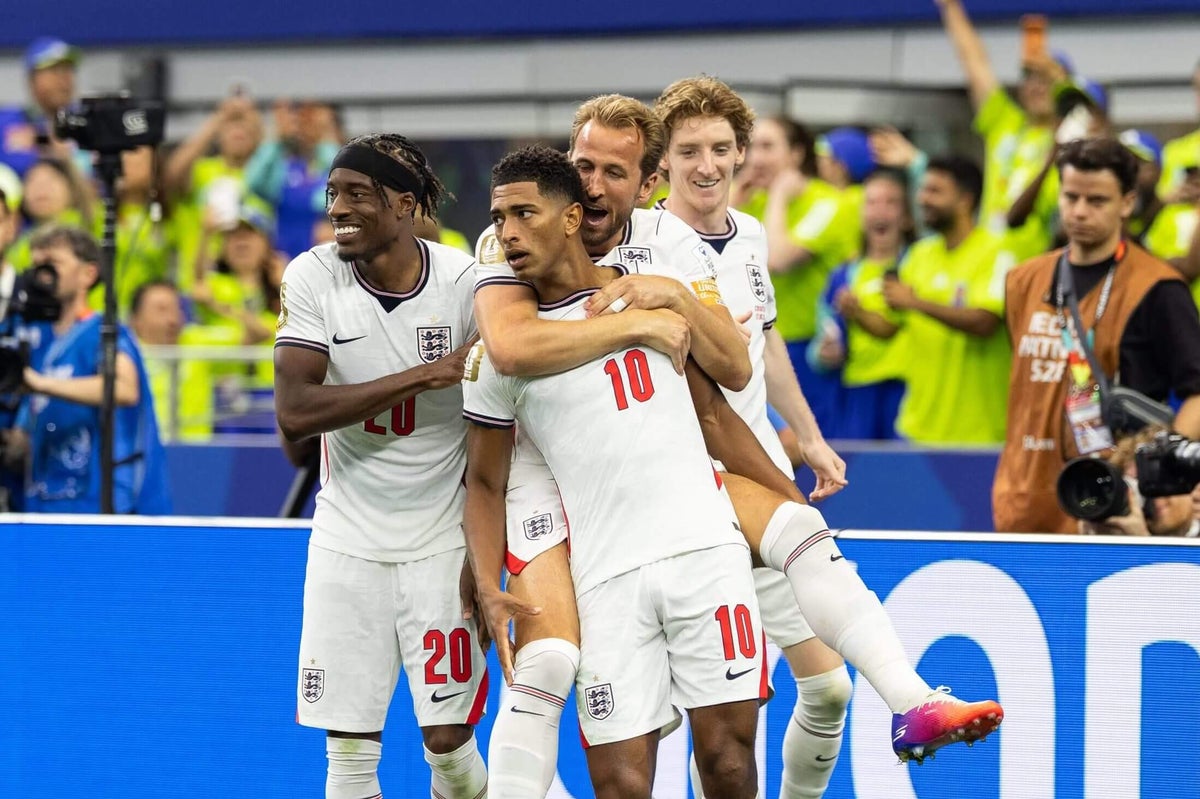
England’s 4-2 win over Croatia on Wednesday wasn’t just an ideal start to their World Cup campaign — it was genuinely fun.
It’s not a word that has often been associated with the team over the years, which have largely been characterised by underachievement or conservative football, but Wednesday was all about high-intensity, free-wheeling attacking… and all the more enjoyable for it.
With that in mind, we asked The Athletic writers from different generations to name the England game they have most enjoyed watching. Let us know yours in the comments below.
England 4-1 Netherlands, 1996
This was more than an emphatic win; it was payback.
England missed out on qualification for World Cup 94 after losing 2-0 to the Netherlands in October 1993. Euro 96 was the first meeting between the two teams since that awful night in Rotterdam.
Everyone of an English persuasion enjoyed what they were seeing at Wembley, though. England did not need to win their final group game to progress to the knockout phase — a draw would have been enough — but England demolished the Dutch, playing the kind of football normally associated with the visitors.
One goal summed up the belief flooding through Terry Venables’ team. Already cruising at 2-0, the mercurial Paul Gascoigne dribbled into the area and picked out Teddy Sheringham. Everyone in the stadium, plus the millions watching on TV, expected the forward to shoot. He faked it, moving the ball on to an unmarked Alan Shearer to drive the ball into the net instead.

Alan Shearer smashes in for England against the Netherlands in 1996 (Stu Forster/Getty Images)
The cameras panned to England fans in the stands celebrating wildly but also with looks of disbelief, which only increased when Sheringham made it 4-0.
Patrick Kluivert got a late consolation, yet even that provided more joy for England supporters as it meant the Netherlands finished above Scotland in the group on goals scored.
Simon Johnson
West Germany 1-1 England 1, 1990
Mesmerising, enchanting, heartbreaking; this semi-final had everything. To put that a different way, I’ve never felt so English as during an epic match in Turin when Sir Bobby Robson’s team took on West Germany and could have won. Enjoyable does not quite cover it. It was life-changing.
Watching football in the 1980s was a grim experience – dangerous and dirty – and the north east of England had been treated with disdain, but I’d seen Peter Beardsley, Chris Waddle and Paul Gascoigne play for Newcastle United and I’d attended the same infants school as Sir Bobby in County Durham. Gascoigne, in particular, made me fall in love.
England played brilliantly in the Germany game; Gascoigne was electric, Sir Bobby was ambassadorial in his FA blazer and the dramatic arc of hope and despair — the yellow card for Gazza which would have ruled him out of the final, the tears he wept, the drama of our failed penalties — proved beyond doubt that football could be poetic and life-enhancing. It was mine, it was ours, it was beautiful, it was painful, it was perfect.
George Caulkin
England 2-0 Scotland, 1996
I remember the excitement, firstly. In the lead-up to a home tournament — the first of my lifetime — I’d seen more England flags displayed than ever before.
I was 14 and don’t remember much of the negativity around England’s behaviour on a pre-tournament trip to Hong Kong where players were pictured partaking in the instantly infamous “dentist’s chair”. But I do remember the feeling of deflation when England’s first game against Switzerland ended in a 1-1 draw, leading to calls for Gascoigne to be dropped.
The result inflated their second game, against Scotland (the Auld Enemy, as people kept calling them), into an even bigger one than it was already destined to be.
The Scots had also drawn their first game, but a 0-0 draw for them against the Netherlands was a boost rather than the comedown of England’s, and they arrived at Wembley buoyed by the negativity surrounding the hosts.
On a steaming hot afternoon, the opening 45 minutes offered no reprieve from the tension. The game remained goalless at the break. It felt like England’s whole tournament hinged on what would happen in the second 45 minutes.
Finally, on 53 minutes, the deadlock was broken: Shearer nodding home Gary Neville’s cross at the back post. The game sparked into life, and Sheringham should have made it 2-0 before Scotland fought back. Gordon Durie could have equalised had it not been for the giant hand of David Seaman clawing the ball away and soon the England keeper was needed again when Scotland won a penalty. Gary McAllister stepped up and drilled it hard, but Seaman was there again, this time batting the ball away with his elbow.
The momentum was swinging wildly now, and a minute later Gascoigne was running onto a cushioned pass from Darren Anderton. The man who’d been slaughtered in the headlines for weeks let the ball bounce, flicked it over the head of Colin Hendry with his left foot and volleyed it into the Scotland goal with his right to score one of England’s most memorable goals.
To celebrate, Gazza lay down on the grass and opened his mouth wide, imitating the dentist’s chair that had got him and his team-mates into so much bother a few weeks earlier.

Gascoigne takes a trip to the dentist after his super strike against Scotland (Stu Forster/Allsport/Getty Images)
The next day, the Daily Mirror newspaper ran an apology under the headline: ‘Mr Gascoigne: An Apology’. “Gazza is no longer a fat, drunken imbecile; he is, in fact, a football genius”.
The tournament was saved. And the excitement reignited.
Sarah Shephard
England 0-0 Netherlands, 1990
A goalless draw? Don’t be fooled by that.
It was the night when the 1990 World Cup came alive for England, marking the emergence of Gascoigne as an international star, and when a football-mad 14-year-old kid was dancing around his living room, wildly celebrating Stuart Pearce scoring a 92nd-minute free kick, only to realise moments later that the referee had ruled it out because it was indirect.
Some context is needed here. The Netherlands had an outstanding team that featured Marco van Basten, Ruud Gullit, Frank Rijkaard and Ronald Koeman, and they had beaten England comprehensively two years earlier, when they went on to win the 1988 European Championship.
As for England, they were awful in their opening group game at Italia 90, drawing 1-1 with the Republic of Ireland in a dire match.
Against the Dutch, the England manager Robson switched to a back three – a move that felt revolutionary at the time. Gascoigne operated in a midfield three alongside Chris Waddle and Bryan Robson, with Gary Lineker and John Barnes up front.

Gascoigne came alive against the Dutch in 1990 (Allsport/Getty Images/Hulton Archive)
It was bold and it was brilliant. England were liberated and Gascoigne stole the show, surging past Dutch players with that unmistakable upright style of dribbling. His crowning moment was a beautiful Cruyff turn that took him between two Dutch players before delivering a wonderful cross that somehow eluded Lineker.
The goal that England deserved never came. But there was hope afterwards – and that hope gave me three of the most enjoyable weeks of my childhood.
Stuart James
Germany 1-5 England, 2001
England were a pretty uninspiring bunch at the turn of the century: aimless, unimaginative and tactically naive. Euro 2000 had largely been a disaster under Kevin Keegan and the start of qualification for the 2002 World Cup was not much better.
Eleven months after losing to Germany in the old Wembley’s final fixture, though, came a beautiful and unexpected redemption in Munich. England did not just find a way to beat Germany to keep automatic qualification hopes alive; they destroyed them.
Sven-Goran Eriksson’s side were outstanding, embarrassing an opponent that had routinely been the source of so much heartache at major tournaments. Michael Owen, who would be awarded the Ballon d’Or two months later, produced a fine hat-trick in a rout that also included goals from Steven Gerrard and Emile Heskey. The latter’s goal, a break to stretch tired German legs, captured the story of a footballing mismatch few had foreseen.
It was all so very un-England — and, boy, was it fun.
Phil Buckingham
Hungary 1-3 England, 1981
This was the game that made me fall in love with the national team.
For younger supporters, it may seem an unlikely choice. It wasn’t a World Cup match, there was no trophy at stake and England were not among the world’s elite at the time. But for those who watched it, the performance is remembered for one extraordinary goal.
Trevor Brooking had kept his England place despite West Ham United having been relegated to the old Second Division. That was unusual enough, although the England manager, Ron Greenwood, knew Brooking’s qualities better than anyone from their years together at West Ham.
Brooking scored twice as England produced one of their finest away performances of the era. His second goal remains etched in my memory. Arriving late in the penalty area, he received a pass from Keegan and guided the ball so perfectly that it became wedged in the stanchion between post and bar. For a moment, players and spectators alike were left searching for where the ball had gone.
“A terrific goal, a terrific goal — look at it caught up in the corner there,” exclaimed ITV’s commentator Brian Moore.
I was watching at my Aunt Peg and Uncle Tom’s flat in north London. Uncle Tom was a Chelsea supporter, so there was something pleasing about a West Ham player being the hero of the day.
The image of Brooking’s shot lodged in the stanchion, and Moore’s delighted commentary, have never left me. England have had bigger victories since, but few have given me more joy.
Lee Clayton
England 6-2 Iran, 2022
England’s first match of a strange winter World Cup kicked off at 1pm on a Monday. We rigged a projector in our university flat and squeezed in far more people than the room — or the floor — was built to hold.
England tore Iran apart. They were 3-0 up by half-time and scored six times through five different players. Only a noise complaint from a neighbour briefly dampened the atmosphere.

Bukayo Saka celebrates scoring England’s second against Iran (Clive Brunskill/Getty Images)
It is one of the few England tournament matches I can remember that carried little anxiety.
The win put England firmly in control of Group B, and they went on to top the group and reach the quarter-finals, where France ended the dream for me in a bar charging criminal prices for a pint.
Amelie Claydon
England 3-0 Poland, 1986
England games have always been a difficult watch. If they take a lead, they usually then go into their shell and hang on. If they are chasing a game, there tends to be frustration. And when they really have to deliver, they normally don’t.
But there was one game when they did.
Mexico 1986. Robson’s England were on the precipice of an early exit. Having lost 1-0 to Portugal and managed just a 0-0 draw with Morocco, little was expected of them in the final game against Poland, a game they had to win.
I was only 13 but allowed to watch it late at night, in bed, on an old black-and-white television, and it was worth it.
Having failed to score in their previous two group games, Robson brought in Beardsley and England scored three times in the first half. To be more accurate: Lineker scored three in the first half.
England were rampant. I can still hear commentator Barry Davies excitedly say, “He’s coming in on it now… Linekerrrr!” as England scored the second and the celebrations of pundit Jimmy Hill being picked up on the microphones behind him.
England went on to reach the quarter-finals… where they were famously given the middle finger of the Hand of God.
Rob Tanner
England 2-1 Netherlands, 2024
Yes, it was only two years ago, and, yes, I am too young to remember any major tournament before 2010, but watching Ollie Watkins’ winner against the Netherlands in the Euro 2024 semi-finals is still goosebump-inducing.
The 90th-minute winner was an exquisite turn-and-shoot strike, which nestled far into the bottom left corner and sparked emotional celebrations. Watkins told BBC Sport he wished he’d celebrated differently and not “like a fan, in shock”, which I hope we all disagree with.
There could be some frustration watching Gareth Southgate’s England teams, such as not seizing the initiative after taking an early 1-0 lead over Italy in the Euro 2020 final, but he kept the vibes high and had some great moments during his managerial era.
Eduardo Tansley
England 3-2 Cameroon (aet), 1990
Sunday night in Naples. A wild alchemy of fortune, fear, chaos and hope. Well, it seemed that way to an 11-year-old watching in Wiltshire.
Despite missing four starters due to indiscipline, Cameroon were relentless and England had an impervious Peter Shilton and David Platt — still euphoric from that volley against Belgium — to thank for a fortunate 1-0 half-time lead.
And then on came Roger Milla.
Gascoigne felled the 38-year-old in the area, immediately raising both arms and looking for the referee. Guilty as charged.
From behind the goal, Shilton appears in slow motion as Emmanuel Kounde’s penalty breaks the net. Not to worry, he won’t be facing too many more. Oh.With a trademark body shuffle, Milla, the oldest swinger in town, sets up Eugen Ekeke for 2-1.
Seven minutes to go. The rug is being paced, nails bitten. The dogs have naffed off upstairs to avoid the racket.
After taking out Claudio Caniggia, Benjamin Massing added Lineker to his collection with a clumsy tackle in the box. Lineker sent the great Thomas N’Kono the wrong way.
Extra time. This is like Hagler vs Hearns if it went 12 rounds.
And then it came. Gascoigne with a sashaying run in his own half and a ball straight into Lineker’s feet. N’Kono felled Lineker, before he smashed the third penalty of the game home.
Not without fortune, England are into the semi-finals. But you make your own luck. This might just be their year…
Peter Carline
England 2-2 Argentina, 1998
I’ve still never been more invested in an England game and an England team. Euro 96 had passed me by and the disappointments of the Golden Generation were still to come.
The match had everything, including an iconic goal which announced Michael Owen’s arrival as a superstar and a sending off which felt destined to tarnish David Beckham’s career.

David Beckham and that moment against Argentina (Mark Leech/Getty Images)
For me, though, what still stands out nearly 30 years later is the injustice of Sol Campbell’s disallowed goal in the 81st minute.
As a Spurs fan, I was particularly invested in Campbell in an England shirt and recall charging around the living room like a lunatic before the reality that it had been chalked off hit home. If I’d have known what was to come, I might have saved my energy.
England would lose on penalties, and it would be decades before they had such a likeable and exciting team again.
Dan Kilpatrick
England 4 Croatia 2, 2004
Forget Dallas, Lisbon 2004 was the time to truly dream as an England fan.
We were on a lads’ holiday that would eventually stretch to 17 nights. On the Algarve with your mates for the most part and then jump on a train north whenever Sven’s boys were playing.
Things didn’t start great. 1-0 up against France heading into stoppage time somehow ended up in a 2-1 loss, meaning a very quiet return trip from Lisbon. But then England — and a teenage Wayne Rooney, in particular — started playing.
After sweeping Switzerland aside in Coimbra, next up in the final group game was Croatia. They’d already gone one better than us by taking a point off leaders France, so this was going to be tough, a sense that only grew during an afternoon spent trawling the bars in and around Rossio Square.
For once, though, England delivered. Rooney was sensational, scoring twice in a thumping win that suggested all those years of hurt were finally about to end.
What we couldn’t know as we partied our way back to Albufeira was how Rooney would break a metatarsal just half an hour into the quarter-final against Portugal.
England quickly lost their way without the teenage talisman and eventually with the penalty shootout that followed a 2-2 draw. The dream — and holiday — was over.
Richard Sutcliffe
Denmark 1-2 England, 2021
It wasn’t glitz, nor glamour, but it was a night a generation’s childhood dreams came to fruition.
Growing up in the 2000s, England just didn’t get close to finals. After being locked away during COVID, Euro 2020 brought me closer to football, family and friends than I’d ever been before.
That familiar sinking feeling that it would be yet another ‘almost’ moment set in when the Danes took the lead but — never the easy way — it ended up being England’s night at Wembley, and it was magical.
I’ll never forget leaping around the living room with eight of my school friends, arm in arm, gleefully singing that football was coming home, with genuine conviction and belief, once Kane swept the rebound home from his 104th-minute penalty.
It wasn’t to be, of course, but that moment of jubilation made the anguish and the past 18 months spent apart worth every second.
George Edwards
